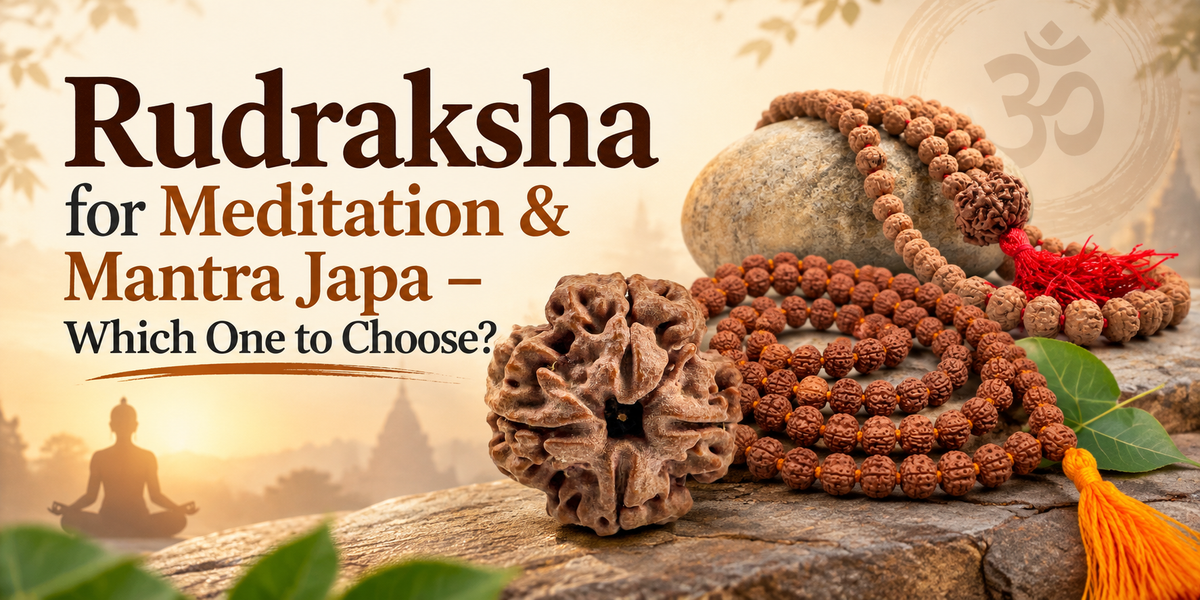
Rudraksha for Meditation & Mantra Japa – Which One to Choose?
A Rudraksha mala can make a meditation or mantra practice feel wonderfully simple: one mantra, one bead, one repetition at a time
The confusing part usually comes before the practice begins.
Should you meditate with a single Rudraksha or use a full mala? Is 5 Mukhi the right choice for japa? Is 1 Mukhi better for deeper meditation because it is rarer? Should you buy Nepali or Indonesian beads? And does a larger or more expensive Rudraksha make the mantra more effective?
For most people who want a straightforward Rudraksha for regular mantra japa and Shiva-centred meditation, a natural 5 Mukhi Rudraksha mala is the most practical traditional starting point. A 108+1 mala is especially useful when you want to count a complete round of mantra repetitions without keeping the number mentally.
That does not mean every meditation practitioner needs the same Rudraksha. A single bead may be enough if your purpose is quiet meditation rather than counting japa, while a particular Mukhi may be chosen when your Guru, lineage or spiritual practice gives a specific instruction.
The important thing is to choose the Rudraksha according to how you will actually practise, rather than according to rarity, price or dramatic claims.
Quick Answer: Which Rudraksha Is Best for Meditation and Japa?
| Your Practice | Practical Traditional Choice |
|---|---|
| Daily Shiva meditation | 5 Mukhi Rudraksha |
| Mantra japa with counting | 5 Mukhi 108+1 Rudraksha Mala |
| Om Namah Shivaya japa | 5 Mukhi Rudraksha Mala is a simple choice |
| Beginner meditation and japa | 5 Mukhi Rudraksha |
| Quiet meditation without counting | A single natural Rudraksha or a mala, according to preference |
| Specific Mukhi mantra or sadhana | Use the Mukhi prescribed by your Guru or tradition |
| Personalised Rashi/Graha practice | Choose according to the traditional system you follow |
There is no need to buy the rarest Rudraksha simply because your goal is meditation.
For someone completely new to Rudraksha, the beginner's guide to choosing your first Rudraksha is a useful starting point before selecting a specialised bead or mala.
Why Is Rudraksha Used for Meditation and Mantra Japa?
Rudraksha has a long association with Lord Shiva and Shaiva devotional practice. It is worn as a sacred bead and is also used in malas for prayer and mantra repetition.
During japa, the practical role of a mala is very simple.
Instead of mentally thinking:
Was that repetition 47 or 48?
you move to the next bead.
The fingers keep track of the count while your attention can return to the sound, meaning and rhythm of the mantra.
That physical rhythm can also make a daily practice easier to repeat consistently. Over time, sitting down, holding the mala and beginning the first repetition can itself become a familiar spiritual routine.
This is a better way to understand a Rudraksha mala than treating it as an object that automatically produces meditation simply by being owned or worn.
Why 5 Mukhi Rudraksha Is Commonly Chosen for Japa
The 5 Mukhi, or Panch Mukhi Rudraksha, is one of the most widely used Rudraksha varieties.
The Shiva Purana identifies the five-faced Rudraksha with Kalagni Rudra. In living devotional practice, 5 Mukhi beads are also widely used for regular wearing, meditation and mantra japa.
There are practical reasons why this matters.
A 5 Mukhi Rudraksha is:
-
well established in Rudraksha tradition,
-
commonly available,
-
suitable for a simple Shiva-centred practice,
-
available in sizes that work well in full malas,
-
and generally much more accessible than rare Mukhi varieties.
This makes it especially practical for someone who wants to develop a regular practice instead of beginning with an expensive specialised bead.
For a deeper explanation of its traditional associations, mantra and wearing method, read the 5 Mukhi Rudraksha complete guide.
Is 1 Mukhi Rudraksha Better for Meditation?
This is where rarity can create unnecessary confusion.
The 1 Mukhi Rudraksha has a profound traditional association with Lord Shiva and spiritual awareness, and it is often discussed in connection with meditation and higher spiritual focus.
But rare does not automatically mean better for your daily japa practice.
If your aim is to chant a mantra through a full mala every morning, a properly made 5 Mukhi japa mala may be far more practical than purchasing a rare individual bead simply because 1 Mukhi sounds spiritually superior.
A rare Rudraksha also requires greater attention to authenticity and verification.
If you are specifically considering 1 Mukhi, first read the 1 Mukhi Rudraksha guide and understand the distinction between traditional significance, market rarity and actual verification.
For meditation, the question should be:
What supports my practice?
Not:
What is the most expensive Mukhi I can buy?
Single Rudraksha or 108+1 Mala for Meditation?
Both can be appropriate, but they serve different purposes.
Choose a Single Rudraksha If You Mainly Meditate
If your practice involves sitting quietly, observing the breath, remembering Lord Shiva, contemplating a mantra internally or simply keeping a sacred Rudraksha with you, a single bead may be enough.
You do not need 108 beads merely to call the practice meditation.
A single bead can also be convenient if you want to wear Rudraksha during the day and maintain a simple devotional connection outside your formal practice.
Choose a 108+1 Mala If You Practise Mantra Japa
If you repeat a mantra a fixed number of times, the mala becomes a functional counting tool.
A traditional japa mala commonly contains 108 counting beads plus one Guru or Meru bead. One repetition is counted on each bead, giving you a complete 108-count round.
If japa is your primary purpose, read the Rudraksha Mala 108+1 guide, which explains the bead count and practical use in more detail.
If you are still deciding between different formats, the Rudraksha mala vs bracelet vs single bead guide can help you choose according to use rather than appearance.
What Does 108+1 Mean in a Rudraksha Japa Mala?
The 108 beads are the counting beads.
The additional bead is generally called the Guru bead, Meru or Sumeru. It marks the point at which a round begins and ends.
In commonly followed japa practice, when you reach the Guru bead, you do not simply continue across it as though it were another counting bead. If you want to perform another round, the mala is traditionally turned and the count continues in the opposite direction.
There are several traditional explanations for the sacred significance of the number 108. Rather than forcing one explanation as the only correct one, the practical point for a beginner is straightforward:
one full 108-bead round gives you 108 mantra repetitions without having to count them in your head.
Which Mantra Can You Chant With a Rudraksha Mala?
For a simple Shiva-centred practice, one of the most widely used mantras is:
ॐ नमः शिवाय
Om Namah Shivaya
You may use a Rudraksha mala to count its repetitions according to the practice you follow.
Individual Mukhi Rudraksha may also have traditionally associated mantras. If you are undertaking a specific mantra sadhana under a Guru, use the mantra and method given within that tradition rather than replacing it with a generic internet recommendation.
The mala is there to support the practice.
It should not become more important than the mantra itself.
How to Use a Rudraksha Mala for Mantra Japa
Japa methods can vary between lineages, so your Guru's instructions should take priority when you have received a specific practice.
For a simple personal routine, the process can be kept uncomplicated.
1. Choose a Quiet Place
Sit somewhere you are unlikely to be interrupted.
You do not need an elaborate meditation room. A clean, consistent place is often more useful than waiting for perfect conditions.
2. Settle Before Starting
Take a few moments to become still.
If your practice is Shiva-centred, remember Lord Shiva and bring your attention to the mantra before beginning the count.
3. Begin Beside the Guru Bead
Start with the first counting bead next to the Guru or Meru bead.
The Guru bead itself is not normally counted as one of the 108 mantra repetitions.
4. Repeat the Mantra Once Per Bead
Chant or mentally repeat your mantra once and move to the next bead.
Continue steadily rather than racing to finish the round.
5. Let the Mala Count for You
This is the practical beauty of japa.
You do not need to keep repeating numbers mentally. The bead in your fingers tells you where you are.
6. Do Not Cross the Guru Bead
When you complete the round and return to the Guru bead, stop there.
If you intend to begin another round, the commonly followed practice is to turn the mala around and continue in the reverse direction.
7. Finish Without Rushing Away
After your final repetition, remain still for a short time if your practice allows.
A minute of quiet after japa can help prevent the entire session from becoming nothing more than a counting exercise.
Should Japa Be Loud, Whispered or Mental?
Different mantra traditions distinguish between audible, softly spoken and mental repetition.
For an ordinary personal practice, the appropriate method depends on the mantra, your stage of practice and the tradition you follow.
A beginner may find that softly audible repetition helps maintain attention because the mantra can be heard as well as mentally followed. With familiarity, some practitioners use quieter or mental japa.
There is no benefit in pretending to follow an advanced method that leaves you distracted.
A steady practice you can actually maintain is more useful than a complicated practice you abandon after three days.
If you have received mantra diksha or specific instruction from a Guru, follow that method.
Meditation With Rudraksha Is Not the Same as Mantra Japa
The two practices can overlap, but they are not identical.
Meditation
Meditation may involve stillness, breath awareness, contemplation, remembrance of Shiva or sustained attention without counting repetitions.
A Rudraksha may be worn, held or kept nearby according to personal practice.
Mantra Japa
Japa specifically involves repeated recitation or remembrance of a mantra.
A mala provides a convenient physical method of counting those repetitions.
So if you ask, "Do I need a 108+1 mala for meditation?" the answer is not necessarily.
If you ask, "Is a 108+1 mala useful for counting mantra japa?" the answer is yes—that is one of its traditional practical uses.
Nepali or Indonesian Rudraksha Mala for Japa?
Both Nepali and Indonesian Rudraksha can be natural and used in spiritual practice.
The important difference for a mala is often physical.
Nepali Rudraksha
Nepali Rudraksha is generally:
-
larger,
-
more deeply textured,
-
heavier,
-
and visually more prominent.
These qualities make Nepali beads particularly attractive as individual pendants and larger spiritual malas, but very large beads can also make a 108-bead mala heavier.
Indonesian Rudraksha
Indonesian, or Java, Rudraksha is generally:
-
smaller,
-
lighter,
-
smoother in appearance,
-
and convenient when many beads are required in one mala.
That can make smaller beads comfortable for regular japa.
Neither origin should be declared spiritually superior simply because of geography.
The more important questions are whether the beads are natural, correctly represented and comfortable for the practice you intend to maintain.
For a detailed comparison, read Nepali vs Indonesian Rudraksha.
What Rudraksha Size Is Best for Meditation and Japa?
For a japa mala, comfort matters more than choosing the biggest possible bead.
Imagine holding a 108-bead mala for regular practice. A small difference in individual bead size can become very noticeable across the entire strand.
Larger beads can provide a stronger tactile feel between the fingers, but they also make the mala longer and heavier. Smaller beads can make a full mala easier to handle and carry.
There is no universal rule that a larger Rudraksha produces stronger meditation.
Size primarily affects characteristics such as:
-
appearance,
-
weight,
-
handling,
-
rarity,
-
and price.
If size is influencing your purchase, read Does Rudraksha size matter? before paying more simply for a larger diameter.
For Nepali beads specifically, the Nepali Rudraksha size and grading guide explains the practical differences between size categories.
Does a More Expensive Rudraksha Make Japa More Effective?
There is no sensible basis for turning mantra practice into a price competition.
Rudraksha prices can vary because of:
-
Mukhi rarity,
-
origin,
-
size,
-
natural formation,
-
condition,
-
supply,
-
craftsmanship,
-
certification,
-
and additional verification.
Those factors can affect what a bead costs. They do not mean that spending more automatically gives you deeper concentration or a more sincere mantra practice.
If you want a regular japa mala, choose a natural and properly represented mala that is comfortable enough to use consistently.
For the commercial factors behind pricing, see the Rudraksha price guide.
Do You Need a Special Mukhi for a Specific Mantra?
Sometimes a particular spiritual tradition connects a Mukhi, deity and mantra in a specific way.
But this should not be reduced to a random online formula such as:
"This mantra always requires this Rudraksha for everyone."
If you are performing a specific sadhana under guidance, follow the method you were given.
If you are simply beginning a daily Shiva practice with Om Namah Shivaya, a natural 5 Mukhi Rudraksha mala offers a straightforward and widely used option.
If you want to understand how the different Mukhi varieties are traditionally distinguished before choosing, see the 1 to 14 Mukhi Rudraksha guide.
Should You Wear the Same Mala You Use for Japa?
Practices differ.
Some people keep a japa mala specifically for mantra practice and store it respectfully when it is not being used. Others wear Rudraksha as part of their regular devotional practice.
If you follow a Guru or sampradaya, use its instructions.
From a practical point of view, keeping a dedicated japa mala can help in two ways:
-
it reduces unnecessary exposure to sweat, perfume, soap and daily wear,
-
and it creates a clear association between that mala and your regular practice.
There is no need to turn this into fear. The goal is respectful use and sensible care.
For everyday questions about wearing, bathing, sleeping and handling Rudraksha, use the Rudraksha wearing rules: do's and don'ts.
How to Begin a Rudraksha Meditation or Japa Practice
You do not need to wait until you understand every rule.
A simple routine is easier to sustain.
For Meditation
-
Choose a consistent place and time.
-
Sit comfortably.
-
Wear or hold your Rudraksha if that is part of your practice.
-
Remember Lord Shiva or your chosen spiritual focus.
-
Bring your attention to the breath, mantra or meditation method you follow.
-
Begin with a realistic duration.
-
Finish quietly.
For Mantra Japa
-
Sit in a clean, peaceful place.
-
Hold your japa mala according to your tradition.
-
Begin beside the Guru bead.
-
Repeat your mantra once per counting bead.
-
Complete the round without rushing.
-
Stop at the Guru bead or reverse the mala if beginning another round.
-
Store the mala cleanly after practice.
If you are preparing to wear a Rudraksha for the first time as well, the Rudraksha wearing Vidhi, mantra and best-day guide explains that process separately.
How Many Mantra Repetitions Should a Beginner Do?
A full traditional japa mala gives you 108 repetitions.
That does not mean a beginner who cannot yet maintain a full round should avoid mantra practice entirely.
Consistency matters.
If your Guru or mantra tradition specifies a count, follow it. Otherwise, begin with a practice that you can perform sincerely and regularly, and build gradually rather than treating japa as a race.
The objective is not to move through the beads as quickly as possible.
A slow, attentive round can be more meaningful to your personal practice than mechanically completing a large number while the mind is elsewhere.
How to Choose an Original Rudraksha Mala
A meditation mala should still be evaluated as a natural Rudraksha product.
Do not lower your authenticity standards simply because a mala contains many beads.
Look for:
-
natural Rudraksha beads rather than moulded imitations,
-
clear product photographs,
-
honest information about origin and bead size,
-
consistent construction,
-
a clearly identifiable Guru/Meru bead when sold as 108+1,
-
realistic descriptions rather than guaranteed spiritual outcomes,
-
and appropriate verification from the seller.
Popular home tricks such as float tests should not be treated as conclusive authentication.
If you are unfamiliar with natural bead characteristics, first read Original Rudraksha Kaise Pehchane – Real vs Fake.
Certificate vs X-Ray: What Matters for a Japa Mala?
This question needs some common sense.
An individual rare Mukhi bead and a full 108-bead 5 Mukhi mala are not always purchased or verified in exactly the same way.
A laboratory report documents findings according to the laboratory's scope and examination methods. X-Ray examination can provide additional information about internal structure.
For higher-value individual Rudraksha, internal verification may be particularly relevant when Mukhi identification and rarity materially affect the purchase.
For a full mala, ask exactly what has been certified, how the product has been examined, and what the supplied report covers rather than assuming that the word "certified" means every possible test has been performed on every bead.
Our detailed Rudraksha Certificate vs X-Ray guide explains the difference.
How to Care for a Rudraksha Japa Mala
A mala used frequently passes through your fingers hundreds of times, so basic care matters.
Keep it away from:
-
soap,
-
shampoo,
-
perfume,
-
detergents,
-
harsh cleaning products,
-
unnecessary prolonged soaking,
-
and rough handling.
If the mala becomes damp, allow it to dry properly before storing it.
Check the thread or string periodically. A worn string is a maintenance issue and is better replaced before it breaks during practice.
When the beads need cleaning, use a gentle method appropriate for natural Rudraksha rather than scrubbing them aggressively.
For a complete maintenance routine, read How to clean and maintain Rudraksha.
Common Mistakes When Choosing Rudraksha for Meditation
1. Buying by Rarity Instead of Practice
A rare bead may have important traditional significance, but that does not automatically make it the most practical japa tool for you.
2. Assuming Higher Mukhi Means Deeper Meditation
Mukhi count is not a meditation score.
Different Mukhi varieties have different traditional associations.
3. Choosing an Uncomfortably Large Mala
If the mala is so heavy or cumbersome that you avoid using it, the impressive size has not helped your practice.
4. Focusing Only on 108
The count is important in traditional japa, but the practice should not become mechanical.
5. Treating the Mala as a Shortcut
A Rudraksha can be part of your spiritual discipline. It cannot sit, chant, concentrate or practise on your behalf.
6. Following Conflicting Internet Rules With Fear
Different traditions follow different details.
When you have a Guru or lineage, follow its instructions. When you do not, keep the practice respectful, simple and consistent.
7. Ignoring Authenticity
A beautiful product description cannot replace natural formation and appropriate verification.
A Simple Buying Checklist for Meditation and Japa
Before choosing a Rudraksha, ask yourself:
-
Am I buying it mainly for wearing, meditation or counted mantra japa?
-
Do I need a single bead or a full 108+1 mala?
-
Would a natural 5 Mukhi Rudraksha meet my purpose?
-
Has my Guru or tradition prescribed a particular Mukhi?
-
Is the bead size comfortable for regular use?
-
Is the origin clearly stated?
-
Does a 108+1 mala actually have the stated construction?
-
Are the Rudraksha beads natural and clearly represented?
-
What exactly does the supplied certificate cover?
-
Is additional X-Ray verification relevant to the product I am buying?
-
Are the claims traditional and responsibly worded rather than guaranteed?
-
Can I realistically use and care for this Rudraksha regularly?
That last question is easy to overlook.
A simple mala used every morning can become a more meaningful part of your practice than an expensive Rudraksha that stays inside its box.
So, Which Rudraksha Should You Choose for Meditation and Mantra Japa?
For general Shiva meditation and regular mantra japa, a natural 5 Mukhi Rudraksha is a practical traditional choice.
For counted japa, a 108+1 5 Mukhi Rudraksha mala is especially useful because the beads provide a physical count for a full round of 108 repetitions.
For quiet meditation without mantra counting, you do not necessarily need a full mala. A single natural Rudraksha may be enough if that suits your practice.
And if you have received a specific Mukhi, mantra or method from your Guru or lineage, that guidance should take priority over a general online guide.
The best Rudraksha for meditation is not automatically the rarest, biggest or most expensive one.
It is the one that is natural, appropriate to your practice, comfortable to use and capable of becoming part of a sincere, consistent spiritual routine.
If you want a broader overview before deciding, read the complete Rudraksha benefits, types and selection guide.
Frequently Asked Questions
Which Rudraksha is best for meditation?
For general Shiva-centred meditation, 5 Mukhi Rudraksha is one of the most widely used and practical choices. A different Mukhi may be appropriate when a specific spiritual tradition or Guru prescribes it.
Which Rudraksha is best for mantra japa?
A 5 Mukhi Rudraksha mala is commonly used for regular mantra japa. A traditional 108+1 mala is particularly convenient for counting one full round of 108 repetitions.
Can I chant Om Namah Shivaya with a Rudraksha mala?
Yes. Om Namah Shivaya is a widely used Shiva mantra and can be counted using a Rudraksha japa mala according to your spiritual practice.
Why does a Rudraksha mala have 108+1 beads?
The 108 beads are used for counting mantra repetitions. The additional bead is generally called the Guru, Meru or Sumeru bead and marks the beginning and end of a round.
Do I count the Guru bead during japa?
In commonly followed japa practice, the Guru or Meru bead is not counted as one of the 108 mantra repetitions.
What happens when I reach the Guru bead?
If you are completing one round, you stop there. If beginning another round, the mala is traditionally turned so that you continue without crossing over the Guru bead.
Is 1 Mukhi better than 5 Mukhi for meditation?
Not automatically. 1 Mukhi has important traditional spiritual associations and is rare, but rarity does not make it universally better for every meditation practice. For regular Shiva meditation and japa, 5 Mukhi is a simpler and more accessible choice.
Can a beginner use a Rudraksha mala for meditation?
Yes. A beginner can use a Rudraksha mala. If there is no specialised instruction from a Guru or tradition, 5 Mukhi is a straightforward starting option.
Should I use Nepali or Indonesian Rudraksha for japa?
Both can be natural and suitable. Nepali beads are generally larger and more deeply textured, while Indonesian beads are generally smaller and lighter. For a full japa mala, comfort and authenticity are more important than assuming one origin is spiritually superior.
Does Rudraksha bead size affect meditation?
There is no reason to treat larger size as a guarantee of deeper meditation. Size mainly affects handling, weight, appearance, rarity and price. Choose a size that feels comfortable during regular practice.
Can I wear my japa mala around my neck?
Practices differ between traditions. Some practitioners keep a dedicated mala specifically for japa, while others wear Rudraksha malas devotionally. Follow your Guru or lineage when you have specific instructions.
How often should I do mantra japa?
That depends on your spiritual practice and any instructions you have received. A full Rudraksha mala provides 108 repetitions, but consistency and attention are more important than competing over large counts.
Do I need an expensive Rudraksha for serious meditation?
No. Price can reflect rarity, Mukhi, size, origin and verification, but a more expensive Rudraksha does not automatically create a deeper or more sincere meditation practice.
Can Rudraksha improve concentration during meditation?
Rudraksha is traditionally associated with meditation, focus and spiritual discipline. A mala also has the practical function of keeping count during japa, allowing you to return attention to the mantra. These traditional associations should not be interpreted as scientifically proven medical or psychological effects.
Disclaimer: Rudraksha is a natural spiritual product and an article of faith within Hindu and Vedic traditions. Spiritual and astrological associations are based on traditional beliefs and are not scientifically proven. Rudraksha does not diagnose, treat, cure or prevent disease, and no specific medical, financial, academic, relationship or personal result is guaranteed. Laboratory reports and X-Ray examinations should be understood according to the scope and methods of the issuing laboratory.