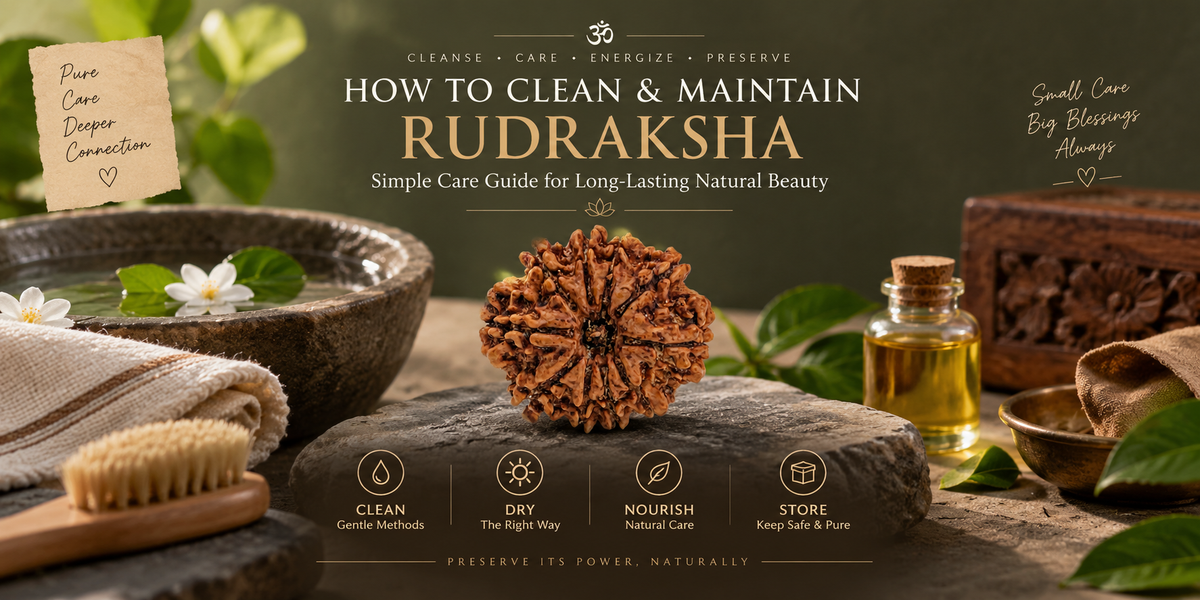
How to Clean & Maintain Rudraksha
Quick answer: Clean Rudraksha gently with clean, lukewarm water and a soft-bristled toothbrush. Rinse it, pat away excess moisture with a soft cotton cloth, and let it dry completely in a shaded, well-ventilated place.
For everyday care, avoid harsh soap, detergent, shampoo, perfume, chemical cleaners, boiling water and aggressive scrubbing. There is also no need to soak or oil a Rudraksha simply because a fixed number of days have passed.
The best approach is much simpler: clean it when it needs cleaning, dry it properly, and handle it gently.
How to Clean Rudraksha at Home
Rudraksha is a natural seed with an uneven surface and deep Mukhi grooves. With regular wear, those grooves can collect dust, sweat, natural skin oils and residue from products that come into contact with the bead.
For most Rudraksha, a simple home-cleaning routine is enough:
-
Inspect the bead before cleaning.
-
Rinse or briefly soak it in clean lukewarm water.
-
Gently clean the grooves with a soft toothbrush.
-
Rinse again with clean water.
-
Pat away surface moisture with a soft cotton cloth.
-
Let it air-dry completely in shade.
-
Consider a very small amount of natural, unscented oil only if the fully dry bead genuinely looks unusually dry.
You do not need expensive cleaning products or complicated mixtures.
The aim is to remove dirt while preserving the Rudraksha's natural surface—not to polish it until it looks new.
What Do You Need?
Keep the cleaning kit simple:
-
Clean lukewarm water
-
A clean bowl
-
A soft-bristled toothbrush
-
A soft cotton cloth
-
A clean, shaded and ventilated place for drying
That is enough for routine cleaning.
If your main concern is whether water itself can harm the bead, also read our Can Rudraksha Get Wet? Complete Care Guide.
Step 1: Inspect the Rudraksha Before Cleaning
Before putting the bead in water, look at it properly.
Check for:
-
Dirt trapped inside the Mukhi grooves
-
Soap or shampoo residue
-
Loose thread or knots
-
Loose metal fittings
-
A damaged central hole
-
A new crack or obvious physical damage
-
Unusual surface growth or persistent dampness
This helps you separate an ordinary cleaning issue from actual physical damage.
Natural Rudraksha is textured and irregular. Every mark, groove or colour variation should not automatically be treated as damage.
Step 2: Use Clean Lukewarm Water
Use clean water that feels comfortable to the touch.
For light dust, rinsing may be enough. If dirt has settled deeper into the grooves, a short soak can help loosen it before brushing.
There is no need to soak a reasonably clean Rudraksha for hours just because a longer treatment sounds more thorough.
Start gently.
If a short rinse or brief soak does the job, stop there.
Step 3: Clean the Grooves Gently
Use a clean, soft-bristled toothbrush and move it gently along the natural grooves.
Do not dig into the Rudraksha with:
-
Needles
-
Pins
-
Knives
-
Metal brushes
-
Sandpaper
-
Abrasive polishing tools
Rudraksha does not have a perfectly smooth surface, and trying to scrape every tiny mark away can damage the bead.
A clean bead should still look natural.
Step 4: Rinse and Dry It Properly
Once the dirt has loosened, rinse the Rudraksha with clean water.
This is particularly important if the bead has accidentally come into contact with soap, shampoo or another product that may leave residue in the grooves.
Pat the bead gently with a soft cotton cloth. Do not rub it aggressively.
Then leave it in a clean, shaded and well-ventilated place until it is completely dry.
Avoid trying to speed things up with:
-
Very hot air
-
A heater
-
A radiator
-
An oven
-
Boiling water
-
A high-heat hair dryer
Do not store the Rudraksha while it is still damp.
If the bead is part of a mala, bracelet or pendant, remember that the thread, elastic, knots and metal fittings also need to dry.
How Often Should You Clean Rudraksha?
There is no useful rule saying that every Rudraksha must be deep-cleaned every week or every month.
Clean it when there is a reason.
A Rudraksha worn daily may need attention sooner if you sweat heavily, live in a dusty or humid environment, wear it directly against the skin, or accidentally expose it to soap or cosmetics.
A bead worn occasionally and stored carefully may need much less cleaning.
A better habit is to inspect it from time to time.
If the grooves are reasonably clean, the bead is completely dry and there is no noticeable buildup, you can leave it alone.
Repeated soaking and brushing without a reason may create more wear than sensible everyday care.
Can You Clean Rudraksha With Soap?
For routine cleaning, plain clean water is the safer default.
You may find different advice online. Some Rudraksha sellers allow a very small amount of mild soap for particularly oily or dirty beads, while others recommend avoiding soap completely.
For normal home care, there is usually no need to introduce another product when lukewarm water and a soft brush are enough.
Regular exposure to detergent, shampoo, body wash and strong cleansers should be avoided.
If you normally wear Rudraksha throughout the day, our Can Rudraksha Be Worn During Bath? Rules & Care Guide explains why plain water and a modern soap-and-shampoo shower should be treated differently.
What If Soap or Shampoo Gets on the Rudraksha?
Do not panic.
One accidental exposure does not mean the Rudraksha is ruined.
Rinse the bead gently with clean water to remove the residue, pat it dry and let it air-dry completely.
There is no need to compensate by applying stronger cleaners or scrubbing harder.
The more important issue is repeated exposure over time.
Can You Clean Rudraksha With Milk or Ghee?
Milk and ghee have a place in certain Hindu puja traditions, but ritual use and routine physical cleaning are not the same thing.
For everyday maintenance, dairy products are unnecessary.
Residue can remain inside the deep grooves if the bead is not subsequently cleaned and dried properly.
If milk or ghee forms part of a particular puja practice you follow, treat it as that—a ritual practice. Afterwards, make sure the Rudraksha is properly cleaned and completely dried.
For ordinary maintenance, clean water is simpler.
Should Rudraksha Be Soaked Overnight?
Not as a regular cleaning habit.
For normal dust, sweat and surface dirt, begin with the least aggressive approach.
A brief soak followed by gentle brushing may be enough when dirt is difficult to remove.
Leaving a Rudraksha submerged overnight should not become a routine simply because “more soaking” sounds like “more cleaning.”
It does not work that way.
Can You Use Hot Water?
Avoid very hot or boiling water.
Room-temperature or mildly lukewarm water is sufficient for ordinary cleaning.
Extreme heat is unnecessary for the natural bead and may also affect the thread, elastic, adhesives, plating or other materials used in a finished Rudraksha product.
Cleaning a Mala, Bracelet or Silver-Capped Rudraksha
The basic cleaning principle stays the same, but the construction around the Rudraksha also matters.
Rudraksha Mala
A mala includes many beads along with thread and knots.
Before cleaning it, check that the thread is still strong and the knots are secure. Clean the beads gently without pulling the mala tight.
After rinsing, lay it on a clean absorbent cloth and allow both the beads and the thread to dry fully.
Do not hang a heavily wet mala in a way that puts unnecessary strain on the thread.
If you use a mala for japa, our Rudraksha Mala Guide – 108+1 Beads, Benefits & How to Use explains the traditional structure and use in detail.
Rudraksha Bracelet
Bracelets often collect more sweat and skin oil because they remain in close contact with the wrist.
If the bracelet uses elastic, spacers or metal fittings, avoid unnecessarily long soaking and make sure moisture is not trapped between tightly spaced beads.
Silver-Capped Rudraksha
Be careful with silver-cleaning chemicals.
A product designed to polish silver is not automatically suitable for a natural Rudraksha seed.
Where possible, clean the silver separately with an appropriate soft cloth rather than immersing the complete Rudraksha piece in a chemical jewellery cleaner.
For a valuable or complicated setting, professional jewellery cleaning can be safer than experimenting with strong products at home.
Daily Rudraksha Maintenance
Good maintenance is mostly about preventing unnecessary buildup.
Keep It Away From Soap and Shampoo
If your normal bath involves soap, shampoo, conditioner or body wash, removing the Rudraksha first is the practical choice.
Avoid Direct Perfume and Cosmetic Spray
Apply perfume, deodorant or hair spray before putting on the Rudraksha and allow the product to dry.
There is no benefit in repeatedly spraying fragrance directly onto a natural bead.
Let It Dry After Heavy Sweating
Normal skin contact and some sweat are part of daily wear.
After heavy exercise or a very hot day, wipe the Rudraksha gently and allow the bead, thread or bracelet to air out if it feels damp.
Never Store It Wet
This is one of the most useful care rules.
Do not put a damp Rudraksha straight into a closed box, pouch or plastic bag.
For broader daily-use questions, including bathing, sleep and regular wearing, see our Rudraksha Wearing Rules: Do's & Don'ts for Daily Wear.
Should You Oil Rudraksha?
Not routinely.
A natural Rudraksha does not need oil every day or every week simply because an internet schedule says so.
Some care traditions use a very small amount of natural, unscented oil when an older bead becomes noticeably dry.
If you choose to do that, first make sure the Rudraksha is completely clean and dry.
Use very little.
The bead should not be soaked in oil or left greasy. Excess oil can attract dust and settle inside the grooves.
If the Rudraksha looks and feels normal, there may be no reason to oil it at all.
That is a more sensible approach than repeatedly “conditioning” a bead that does not need anything.
What If Rudraksha Develops White Spots or Mold?
First check whether the mark is actually mold.
Natural surface variation, dried residue and dust can sometimes appear pale.
If you see obvious surface growth, notice an unusual smell, or find that the bead has remained damp:
-
Stop wearing it temporarily.
-
Inspect the bead carefully.
-
Use clean lukewarm water.
-
Gently brush the affected grooves.
-
Rinse thoroughly.
-
Let the Rudraksha dry completely in a shaded, ventilated place.
-
Inspect it again before wearing.
Do not spray bleach, insecticide or household disinfectant onto the Rudraksha.
If the bead becomes soft, badly cracked, structurally weak or repeatedly develops growth despite being kept dry, it may need examination by someone familiar with Rudraksha rather than increasingly aggressive home cleaning.
What If the Rudraksha Develops a Crack?
Do not confuse natural Mukhi lines and surface texture with a new structural crack.
If a crack appears, inspect whether it is merely superficial or whether the bead has actually split or weakened.
Impact, excessive friction, very dry conditions and poor storage can all contribute to deterioration.
Oil cannot repair a genuinely broken Rudraksha.
If the bead has split badly or its structure is compromised, trying to fill it with glue is generally not a good substitute for replacing a damaged bead.
How Should You Store Rudraksha?
Store the Rudraksha clean and completely dry.
A clean cloth pouch or dedicated Rudraksha or jewellery box works well.
Keep it away from:
-
Bathroom humidity
-
Perfume
-
Household chemicals
-
Insecticide
-
Strong heat
-
Damp cloth
-
Places where it can be crushed
If you remove Rudraksha before sleeping, keep it somewhere clean and safe rather than leaving it loose on the bed or floor.
For the traditional and practical sides of sleeping with Rudraksha, read Can We Wear Rudraksha While Sleeping? Rules & Traditions.
Does Rudraksha Need to Be Re-Energised After Cleaning?
Routine cleaning does not automatically remove the spiritual significance of a Rudraksha.
Once the bead is clean and completely dry, you can wear it again.
If mantra forms part of your personal practice, you may chant:
ॐ नमः शिवाय — Om Namah Shivaya
There is no need to perform the complete first-wearing ritual every time the bead is rinsed.
If you are wearing Rudraksha for the first time, read our Rudraksha Kaise Pehne? Complete Vidhi, Mantra & Best Day.
Do Different Mukhi Rudraksha Need Different Cleaning?
The basic physical-care method is broadly the same.
A 5 Mukhi and a 12 Mukhi may differ in natural formation, size and traditional association, but both are natural Rudraksha seeds.
What can change is how deep the grooves are, the size of the bead and whether it is loose, capped, threaded or used in jewellery.
If you are comparing different Mukhi for spiritual use rather than cleaning, see our Which Mukhi Rudraksha Should I Wear? 1–14 Mukhi Guide.
Does Rudraksha Size Affect Cleaning?
Not fundamentally.
A larger Nepali Rudraksha with deeper grooves may simply need a little more attention while brushing and drying because moisture and dust can settle deeper into the natural surface.
A smaller Rudraksha inside a tightly strung mala may be harder to inspect individually.
Neither size should be treated as automatically easier to maintain or spiritually superior.
For more on bead dimensions, read our Rudraksha Size Guide: Does Size Really Matter?.
Cleaning Does Not Prove Authenticity
A water test, floating test or cleaning method cannot reliably prove that a Rudraksha is genuine or that its Mukhi has been correctly identified.
Cleaning and verification are two different questions.
For a valuable Rudraksha, pay attention to its natural structure, correct Mukhi identification, product details and appropriate independent verification.
A laboratory certificate and an X-Ray examination also do not provide exactly the same information. Our Rudraksha Certificate vs X-Ray Guide explains the difference.
A Simple Maintenance Routine
You do not need a complicated calendar.
After normal daily wear:
If the Rudraksha is clean and dry, leave it alone.
After heavy sweating:
Wipe it gently and allow the thread, bracelet or setting to air-dry.
After accidental soap or shampoo exposure:
Rinse with clean water and dry it completely.
When dirt collects inside the grooves:
Use lukewarm water and a soft toothbrush.
If the bead becomes unusually dry:
Once it is clean and completely dry, consider a very light application of natural, unscented oil.
Before long-term storage:
Make sure the Rudraksha is clean, dry and protected from humidity, chemicals and physical pressure.
The condition of the bead should guide the care routine—not an arbitrary cleaning schedule.
Common Rudraksha Cleaning Mistakes
A few mistakes cause more problems than they solve:
-
Using boiling or very hot water
-
Scraping grooves with pins or metal tools
-
Using detergent or strong household cleaners
-
Putting the Rudraksha away while it is damp
-
Applying too much oil
-
Treating every natural mark as damage
-
Trying to polish the bead until it looks unnaturally glossy
-
Deep-cleaning it far more often than necessary
Rudraksha care should preserve the bead, not constantly interfere with it.
Frequently Asked Questions
What is the best way to clean Rudraksha?
Use clean lukewarm water and a soft-bristled toothbrush. Clean the grooves gently, rinse the bead, pat it dry and let it air-dry completely in shade.
How often should I clean Rudraksha?
Clean it when visible dirt, sweat or residue has built up. A fixed weekly or monthly deep-cleaning routine is usually unnecessary.
Can I wash Rudraksha with soap?
For normal home cleaning, plain water is the safer default. Avoid harsh soap, detergent, shampoo and chemical cleaners.
Can I clean Rudraksha with milk?
Milk may be used in certain ritual practices, but it is unnecessary for routine physical cleaning and can leave residue if the bead is not subsequently cleaned properly.
Should Rudraksha be soaked overnight?
Not routinely. Start with a rinse or brief soak and gentle brushing. Longer soaking does not automatically clean the bead better.
Can I use a toothbrush?
Yes. Use a clean, soft-bristled toothbrush and brush gently along the natural grooves.
Can I dry Rudraksha in sunlight?
A shaded and well-ventilated place is preferable for routine drying. Avoid unnecessary strong heat.
Should Rudraksha be oiled every day?
No. Daily oiling is unnecessary. Consider a very small amount of natural, unscented oil only when a completely dry bead genuinely appears unusually dry.
What should I do if Rudraksha gets mold?
Gently clean it with lukewarm water and a soft brush, rinse it and allow it to dry completely. Avoid bleach and harsh disinfectants. If the bead is badly deteriorated or the problem keeps returning, have its condition assessed.
Do I need to energise Rudraksha again after cleaning?
Routine physical cleaning does not require the complete first-wearing ritual again. Once the Rudraksha is clean and dry, it can normally be worn again according to your practice.
Final Answer: How Should You Clean and Maintain Rudraksha?
For most people, Rudraksha care is quite simple.
Clean it only when needed. Use lukewarm water. Brush gently. Rinse properly. Let it dry completely. Keep it away from harsh chemicals and excessive heat.
Beyond that, avoid over-maintaining it.
A natural Rudraksha will have texture, colour variation and an irregular surface. Those characteristics do not need to be polished away.
The most useful care routine is one that protects the bead while allowing you to wear and use it naturally—whether as a single Rudraksha, pendant, bracelet or full mala.
For everyday questions beyond cleaning, keep our Rudraksha Wearing Rules: Do's & Don'ts for Daily Wear as a practical reference.
Disclaimer: Rudraksha is a natural spiritual product and an article of faith within Hindu and Vedic traditions. Spiritual and astrological associations are based on traditional beliefs and are not scientifically proven. Rudraksha does not diagnose, treat, cure or prevent disease, and no specific medical, financial, academic, relationship or personal result is guaranteed. Laboratory reports and X-Ray examinations should be understood according to the scope and methods of the issuing laboratory.