Rudraksha for Stress, Calmness & Meditation – Traditional Perspective
When people search for a Rudraksha for stress, they are often looking for something very human: a little more steadiness when the mind feels crowded.
That is also where the subject needs to be handled carefully.
Rudraksha is a sacred spiritual bead, not a medical treatment for stress, anxiety, depression or any other health condition. In Hindu and Vedic traditions, however, certain Mukhi Rudraksha are associated with qualities such as inner peace, balance, meditation, self-discipline and spiritual awareness.
For someone looking for a simple Rudraksha to include in a calm daily spiritual routine, 5 Mukhi Rudraksha is the most practical traditional starting point. It is widely used for meditation and mantra japa and is traditionally associated with peace, steadiness and spiritual discipline.
Other Mukhi may be considered when the intention is more specific. For example, 2 Mukhi is traditionally connected with harmony and emotional balance, while 10 Mukhi is associated with peace, balance and spiritual protection.
The important distinction is simple:
Rudraksha may be part of a spiritual practice for calmness. It should not be presented as a cure for stress or anxiety.
Quick Answer: Which Rudraksha Is Traditionally Chosen for Calmness and Meditation?
| Your Spiritual Intention | Traditional Choice to Consider |
|---|---|
| General peace and daily spiritual practice | 5 Mukhi Rudraksha |
| Meditation and mantra japa | 5 Mukhi Rudraksha or 108+1 5 Mukhi Mala |
| Harmony and emotional balance | 2 Mukhi Rudraksha |
| Peace, balance and spiritual protection | 10 Mukhi Rudraksha |
| Spiritual awareness and deeper meditation | 1 Mukhi Rudraksha is traditionally associated, but authenticity and rarity require care |
| Beginner seeking a simple daily Rudraksha | 5 Mukhi Rudraksha |
This is a traditional spiritual guide, not a treatment chart.
If you are completely new to Rudraksha, start with Which Rudraksha Is Best for Beginners? before moving into rare or specialised Mukhi choices.
Why 5 Mukhi Rudraksha Is Commonly Chosen for Calmness
The 5 Mukhi, or Panch Mukhi Rudraksha, is one of the most widely used Rudraksha varieties.
It is traditionally associated with Kalagni Rudra, a form of Lord Shiva, and is commonly connected with:
-
inner peace,
-
spiritual discipline,
-
meditation,
-
mantra japa,
-
focus,
-
and balanced living.
Its value for a beginner is also practical.
You do not need to begin with a rare or expensive bead to create a meaningful spiritual routine. A natural 5 Mukhi can be worn as a single bead, and 5 Mukhi beads are widely used in full japa malas.
For someone whose intention is simply:
“I want a Rudraksha that fits naturally into prayer, meditation and a calmer daily routine,”
5 Mukhi is a sensible place to begin.
For a deeper explanation of its traditional significance, read the 5 Mukhi Rudraksha complete guide.
Does Rudraksha Scientifically Reduce Stress?
This distinction is important.
There is scientific research on meditation and mindfulness, and some evidence suggests that certain meditation or mindfulness practices may help people manage perceived stress or symptoms of anxiety in some settings. The evidence varies by practice, population and study quality.
That evidence should not be transferred to Rudraksha itself.
A person may use Rudraksha while meditating, praying or doing mantra japa, but that does not prove that the bead itself medically reduces stress.
A more responsible way to describe its role is:
-
Rudraksha can serve as a sacred focus in spiritual practice.
-
A mala can help count mantra repetitions.
-
Wearing a bead can remind a person of a spiritual intention.
-
Meditation or mantra practice may form part of a person's wider routine for calmness.
If stress is persistent, severe, affecting sleep or daily functioning, or accompanied by significant anxiety or low mood, spiritual practice should not replace appropriate professional healthcare.
Rudraksha, Calmness and the Power of Routine
There is something easy to overlook when people search for a “stress Rudraksha.”
Often, what they are really seeking is a pause.
A few minutes before work.
A quiet period after a difficult day.
A mantra repeated slowly instead of another ten minutes of scrolling.
A consistent morning ritual that does not begin with notifications.
Rudraksha can fit naturally into such a routine because it gives the practice a physical and devotional anchor.
You may hold a mala.
You may wear a single bead.
You may sit with Om Namah Shivaya.
The bead does not have to become a complicated object surrounded by fear and rules. Its role can remain simple: a sacred reminder to return to your practice.
5 Mukhi Rudraksha for Meditation and Mantra Japa
One of the strongest traditional uses of 5 Mukhi Rudraksha is in japa malas.
For counted mantra practice, a 108+1 Rudraksha mala is especially useful.
The 108 beads are used for mantra repetitions, while the additional bead is generally known as the Guru, Meru or Sumeru bead.
Instead of mentally counting numbers while chanting, you move through the beads one repetition at a time.
That leaves more attention available for the mantra itself.
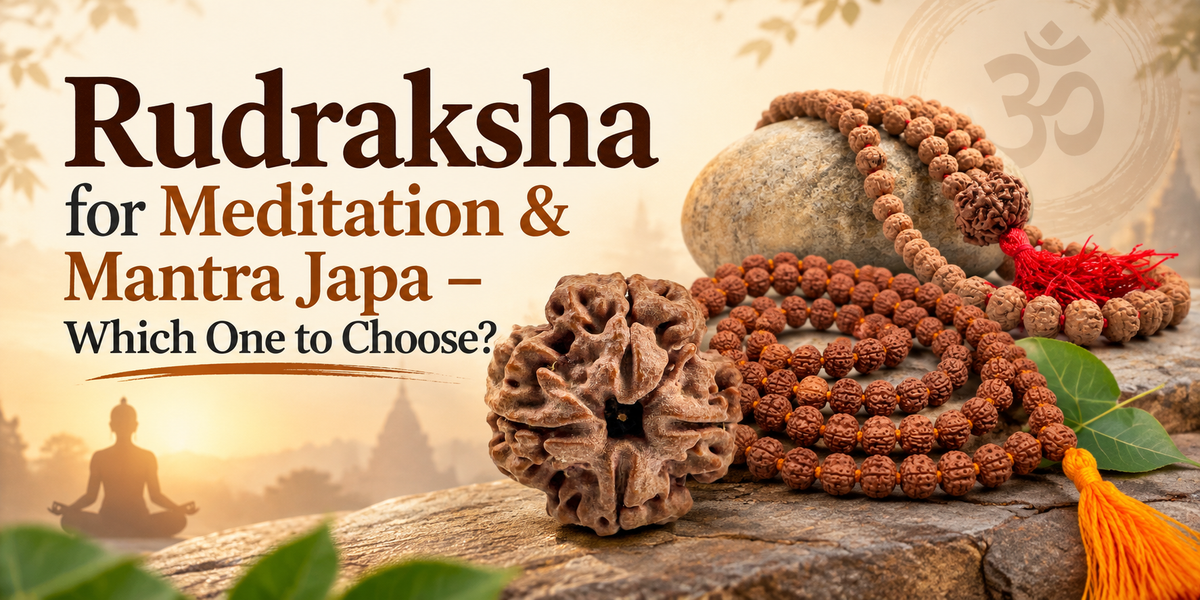
If meditation and japa are your primary reasons for choosing Rudraksha, read Rudraksha for Meditation & Mantra Japa – Which One to Choose?.
For a detailed explanation of bead count and Guru bead use, see the 108+1 Rudraksha Mala guide.
2 Mukhi Rudraksha for Harmony and Emotional Balance
The 2 Mukhi Rudraksha is traditionally associated with Ardhanarishvara, the united form of Shiva and Shakti.
Its symbolism centres on unity and harmony.
For that reason, traditional discussions often connect it with:
-
emotional balance,
-
mutual understanding,
-
harmony,
-
inner unity,
-
and balance between different aspects of life.
This can make 2 Mukhi meaningful for someone whose spiritual intention is not simply “I want to feel less stressed,” but rather:
“I want to cultivate greater balance and harmony in the way I respond to life.”
That is a spiritual intention—not a clinical claim.
A 2 Mukhi Rudraksha should not be described as a treatment for anxiety, relationship distress or any psychological condition.
10 Mukhi Rudraksha for Peace and Spiritual Protection
The 10 Mukhi Rudraksha is traditionally associated with Lord Vishnu or Janardana and with peace, balance and protection.
Some wearers choose it when their spiritual intention is centred on feeling grounded, protected and inwardly balanced.
Again, “protection” in a devotional context should not be converted into an exaggerated guarantee that nothing difficult will happen after wearing the bead.
A more grounded approach is to understand it as part of a spiritual tradition in which the wearer seeks steadiness, faith and a sense of divine protection.
If your purpose is simply daily meditation and calmness, you do not need to jump to 10 Mukhi. A 5 Mukhi may remain the simpler choice.
What About 1 Mukhi Rudraksha for Deep Meditation?
The 1 Mukhi Rudraksha has one of the strongest spiritual reputations among Rudraksha varieties.
It is traditionally associated with Lord Shiva, spiritual awareness, meditation, clarity and detachment.
That can make it relevant to a discussion of meditation.
But it also requires caution.
A genuine 1 Mukhi is rare, and the market contains many exaggerated claims around shape, origin and supposed powers. A beginner does not need to buy a rare 1 Mukhi simply to begin meditating.
For many people, a natural 5 Mukhi Rudraksha or 5 Mukhi mala is a far more practical first step.
If you are specifically considering 1 Mukhi, first read the 1 Mukhi Rudraksha guide and understand the authenticity questions before buying.
Do You Need a Special Rudraksha for Stress?
No single Mukhi should be presented as a medically proven “stress cure.”
A better question is:
What kind of spiritual practice are you trying to build?
If you want a simple daily Shiva practice, 5 Mukhi is a natural traditional starting point.
If your intention is harmony and emotional balance, you may explore 2 Mukhi.
If your practice is specifically about meditation and spiritual awareness, you may study the traditional significance of 1 Mukhi while being careful about rarity and authenticity.
If you seek peace, balance and devotional protection, 10 Mukhi may be relevant in traditional practice.
And if a Guru or lineage has given you a specific recommendation, follow that guidance.
For a broader comparison of different Mukhi varieties, use the 1 to 14 Mukhi Rudraksha guide.
Stress, Anxiety and Everyday Pressure Are Not All the Same Thing
People often use the word “stress” for very different experiences.
It may mean:
-
a demanding week at work,
-
feeling mentally overloaded,
-
exam pressure,
-
trouble switching off after work,
-
persistent worry,
-
difficulty sleeping,
-
grief,
-
burnout,
-
or symptoms of a mental health condition.
A spiritual routine may feel supportive for some people, but these situations should not all be treated as though they have the same cause or need the same response.
This is one reason responsible Rudraksha guidance should avoid statements such as:
“Wear this Mukhi and anxiety will disappear.”
That is not an appropriate promise.
If your concern is significant or persistent, consider speaking with an appropriately qualified healthcare or mental-health professional.
Rudraksha can remain part of your faith and spiritual practice alongside appropriate care.
A Simple Rudraksha Meditation Routine for a Busy Day
You do not need a one-hour meditation session to begin a consistent spiritual routine.
A simple practice might look like this:
1. Put the Phone Away
Choose a few minutes when you will not be interrupted.
The goal is to create a small boundary around the practice.
2. Sit Comfortably
You do not need a complicated posture.
Sit in a stable position that allows you to remain attentive without unnecessary discomfort.
3. Hold or Wear Your Rudraksha
If you use a single bead, you may simply wear it.
If you use a mala, hold it according to the practice you follow.
4. Bring Attention to the Mantra or Breath
For a Shiva-centred practice, Om Namah Shivaya is a simple and widely used mantra.
You may also follow another mantra given by your Guru or tradition.
5. Continue Without Chasing an Experience
Some days the mind may feel quiet.
Other days it may not.
The aim is not to force yourself into instant calmness.
Return to the mantra or your chosen meditation focus.
6. Finish Slowly
After the last repetition or the end of your meditation time, sit quietly for a moment before returning to the day.
A routine like this keeps Rudraksha in its proper place—as part of spiritual practice rather than as a promise of instant emotional control.
Should You Use a Single Rudraksha or a Mala?
The answer depends on what you actually do.
Single Rudraksha
Choose a single bead when you primarily want to wear Rudraksha during daily life.
This can be the simplest option if you want a devotional reminder without performing counted japa.
108+1 Rudraksha Mala
Choose a mala when mantra japa is a central part of your routine.
The beads give you a physical counting method, allowing you to focus on the mantra rather than remembering the number.
Bracelet
A bracelet can be convenient for daily wear, but it is less directly connected with traditional 108-count japa.
If you are deciding between formats, read the Rudraksha Mala vs Bracelet vs Single Bead guide.
Morning or Evening: When Should You Meditate With Rudraksha?
There is no need to make the timing so complicated that you never practise.
Many people prefer the morning because the mind has not yet been pulled into the day's activity.
Others find evening practice useful because it creates a transition between work and rest.
The more practical question is:
Which time can you follow consistently?
A regular ten-minute practice at a realistic time may be more sustainable than an elaborate routine scheduled at an hour you cannot maintain.
If your Guru or spiritual tradition prescribes a particular time, follow that practice.
Can You Meditate With Rudraksha Every Day?
Yes, Rudraksha is commonly used in regular spiritual practice.
Daily consistency can be especially useful for mantra japa because the mala becomes familiar in the hands and the practice develops a clear rhythm.
You do not need to chase a different Mukhi every few weeks.
If a natural 5 Mukhi Rudraksha supports the devotional routine you actually follow, there may be no reason to complicate it.
Spiritual practice is not a collection contest.
Should You Wear Rudraksha While Sleeping?
Some people wear Rudraksha continuously, while others remove it before sleeping.
Practices vary, and practical factors also matter.
A large pendant, metal capping or long mala may be uncomfortable during sleep or may place unnecessary strain on the thread.
If this is one of your concerns because you are trying to maintain a calm evening routine, read Can We Wear Rudraksha While Sleeping?.
Do not assume that sleeping in a Rudraksha is medically proven to improve sleep.
Can Rudraksha Get Wet?
A natural Rudraksha can come into contact with water, but repeated exposure to soap, shampoo, chemicals and prolonged moisture is a different matter.
If you wear it daily, sensible care helps preserve the bead and its stringing or metal fittings.
For detailed guidance, read Can Rudraksha Get Wet?.
For routine maintenance, see How to Clean & Maintain Rudraksha.
How to Wear Rudraksha for the First Time
Traditional methods vary across families and lineages.
A simple Shiva-centred practice may include:
-
Gently cleaning the Rudraksha.
-
Keeping it in a clean puja space.
-
Offering your prayer to Lord Shiva.
-
Chanting Om Namah Shivaya or the mantra associated with the chosen Mukhi.
-
Wearing it respectfully.
Monday is traditionally associated with Lord Shiva and is a popular day for first wear, but missing a particular day should not turn spiritual practice into anxiety.
For the full process, read How to Wear Rudraksha – Vidhi, Mantra & Best Day.
Afterwards, the Rudraksha Wearing Rules: Do's & Don'ts provides a practical reference for everyday use.
Does Rudraksha Size Matter for Meditation or Calmness?
A bigger bead is not automatically a calmer bead.
Natural Rudraksha varies in diameter, shape, texture and weight.
For meditation, size is mainly a practical consideration:
-
Is the bead comfortable to wear?
-
If it is a mala, does it move comfortably through your fingers?
-
Is the full mala too heavy for regular use?
-
Are you paying more for rarity when you do not actually need it?
There is no responsible basis for promising that a larger Rudraksha will produce a stronger stress-relieving effect.
If you are comparing sizes, read Does Rudraksha Size Matter?.
Nepali or Indonesian Rudraksha for Meditation?
Both can be natural Rudraksha.
Nepali Rudraksha is generally larger, more deeply textured and visually prominent.
Indonesian or Java Rudraksha is generally smaller and lighter, which can be convenient in full malas containing many beads.
For meditation and japa, comfort matters.
Someone may prefer the tactile feel of larger Nepali beads. Another person may prefer a lighter mala made with smaller beads.
Neither origin should be described as medically better for stress.
For the practical differences, read Nepali vs Indonesian Rudraksha.
Authenticity Still Matters
A person seeking calmness may be especially vulnerable to dramatic promises.
That makes careful buying important.
Do not choose a Rudraksha simply because a seller says:
-
“guaranteed stress relief,”
-
“instant anxiety cure,”
-
“works in 7 days,”
-
or “scientifically proven to remove negative thoughts.”
Instead, check the product itself.
Look for:
-
naturally formed Mukhi lines,
-
clear photographs,
-
natural variation in shape and texture,
-
stated origin and size,
-
appropriate laboratory documentation,
-
and realistic descriptions of traditional benefits.
If you are new to authentication, read Original Rudraksha Kaise Pehchane – Real vs Fake.
Certificate and X-Ray: What Should You Check?
A certificate and an X-Ray do not provide exactly the same information.
A laboratory report records findings according to the issuing laboratory's examination methods and scope.
X-Ray examination can provide additional information about internal structure and compartments.
This becomes particularly relevant when buying a rarer or higher-value Mukhi.
Do not assume that a card with the word “certificate” answers every authenticity question.
Ask what was tested and whether the report corresponds to the bead being sold.
For a complete explanation, read Rudraksha Certificate vs X-Ray.
Common Mistakes to Avoid
1. Treating Rudraksha as a Medical Treatment
Traditional calmness associations should not be converted into claims that Rudraksha cures stress, anxiety, depression or insomnia.
2. Buying a Rare Mukhi Because You Feel Overwhelmed
A rare bead is not automatically more suitable.
For a simple daily practice, 5 Mukhi may be enough.
3. Expecting Instant Calm
Meditation itself can take practice. The mind does not always become silent because you sat down with a mala.
4. Ignoring the Practice and Focusing Only on the Bead
Buying a meditation mala and never meditating misses the point.
5. Believing Bigger Means Better
Size affects handling, appearance, rarity and price—not a guaranteed emotional outcome.
6. Following Every Internet Rule
Conflicting rules can create more worry than clarity.
Follow your Guru or family tradition when you have one. Otherwise, keep the practice respectful and manageable.
7. Delaying Professional Help
If stress or anxiety is severe or persistent, do not postpone appropriate professional support because you are waiting for a spiritual product to solve it.
A Calmness-Focused Rudraksha Buying Checklist
Before buying, ask:
-
Am I looking for a spiritual practice or expecting a medical treatment?
-
Would a simple 5 Mukhi Rudraksha meet my purpose?
-
Do I want to wear a bead or practise counted mantra japa?
-
If I want a mala, is 108+1 the format I need?
-
Has a Guru or tradition recommended a particular Mukhi?
-
Is the Rudraksha natural?
-
Are the Mukhi lines naturally formed?
-
Are the size and origin clearly stated?
-
Is the bead or mala comfortable enough for regular use?
-
What exactly does the laboratory report cover?
-
Is X-Ray verification relevant for the bead I am considering?
-
Does the seller clearly separate traditional belief from scientific or medical claims?
-
Can I realistically build a consistent meditation or mantra routine around it?
The final question matters more than it appears.
A simple Rudraksha used regularly in a meaningful practice may be more useful to your spiritual routine than a rare bead purchased only because its marketing sounded powerful.
So, Which Rudraksha Should You Choose for Calmness and Meditation?
For someone seeking a simple daily spiritual practice centred on peace, meditation and mantra japa, 5 Mukhi Rudraksha is the most practical traditional starting point.
For harmony and emotional balance, 2 Mukhi Rudraksha has a relevant traditional association.
For peace, balance and spiritual protection, 10 Mukhi Rudraksha may be considered within traditional practice.
For deeper spiritual awareness and meditation, 1 Mukhi Rudraksha has an important traditional association, but its rarity means authenticity should be examined carefully. A beginner does not need 1 Mukhi simply to begin meditating.
And if you already have a specific recommendation from your Guru or spiritual lineage, follow that guidance.
Most importantly, keep two ideas separate:
Rudraksha belongs to spiritual tradition. Meditation has its own developing scientific evidence. One should not be used to falsely prove medical effects for the other.
Choose a natural Rudraksha that fits your practice. Use it with respect. Build a routine you can maintain.
If you want a broader overview before selecting a Mukhi, read the complete Rudraksha benefits, types and selection guide.
Frequently Asked Questions
Which Rudraksha is traditionally chosen for stress and calmness?
For a general spiritual routine focused on peace, meditation and balance, 5 Mukhi Rudraksha is one of the most practical traditional choices. This is a spiritual association, not a medical treatment for stress or anxiety.
Does Rudraksha reduce stress?
Rudraksha is traditionally associated with calmness, meditation and spiritual balance, but it should not be described as scientifically proven to treat stress. Research on meditation and mindfulness should not be treated as proof that a Rudraksha bead itself has a medical effect.
Which Rudraksha is best for meditation?
5 Mukhi Rudraksha is widely used for meditation and mantra japa. 1 Mukhi also has a strong traditional association with spiritual awareness and meditation, but it is rare and not necessary for a beginner.
Which Rudraksha is traditionally associated with emotional balance?
2 Mukhi Rudraksha is traditionally associated with Ardhanarishvara, harmony, unity and emotional balance.
Which Rudraksha is associated with peace and protection?
10 Mukhi Rudraksha is traditionally associated with Lord Vishnu or Janardana and with peace, balance and spiritual protection.
Can I use a 5 Mukhi Rudraksha mala for Om Namah Shivaya?
Yes. A 5 Mukhi Rudraksha mala is commonly used for Shiva mantra japa, including Om Namah Shivaya, according to the spiritual practice being followed.
Is a single Rudraksha enough for meditation?
Yes. If you are meditating without counting mantra repetitions, a single Rudraksha may be sufficient as part of your devotional practice. A 108+1 mala is especially useful when you want to count japa.
Can Rudraksha cure anxiety?
Rudraksha should not be presented as a cure for anxiety or any mental-health condition. Someone experiencing persistent or significant anxiety should consider appropriate professional healthcare while continuing spiritual practices if they find them personally meaningful.
Is meditation scientifically proven to help stress?
Research suggests that some meditation and mindfulness approaches may help with stress or related symptoms in some populations, but results vary and study quality is not uniform. That evidence concerns meditation practices; it does not prove that Rudraksha itself treats stress.
Should I buy 1 Mukhi for deeper meditation?
Not simply because it is rare. 1 Mukhi has important traditional spiritual associations, but a natural 5 Mukhi Rudraksha or mala is a much simpler option for regular meditation and japa.
Does a bigger Rudraksha give more peace?
There is no responsible basis for saying a larger bead produces greater calmness. Size mainly affects appearance, handling, rarity, weight and price.
Can I wear Rudraksha all day?
Rudraksha is commonly worn during daily life, but customs and practical considerations vary. Protect the bead from harsh chemicals, repeated soap exposure and unnecessary prolonged moisture.
Can I sleep wearing Rudraksha for better sleep?
Some traditions allow sleeping with Rudraksha while others prefer removing it. There is no scientific basis for guaranteeing better sleep simply from wearing the bead.
Do I need a certificate for a 5 Mukhi Rudraksha?
When buying online, laboratory documentation can provide useful information about the tested bead. The importance and type of verification may vary with Mukhi rarity, price and the seller's claims.
What is the simplest Rudraksha practice for a beginner?
A natural 5 Mukhi Rudraksha combined with a simple, consistent Shiva-centred practice—such as a few minutes of meditation or Om Namah Shivaya japa—is a straightforward traditional starting point.
Disclaimer: Rudraksha is a natural spiritual product and an article of faith within Hindu and Vedic traditions. Spiritual and astrological associations are based on traditional beliefs and are not scientifically proven. Rudraksha does not diagnose, treat, cure or prevent disease, and no specific medical, financial, academic, relationship or personal result is guaranteed. Laboratory reports and X-Ray examinations should be understood according to the scope and methods of the issuing laboratory.