Article: Can Children Wear Rudraksha According to Hindu Tradition?
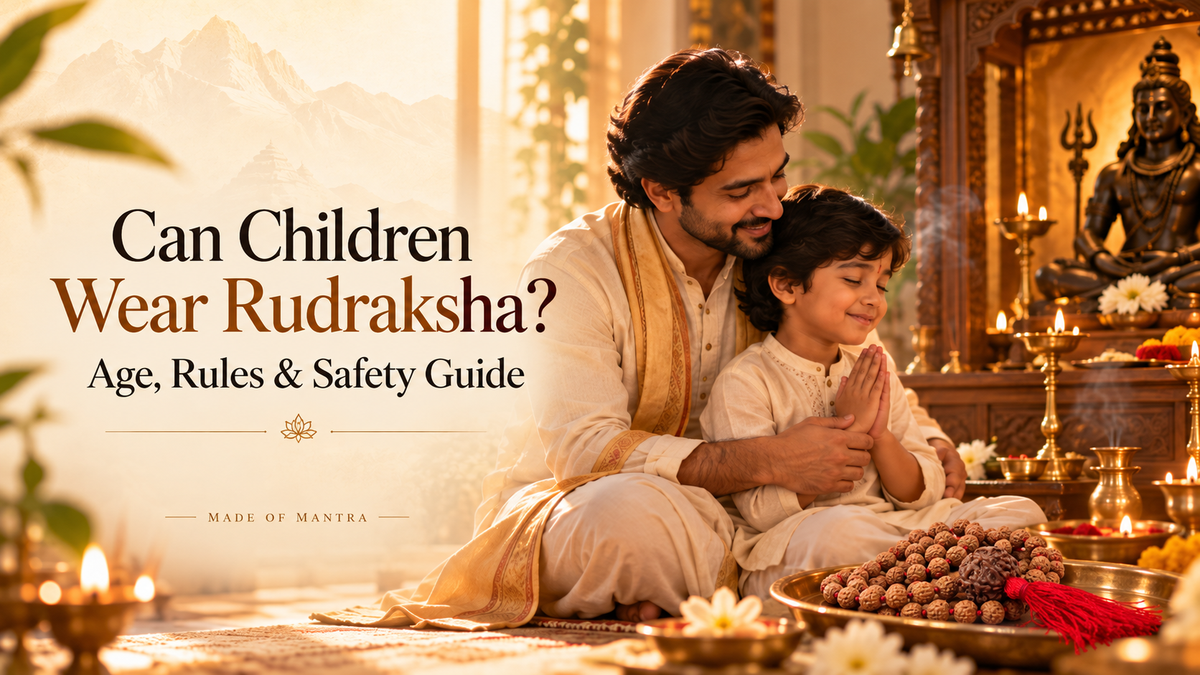
Can Children Wear Rudraksha According to Hindu Tradition?
Can Children Wear Rudraksha According to Hindu Tradition?
Many Indian families introduce children to prayer at an early age. It may begin with folding their hands before a temple, learning to say Om Namah Shivaya, or sitting beside their grandparents during a morning puja.
Rudraksha sometimes becomes part of that introduction.
But when parents consider giving their child a Rudraksha, a few questions naturally come up. Is there a minimum age? Can children wear 5 Mukhi Rudraksha? Should they wear a bracelet or mala? And is it safe for a young child to wear Rudraksha every day?
The short answer is yes, children can be introduced to Rudraksha as part of Hindu devotional practice. However, wearing it is a separate decision, and a child's safety, age and ability to handle the beads must come first.
Is There a Minimum Age to Wear Rudraksha?
There is no single minimum age universally followed across Hindu traditions for wearing Rudraksha.
Some families introduce it during childhood, while others prefer waiting until a child is old enough to understand its spiritual significance. Practices may also differ between families, temples and spiritual lineages.
The distinction is between whether a child is traditionally allowed to wear Rudraksha and whether wearing it is physically safe.
For babies and toddlers, a loose bead, thread, bracelet or necklace can present serious safety risks. Young children frequently put objects in their mouths, and a broken string can release small beads.
For that reason, it is better to introduce very young children to Rudraksha through supervised prayer rather than wearable jewellery.
Rudraksha Safety by Age
|
Age group |
Practical guidance |
|---|---|
|
Babies (under 1 year) |
Do not use wearable Rudraksha jewellery. |
|
Toddlers (1–3 years) |
Avoid Rudraksha necklaces, bracelets and loose beads. |
|
Young children (4–6 years) |
Prefer supervised prayer without wearable beads, especially if they still mouth objects. |
|
School-age children (7–12 years) |
Consider wearable Rudraksha only when the child is mature enough and the product is suitable, secure and supervised. |
|
Teenagers (13+ years) |
May follow an age-appropriate spiritual practice with normal jewellery safety precautions. |
These age groups are practical guidance, not religious eligibility rules or guarantees of safety. A child's individual development and behaviour matter more than the birthday alone.
Which Rudraksha Is Traditionally Chosen for Children?
Parents sometimes hear that a particular Mukhi Rudraksha will make their child intelligent, improve memory or help them perform better in examinations.
Traditional associations do exist, but they should not be confused with guaranteed results.
For a child beginning a simple devotional practice, parents commonly consider the following Mukhis.
5 Mukhi Rudraksha – For Everyday Spiritual Practice
5 Mukhi Rudraksha is one of the most commonly worn Rudraksha types. It is traditionally associated with Lord Shiva, particularly Kalagni Rudra, and is widely used for prayer, meditation and mantra japa.
For a school-age child who is ready to understand and safely handle Rudraksha, it can be a straightforward introduction to a regular spiritual routine.
A parent might encourage the child to sit quietly for a few minutes, offer a prayer or chant Om Namah Shivaya.
There is no need to make the practice complicated.
If you are exploring the natural bead itself, you can see the 5 Mukhi Nepali Rudraksha. Adult products and loose beads should not automatically be treated as child-safe jewellery.
4 Mukhi Rudraksha – Traditionally Associated With Learning
4 Mukhi Rudraksha is associated with Lord Brahma in commonly followed Rudraksha traditions. It is connected symbolically with knowledge, learning, expression and communication.
Some families choose it for students because of these traditional associations.
However, parents should be careful with claims suggesting that wearing 4 Mukhi Rudraksha will automatically increase a child's IQ, memory or school performance.
For a more detailed discussion, read our Rudraksha for Students: Focus, Study & Traditional Guide.
6 Mukhi Rudraksha – Traditionally Associated With Discipline
6 Mukhi Rudraksha is commonly associated with Lord Kartikeya, who represents courage, discipline and determination in Hindu tradition.
Older children and teenagers may encounter this Rudraksha in discussions about confidence and personal discipline.
That does not mean a child needs 6 Mukhi Rudraksha to become disciplined. Good habits, encouragement and a supportive environment remain part of growing up.
For most families, there is no reason to buy several different Mukhis simply because a child has started wearing Rudraksha.
Can Children Wear 5 Mukhi Rudraksha Daily?
Yes, older children may wear 5 Mukhi Rudraksha as part of their daily spiritual practice, provided the wearing arrangement is appropriate and safe.
Parents should consider the child's routine before deciding.
A child who spends the day running, climbing, playing sports and changing clothes at school may find a necklace or bracelet inconvenient. Loose or dangling jewellery can also catch on objects.
If the school does not permit jewellery, that rule should be respected.
There is no need for a child to wear Rudraksha continuously to maintain a meaningful connection with prayer.
For younger children, keeping the bead safely with a parent and using it during a supervised prayer session may be a better choice.
Rudraksha Bracelet, Pendant or Mala – Which Is Better for Children?
The safest choice depends on the child's age, maturity and activity, not simply the style of jewellery.
Rudraksha Bracelet
A bracelet may appear easier to manage than a necklace, but it still needs careful consideration.
It should not be tight, easy to pull apart, or made with components that can detach. For small children, even a bracelet can create choking or entanglement risks.
If you are comparing designs, the 5 Mukhi Nepali Rudraksha Bracelet shows a traditional adult design. It is not a recommendation for babies or toddlers.
Single Rudraksha Pendant
A single bead may be easier for an older child to manage than a full mala, but a pendant introduces a cord or chain around the neck.
It should not be worn during sleep, sports or other activities where it could become caught or pulled.
Never place a Rudraksha pendant around the neck of a baby or toddler.
Rudraksha Japa Mala
A full japa mala is best treated as a devotional item rather than everyday jewellery for children.
Older children can learn to count mantras using a mala under adult guidance. Once their practice is finished, it can be returned to a clean, secure storage place.
A traditional 5 Mukhi Rudraksha Japa Mala generally has 108 beads plus a Guru bead. Such a mala should remain out of the reach of small children.
Important Safety Rules for Children Wearing Rudraksha
Rudraksha is a natural seed, but being natural does not make a bead or jewellery arrangement automatically safe for children.
Parents should pay attention to the following points.
1. Keep Small Beads Away From Young Children
Small Rudraksha beads and jewellery components can become choking hazards if swallowed or placed in the mouth.
Do not leave loose beads where a baby or toddler can reach them.
2. Never Allow Children to Sleep Wearing Rudraksha Jewellery
Remove Rudraksha necklaces, bracelets and pendants before bedtime or naps.
This avoids unnecessary risks from cords, loose components, pressure and entanglement.
3. Remove Jewellery During Sports and Outdoor Play
Running, climbing, cycling and playground activities can increase the chances of jewellery getting caught on something.
A child does not need to wear Rudraksha during every activity.
4. Check the Thread and Bead Condition
Before an older child wears Rudraksha, inspect the string, knots, fittings and beads.
If the thread is fraying, a fastening is loose or a bead is cracked, stop using the jewellery until it has been safely repaired or replaced.
5. Teach Children Not to Chew the Beads
Rudraksha should not be used as a teething accessory or chewing object.
If a child still frequently puts small objects into their mouth, wearable Rudraksha jewellery is not appropriate.
6. Keep the Practice Voluntary
A child may feel curious about Rudraksha after watching a parent or grandparent use it.
That curiosity can be encouraged without forcing the child to wear something.
Prayer should feel like a meaningful family practice, not another obligation.
For general care and traditional observances, see our Rudraksha Wearing Rules: Do's & Don'ts.
How Should Parents Introduce Rudraksha to Children?
For many families, the most natural introduction does not begin with buying a bracelet.
It begins with the child watching a parent pray.
A parent can explain that Rudraksha is traditionally associated with Lord Shiva and is used by devotees during prayer and mantra chanting.
An older child might begin by learning a short mantra such as:
ॐ नमः शिवाय — Om Namah Shivaya
Some families prefer introducing Rudraksha on a Monday or during a Shiva-related occasion. Others keep it simple and begin with their usual morning puja.
Neither approach needs to become a complicated ceremony.
For children who are not ready to wear Rudraksha, an adult can keep the bead and allow the child to observe a supervised prayer session without handling small loose beads.
The aim is to introduce respect, understanding and interest in spiritual practice gradually.
Should Children Remove Rudraksha While Bathing or Sleeping?
Yes. For children, removing wearable Rudraksha before sleeping and bathing is the safer practical choice.
Bathing also exposes the bead and thread to soaps, shampoos and repeated moisture. Removing it helps protect the natural material.
Some adults follow traditions in which Rudraksha is worn continuously. That custom should not override child safety precautions.
If the child removes the Rudraksha, it can be placed in a clean, dry box or pouch until the next suitable occasion.
Can Girls and Boys Both Wear Rudraksha?
Yes. Rudraksha is not traditionally restricted to boys alone.
Girls and boys may both be introduced to Rudraksha through family prayer, Shiva devotion and age-appropriate spiritual practices.
The Shiva Purana is among the traditional sources discussing Rudraksha wearing across different groups of devotees, including women. Families and spiritual teachers may still follow different observances.
There is no need to market separate Mukhis as compulsory for boys or girls.
You can read more in our Can Women Wear Rudraksha? Rules, Myths & Traditions.
How to Choose an Authentic Rudraksha for an Older Child
Once you have decided that a child is mature enough to use Rudraksha safely, authenticity becomes an important consideration.
Look for a naturally formed bead with clearly identified Mukhi lines, an appropriate condition and transparent product information.
Consider whether the bead has been independently examined and whether the seller clearly explains its origin, specifications and certification.
Avoid selecting a large or expensive Rudraksha simply because someone claims that it will make the child unusually intelligent, calm or successful.
Larger beads are not automatically better, and higher prices do not prove spiritual suitability.
Our Rudraksha Size Guide explains how size affects comfort, appearance, rarity and price.
For families exploring traditional Mukhi associations, the Complete Rudraksha Selection Guide is a useful starting point.
Frequently Asked Questions
Can a 5-year-old child wear Rudraksha?
Hindu tradition does not establish a universally followed minimum age. However, at five years old, safety remains a significant consideration. Supervised prayer without wearable beads is generally preferable, especially if the child mouths objects or is very physically active.
Can a 10-year-old wear 5 Mukhi Rudraksha?
A 10-year-old may be introduced to 5 Mukhi Rudraksha through a supervised spiritual practice. Wearing jewellery should depend on maturity, safe construction, the child's activities and parental judgement.
Can a baby wear Rudraksha for protection?
Rudraksha has protective associations in some devotional traditions, but babies should not wear Rudraksha necklaces, bracelets or other beaded jewellery because of choking and strangulation risks.
Which Mukhi Rudraksha is best for students?
4 Mukhi is traditionally associated with knowledge and communication, while 5 Mukhi is commonly used for general spiritual practice. 6 Mukhi is associated with discipline and courage. None is proven to guarantee academic performance.
Can children wear Rudraksha to school?
Older children may wear suitable jewellery if their school permits it and it does not interfere with safety or activities. Parents should check the school's rules and avoid loose or dangling jewellery.
Can children wear Rudraksha while sleeping?
Children should remove Rudraksha jewellery before sleeping. Necklaces, strings and detachable beads can create avoidable safety risks.
Is Rudraksha suitable for both boys and girls?
Yes. Both boys and girls can participate in Rudraksha-related devotional practices. Wearing decisions should be based on safety, maturity and family traditions rather than gender.
Can children use a Rudraksha mala for mantra japa?
Older children can learn mantra counting with adult guidance. Full malas and loose beads should remain out of reach of younger children.
A Simple Beginning Is Enough
Introducing a child to Rudraksha need not begin with a costly bead, a detailed ritual or a list of strict rules.
A few moments of family prayer, a simple explanation of Lord Shiva, or learning to chant Om Namah Shivaya can be a meaningful beginning.
As children grow older, they may develop their own interest in wearing Rudraksha or using a mala for japa.
For parents, the sensible approach is to respect the spiritual tradition while making age, comfort and safety the first considerations.
Editorial Note: This article explains traditional Hindu beliefs about Rudraksha and offers practical guidance for parents. Customs may vary between families and spiritual traditions. Children's comfort, age and safety should always be considered.
Disclaimer: Rudraksha is a devotional and spiritual item, not a medical treatment or a proven method for improving a child's health, intelligence or academic performance. Beaded jewellery may create choking or strangulation hazards. Avoid wearable Rudraksha jewellery for babies and toddlers, and assess age, maturity and safety carefully for older children.