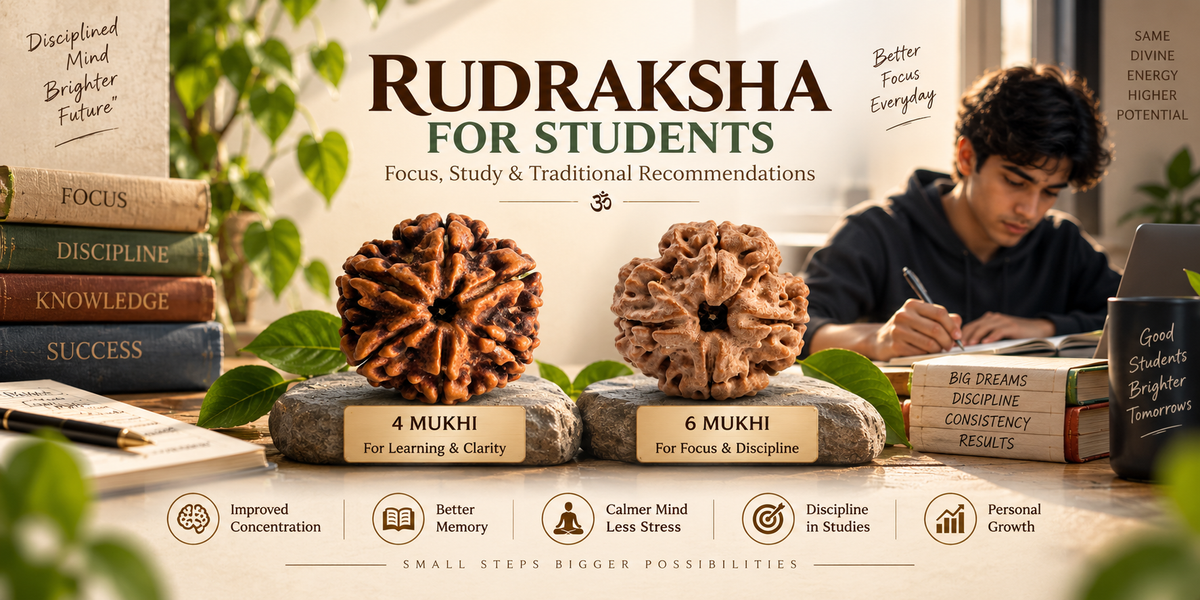
Rudraksha for Students – Focus, Study & Traditional Recommendations
Students today rarely struggle because of one problem alone. A school student may understand a chapter but lose focus after ten minutes. A college student may study for hours but struggle to explain an answer clearly. A competitive-exam aspirant may know the material yet find it difficult to stay consistent for months.
This is why the question “Which Rudraksha is best for students?” deserves a more careful answer than simply naming one bead.
In traditional Rudraksha practice, 4 Mukhi, 5 Mukhi and 6 Mukhi are the three Mukhis most commonly discussed for students:
-
4 Mukhi Rudraksha — traditionally associated with Lord Brahma and Mercury (Budha); connected with knowledge, learning, communication and intellectual expression.
-
5 Mukhi Rudraksha — traditionally associated with Kalagni Rudra and Jupiter (Guru); widely used for daily spiritual practice, japa, wisdom and balanced discipline.
-
6 Mukhi Rudraksha — traditionally associated with Lord Kartikeya and Venus (Shukra); connected with discipline, focus, confidence and purposeful action.
A student does not need all three simply because all three appear in a guide. The right choice depends on what kind of spiritual support the student wants.
And one point should remain clear throughout:
Rudraksha can be part of a student's spiritual routine, but it cannot replace study, revision, sleep, practice, teachers, counselling or appropriate medical support.
The benefits discussed below belong to traditional Hindu, Vedic and Rudraksha practice. They are not scientifically established improvements in memory, concentration, grades or examination performance.
Quick Answer: Which Rudraksha Is Best for Students?
For most students, the traditional choices can be understood like this:
| Student's Purpose | Traditional Rudraksha Choice | Why It Is Chosen |
|---|---|---|
| Learning, knowledge and communication | 4 Mukhi | Associated with Brahma and Mercury |
| Simple daily spiritual practice | 5 Mukhi | Associated with Kalagni Rudra and Jupiter |
| Discipline, confidence and focused effort | 6 Mukhi | Associated with Kartikeya and Venus |
| Knowledge + wisdom | 4 + 5 Mukhi | Traditional Budh–Guru combination |
| Learning + discipline + auspicious beginnings | 4 + 6 + Ganesh Mukhi | Used in Mahadev Mala's Saraswati Gyaan Kavach |
| Mantra japa and meditation | 5 Mukhi Mala | 5 Mukhi is widely used in japa malas |
If a student wants only one specialised bead for studies, 4 Mukhi is the most direct traditional choice because its symbolism is centred on knowledge, learning and communication.
If the student simply wants a beginner-friendly Rudraksha for daily devotion and japa, 5 Mukhi is a practical choice.
If the student's main challenge is discipline, confidence and consistent effort, 6 Mukhi is traditionally relevant.
Why Students Look for Rudraksha
Study life can involve long hours, digital distractions, revision pressure, presentations and the challenge of staying consistent. In a devotional practice, Rudraksha may become part of a student's routine—a reminder to begin with a calm mind and return to focused effort.
Its role should remain clear: the spiritual meaning comes from tradition, while academic progress still depends on study, revision, practice, rest and guidance.
4 Mukhi Rudraksha for Students
Traditional association
Deity: Lord Brahma
Planet: Mercury — Budha
Traditional themes: Knowledge, learning, communication, creativity and intellect
Beej Mantra commonly used: Om Hreem Namah — ॐ ह्रीं नमः
Among individual Mukhis, 4 Mukhi is the most directly associated with education and learning.
Lord Brahma represents creation and knowledge in Hindu tradition. Mercury, or Budha, is traditionally associated in Jyotisha with intellect, communication, analysis, speech and learning.
That is why 4 Mukhi is commonly considered by:
-
school students
-
college students
-
competitive-exam aspirants
-
researchers
-
writers
-
speakers
-
teachers
-
people studying communication-heavy subjects
When might a student consider 4 Mukhi?
A student may be drawn to 4 Mukhi when the personal intention is:
-
developing a more serious learning routine
-
improving clarity while expressing ideas
-
preparing for written or oral examinations
-
becoming more confident in presentations
-
building a devotional practice around knowledge
These are traditional intentions, not guaranteed academic outcomes.
A 4 Mukhi does not put information into memory. The student still needs active recall, revision and practice.
Is 4 Mukhi the “Best” Rudraksha for Studies?
If the question is specifically:
“Which Mukhi has the clearest traditional connection with education, knowledge and communication?”
then 4 Mukhi is the most directly associated with this intention in traditional Rudraksha practice.
But “best” changes with purpose.
A student who already learns well but struggles with consistency may be more interested in the traditional symbolism of 6 Mukhi.
A student who simply wants a Rudraksha for everyday Shiva devotion and japa may prefer 5 Mukhi.
So instead of treating one Mukhi as universally superior, identify the actual need first.
For a wider comparison, read Which Mukhi Rudraksha Should I Wear? 1–14 Mukhi Guide.
5 Mukhi Rudraksha for Students
Traditional association
Deity: Kalagni Rudra / Lord Shiva
Planet: Jupiter — Guru
Traditional themes: Wisdom, balanced judgement, spiritual discipline and japa
Beej Mantra commonly used: Om Hreem Namah — ॐ ह्रीं नमः
5 Mukhi is one of the most widely available and commonly worn Rudraksha varieties.
For students, its value is not that it is a “memory bead.” Its traditional role is broader.
It is widely used for:
-
daily spiritual practice
-
meditation
-
mantra japa
-
disciplined living
-
awareness
-
wisdom-oriented practice
This makes it a good choice for a student who wants a simple Rudraksha without moving immediately into a specialised or expensive Mukhi.
Read the detailed 5 Mukhi Rudraksha Benefits & Complete Guide if you are considering it for daily wear.
Why 5 Mukhi Can Make Sense for a Beginner
A student does not need a rare Rudraksha simply because exams are important.
5 Mukhi is:
-
widely available
-
commonly used for daily wear
-
traditionally connected with Shiva
-
widely used in japa malas
-
generally more accessible than uncommon Mukhis
A simple spiritual routine followed consistently can be more meaningful than buying a rare bead and expecting instant results.
If mantra japa is part of the student's routine, read Rudraksha Mala Guide – 108+1 Beads, Benefits & How to Use.
6 Mukhi Rudraksha for Students
Traditional association
Deity: Lord Kartikeya
Planet: Venus — Shukra
Traditional themes: Discipline, focus, confidence and purposeful action
Beej Mantra commonly used: Om Hreem Hum Namah — ॐ ह्रीं हुं नमः
Lord Kartikeya is traditionally associated with courage, discipline and purposeful action.
This makes 6 Mukhi particularly relevant in traditional recommendations for students who feel their main difficulty is not understanding a subject but staying disciplined enough to do the work consistently.
Who may traditionally consider 6 Mukhi?
It may appeal to:
-
competitive-exam aspirants
-
students preparing for interviews
-
students who need a more consistent routine
-
students working on confident expression
-
people who struggle to turn plans into regular action
Again, wearing it does not create discipline automatically.
A student still has to sit down and study.
The bead can be part of the commitment; it is not a substitute for the commitment.
4 Mukhi vs 5 Mukhi vs 6 Mukhi for Students
This is the comparison most students actually need.
| Rudraksha | Traditional Focus | Practical Student Profile |
|---|---|---|
| 4 Mukhi | Knowledge, learning, communication | Student focused on learning and expression |
| 5 Mukhi | Wisdom, japa, balanced spiritual practice | Beginner wanting a simple daily Rudraksha |
| 6 Mukhi | Discipline, confidence, focused action | Student working on consistency and purposeful effort |
There is no need to turn this into a competition between beads.
Ask:
What am I trying to build in my student life?
That answer usually makes the choice much clearer.
What About 4 + 5 Mukhi Together?
4 Mukhi and 5 Mukhi are also used together in a Budh–Guru combination.
The symbolism is straightforward:
-
4 Mukhi / Budha: learning, communication and intellect
-
5 Mukhi / Guru: wisdom, discipline and balanced judgement
Mahadev Mala's Budh–Guru Buddhi Vriddhi Kavach – 4 & 5 Mukhi Natural Rudraksha is created around this traditional combination.
It may appeal to students, professionals and people involved in knowledge-based work who prefer a combination rather than one individual bead.
A combination should still be chosen for a clear reason. More beads do not automatically mean more benefit.
What About 4 Mukhi + 6 Mukhi + Ganesh Mukhi?
For a student-oriented combination, Mahadev Mala also offers the Saraswati Gyaan Kavach – 4 Mukhi, 6 Mukhi & Ganesh Rudraksha.
Its traditional logic combines:
-
4 Mukhi: knowledge, learning and communication
-
6 Mukhi: discipline, focus and confident expression
-
Ganesh Mukhi: wisdom, auspicious beginnings and obstacle-related symbolism
This combination is intended for students, researchers, teachers, writers, professionals and people engaged in continuous learning.
It should be understood as a devotional combination—not a guarantee of examination marks or academic success.
Which Rudraksha Is Traditionally Chosen for Competitive Exams?
Competitive exams demand several things at once:
-
understanding
-
revision
-
consistency
-
time management
-
confidence
-
performance under pressure
No one Rudraksha can replace these skills.
Traditionally:
-
4 Mukhi may be chosen for knowledge and communication themes.
-
5 Mukhi may suit a student wanting a simple daily spiritual and japa practice.
-
6 Mukhi may be chosen for discipline and confident effort.
-
A 4 + 5 or 4 + 6 + Ganesh combination may appeal to someone who specifically prefers a multi-Mukhi traditional arrangement.
The more important competitive-exam formula remains:
syllabus clarity + realistic timetable + revision + mock tests + sleep + consistency.
Rudraksha belongs beside that routine, not in place of it.
Which Rudraksha Is Traditionally Chosen for Memory?
4 Mukhi is commonly discussed in traditional Rudraksha practice when the intention relates to knowledge, learning, intellect and memory.
But there is an important wording distinction.
It is reasonable to say:
“4 Mukhi is traditionally associated with learning and memory.”
It is not reasonable to promise:
“4 Mukhi will improve your memory.”
Human memory is affected by attention, sleep, repetition, retrieval practice, stress, health and many other factors.
Students should be especially careful with spiritual products marketed as guaranteed “memory boosters.”
Which Rudraksha Is Traditionally Chosen for Concentration?
For concentration-related intentions, 4 Mukhi, 5 Mukhi and 6 Mukhi may all appear in traditional recommendations, but for different reasons.
4 Mukhi — learning and intellectual clarity
5 Mukhi — meditation, awareness and steady spiritual practice
6 Mukhi — discipline and focused effort
If your concentration problem comes mainly from notifications and social media, however, the first remedy is practical:
move the phone away from the study table.
A spiritual practice works better when the environment supports the same intention.
Which Rudraksha Is Traditionally Chosen for Exam Fear?
Students sometimes search for a Rudraksha because they feel nervous before an examination.
Traditional recommendations may connect:
-
5 Mukhi with a steady spiritual routine
-
6 Mukhi with courage, discipline and confidence
-
Ganesh Mukhi with Ganesha and obstacle-related symbolism
But ordinary pre-exam nervousness and serious anxiety are not the same thing.
If fear becomes intense, persistent, causes panic, prevents sleep or interferes with normal functioning, speak with a parent, teacher, counsellor or qualified healthcare professional.
Rudraksha should not be used as a replacement for appropriate support.
Which Rudraksha Is Good for School Students?
For a school student, there is usually no reason to begin with an expensive rare Mukhi.
The simplest traditional options are:
4 Mukhi if the family specifically wants a learning-oriented Rudraksha.
5 Mukhi if the aim is a simple, broadly used devotional Rudraksha.
The more important question is whether the child understands why the Rudraksha is being worn.
It should be introduced positively—as part of prayer, discipline and respect for learning—not as something that creates fear:
“If you remove this, your marks will fall.”
That kind of message is unnecessary and unhealthy.
Which Rudraksha Is Good for College Students?
College students often face a different set of challenges:
-
independent study
-
presentations
-
projects
-
internships
-
interviews
-
career uncertainty
-
irregular routines
For traditional selection:
-
4 Mukhi fits learning and communication themes.
-
5 Mukhi fits daily meditation or japa.
-
6 Mukhi fits discipline and confident action themes.
A college student who has to present, write and communicate frequently may naturally connect with 4 Mukhi symbolism.
Someone struggling mainly with routine may prefer 6 Mukhi.
Which Rudraksha Is Good for Research, Writing and Higher Studies?
Research and higher education require long-term intellectual work rather than one examination.
4 Mukhi is traditionally relevant because of its association with knowledge, communication and intellectual expression.
5 Mukhi may complement a meditation or japa routine.
Researchers, writers and teachers are also among the groups commonly associated with 4 Mukhi in traditional Rudraksha discussions.
But the best “study tool” remains a system that includes:
-
focused reading
-
note-making
-
questioning
-
spaced revision
-
writing
-
feedback
-
sufficient rest
Do Students Need an Astrologer to Wear Rudraksha?
Not necessarily.
Many people wear Rudraksha devotionally as part of Shiva worship without any horoscope-based prescription.
If a student simply wants 5 Mukhi for daily spiritual practice, a complicated astrological process is not automatically necessary.
If the family is choosing a specific Rudraksha as a Jyotisha remedy, however, complete birth-chart interpretation can provide more context than a generic internet recommendation based only on Rashi.
For the broader selection framework, read Which Mukhi Rudraksha Should I Wear? 1–14 Mukhi Guide.
Can Students Choose Rudraksha According to Rashi?
Some families follow Rashi-based Rudraksha selection.
That is a valid traditional framework if it is the system you choose to follow, but Rashi is only one component of a Vedic horoscope.
A generic zodiac chart should not be treated as a complete personalised astrological diagnosis.
If you want to understand that approach separately, read Which Rudraksha Should You Wear According to Your Rashi? Complete Guide.
How Should a Student Wear Rudraksha?
The process does not need to become complicated.
A simple traditional approach is:
-
Bathe and wear clean clothes.
-
Keep the Rudraksha in a clean place.
-
Offer it respectfully before Lord Shiva or the deity connected with your practice.
-
Chant Om Namah Shivaya or the traditional mantra associated with the chosen Mukhi.
-
Wear it in a clean thread or appropriate setting.
-
Begin your study routine with a calm and disciplined intention.
Different families and Gurus may follow different details.
For the complete method, see Rudraksha Kaise Pehne? Complete Vidhi, Mantra & Best Day.
Which Day Should a Student Start Wearing Rudraksha?
Monday is widely used for Rudraksha because of its association with Lord Shiva.
Some traditions may choose a day related to the bead's planetary association—for example, Wednesday in a Mercury-oriented 4 Mukhi practice.
Do not become so anxious about finding a perfect date or minute that the spiritual practice itself is lost.
If your Guru or family tradition gives a specific method, follow that tradition.
Otherwise, a sincere and simple beginning is enough.
Mantras Students Can Use With Rudraksha
A universal Shiva mantra commonly used with Rudraksha is:
ॐ नमः शिवाय — Om Namah Shivaya
Traditional Mukhi-specific mantras used by Mahadev Mala include:
4 Mukhi: ॐ ह्रीं नमः — Om Hreem Namah
5 Mukhi: ॐ ह्रीं नमः — Om Hreem Namah
6 Mukhi: ॐ ह्रीं हुं नमः — Om Hreem Hum Namah
Ganesh Mukhi: ॐ गं गणपतये नमः — Om Gam Ganapataye Namah
Students following Saraswati worship may also use:
ॐ ऐं सरस्वत्यै नमः — Om Aim Saraswatyai Namah
A student does not need to chant every mantra on this page.
Choose a simple practice you can follow consistently.
Can Students Use a 108+1 Rudraksha Mala?
Yes, students who practise mantra japa or meditation may use a Rudraksha mala.
5 Mukhi is widely used for japa malas.
A traditional mala commonly uses 108 counting beads plus one Guru or Meru bead.
If you want to understand why the mala has 108+1 beads and how to count without crossing the Guru bead, read Rudraksha Mala Guide – 108+1 Beads, Benefits & How to Use.
A mala is not required for every student. A single bead or small Kavach may be more convenient for everyday wear.
Can a Student Wear Rudraksha Every Day?
Rudraksha is commonly worn as part of a daily devotional practice.
Practical care matters more than fear-based rules.
Keep it away from harsh chemicals, protect it from prolonged exposure to soap and shampoo, clean it gently and store it respectfully when removed.
Different traditions may have additional customs around bathing, sleep, food or particular occasions.
For a balanced explanation, read Rudraksha Wearing Rules: Do's & Don'ts for Daily Wear.
Does Rudraksha Size Matter for Students?
Not in the way many advertisements imply.
A larger bead can be:
-
more visually prominent
-
heavier
-
rarer within a particular origin and Mukhi
-
more expensive
But bigger does not automatically mean “better for concentration.”
For a student wearing Rudraksha every day, comfort can matter more than buying the largest bead available.
Read Rudraksha Size Guide – Does Size Really Matter? before paying a premium simply for size.
Nepali or Indonesian Rudraksha for Students?
Both can be natural Rudraksha.
Nepali beads are generally larger with deeper surface texture and more prominent Mukhi lines.
Indonesian beads are generally smaller and lighter, making them convenient for bracelets and full malas.
A student's choice can therefore depend on:
-
comfort
-
budget
-
preferred appearance
-
single bead vs mala
-
availability
Origin does not turn one 4 Mukhi into a “more intelligent” Rudraksha than another.
The traditional Mukhi association remains the main spiritual classification.
For a detailed comparison, read Nepali vs Indonesian Rudraksha: Difference, Size, Quality & Which to Choose.
How Much Should a Student Spend on Rudraksha?
There is no spiritual rule saying that a student needs an expensive Rudraksha.
Price can vary because of:
-
Mukhi rarity
-
origin
-
size
-
natural formation
-
condition
-
certification
-
X-Ray verification
-
jewellery work
-
product construction
Do not assume:
expensive = more effective for studies.
If budget matters, understand the specification before paying for rarity or an unusually large bead.
Read Rudraksha Price Guide – Why Do Prices Vary? before comparing products only by price.
Certification Matters More Than Marketing Claims
For a student product, words such as “focus,” “memory” or “exam success” can sound attractive.
But before spiritual claims, verify the physical product.
Ask:
-
Is the Rudraksha natural?
-
Are the Mukhi lines natural?
-
Is an independent laboratory certificate supplied?
-
What does the certificate actually verify?
-
Is X-Ray included, optional or unnecessary for this purchase?
At Mahadev Mala, every Rudraksha product is supplied with an independent laboratory certificate. X-Ray verification is available separately as an optional paid add-on for eligible products.
Read Rudraksha Certificate vs X-Ray – What's the Difference? before assuming the two are the same service.
What Rudraksha Cannot Do for a Student
Rudraksha should not be marketed as a shortcut to marks, admission or selection. It cannot replace study, revision, sleep, teachers or appropriate professional support, and it should not be presented as a treatment for ADHD, anxiety, depression or another medical or mental-health condition.
If a seller promises guaranteed marks, memory improvement or admission simply from wearing a bead, treat that claim cautiously. A spiritual product should support faith—not exploit academic fear.
Rudraksha Alongside a Practical Study Routine
Rudraksha can sit within a student's spiritual routine, but it should complement—not replace—the habits that actually support learning. A realistic timetable, active recall, spaced revision, practice questions, sufficient sleep and fewer digital distractions remain important.
If a concept is unclear, asking a teacher or mentor for help is more useful than repeatedly reading without understanding. The Rudraksha may serve as a devotional reminder of knowledge, discipline and sincere effort; the student still has to do the work.
A Student-Friendly Way to Choose
Use this simple framework.
Choose 4 Mukhi if:
Your traditional intention is primarily learning, knowledge, communication or intellectual expression.
Choose 5 Mukhi if:
You want a simple daily Rudraksha for Shiva devotion, japa or meditation and do not need a specialised choice.
Choose 6 Mukhi if:
Your traditional intention is discipline, confidence and focused effort.
Consider 4 + 5 Mukhi if:
You specifically want the traditional Budh–Guru combination of knowledge and wisdom.
Consider 4 + 6 + Ganesh Mukhi if:
You prefer a student-oriented combination built around learning, discipline and Ganesha symbolism.
You do not need to buy every option.
Choose the one that makes sense for your practice.
Frequently Asked Questions About Rudraksha for Students
Which Rudraksha is best for students?
4 Mukhi is the most directly associated with knowledge, learning and communication in traditional Rudraksha practice. 5 Mukhi is a practical beginner choice for daily spiritual practice, while 6 Mukhi is traditionally connected with discipline, focus and confident action.
Which Rudraksha is traditionally used for concentration?
4 Mukhi, 5 Mukhi and 6 Mukhi are all discussed for student-related intentions, but for different reasons. 4 Mukhi relates to learning, 5 Mukhi to steady spiritual practice and 6 Mukhi to disciplined effort.
Which Rudraksha is traditionally associated with memory?
4 Mukhi is traditionally associated with knowledge, intellect, communication and memory-related themes. It should not be marketed as a scientifically proven memory treatment.
Can students wear 5 Mukhi Rudraksha?
Yes. 5 Mukhi is widely worn and is commonly used for daily spiritual practice, meditation and japa.
Can a child wear Rudraksha?
Rudraksha is worn by people of different ages in devotional traditions. For a child, keep the practice simple and ensure the jewellery or thread is physically appropriate and safe for the child's age and activity.
Which Rudraksha is traditionally considered for competitive exams?
4 Mukhi may be chosen for learning and communication, while 6 Mukhi is traditionally associated with discipline and confidence. Some students also use 5 Mukhi for daily meditation or japa. None guarantees examination success.
Is 4 Mukhi or 6 Mukhi better for students?
They represent different traditional themes. 4 Mukhi is more directly connected with learning and communication; 6 Mukhi with discipline, focus and confidence. The choice depends on the student's intention.
Can 4 Mukhi and 5 Mukhi be worn together?
Yes, they are used together in traditional Budh–Guru combinations. Mahadev Mala's Budh–Guru Buddhi Vriddhi Kavach combines these two natural Mukhis.
Can 4 Mukhi and 6 Mukhi be worn together?
Different Mukhi combinations are used in Rudraksha traditions. Mahadev Mala's Saraswati Gyaan Kavach combines 4 Mukhi, 6 Mukhi and Ganesh Mukhi for a student and learning-oriented traditional combination.
Which mantra should students chant with Rudraksha?
Om Namah Shivaya is a simple Shiva mantra commonly used with Rudraksha. Individual Mukhi mantras may also be followed according to tradition.
Do students need Kundli analysis before wearing Rudraksha?
Not for ordinary devotional use. If a Rudraksha is being selected specifically as an astrological remedy, personalised horoscope analysis can provide more context.
Can Rudraksha improve exam marks?
No guaranteed claim can be made that wearing Rudraksha improves marks. Academic performance depends on preparation, understanding, revision, health, examination conditions and many other factors.
Can Rudraksha help ADHD or anxiety?
Rudraksha should not be presented as a treatment for ADHD, anxiety or any medical or mental-health condition. Students experiencing persistent symptoms should seek appropriate professional support.
Does a bigger Rudraksha help students more?
There is no scientific evidence that a larger bead provides stronger academic effects. Size can influence comfort, rarity, appearance and price.
Does an expensive Rudraksha work better for studies?
No. Price is influenced by rarity, origin, size, formation and verification. Higher price does not prove stronger spiritual or academic results.
Should a student buy a single bead or a mala?
A single bead or Kavach can be convenient for everyday wear. A 108+1 5 Mukhi mala is more relevant when the student wants to practise mantra japa or meditation.
The Bottom Line
If you are choosing Rudraksha for a student, keep the decision simple.
4 Mukhi is the clearest traditional choice when the intention is knowledge, learning and communication.
5 Mukhi is a practical option for a student who wants a widely used Rudraksha for daily Shiva devotion, meditation or japa.
6 Mukhi is traditionally associated with discipline, confidence and purposeful action.
Combinations such as 4 + 5 Mukhi or 4 + 6 + Ganesh Mukhi are also available for people who prefer a multi-bead traditional approach.
But the most important formula for a student remains:
Faith + disciplined study + revision + rest + consistency.
Rudraksha can become part of that routine.
It should never become a reason to stop doing the work.
If you are still unsure which Mukhi fits your purpose, begin with the 1–14 Mukhi Rudraksha selection guide.
Before buying, these guides may also help:
Explore Natural Certified Rudraksha at Mahadev Mala
Disclaimer: Rudraksha is a natural spiritual product and an article of faith within Hindu, Vedic and related devotional traditions. The deity, planetary, educational and spiritual associations described in this article are based on traditional beliefs and are not scientifically proven. Rudraksha does not diagnose, treat, cure or prevent medical or mental-health conditions and cannot guarantee concentration, memory, examination marks, admission, career selection or any other academic result. Students should rely on appropriate study methods, teachers and professional medical or psychological support where needed. Individual spiritual experiences may vary.