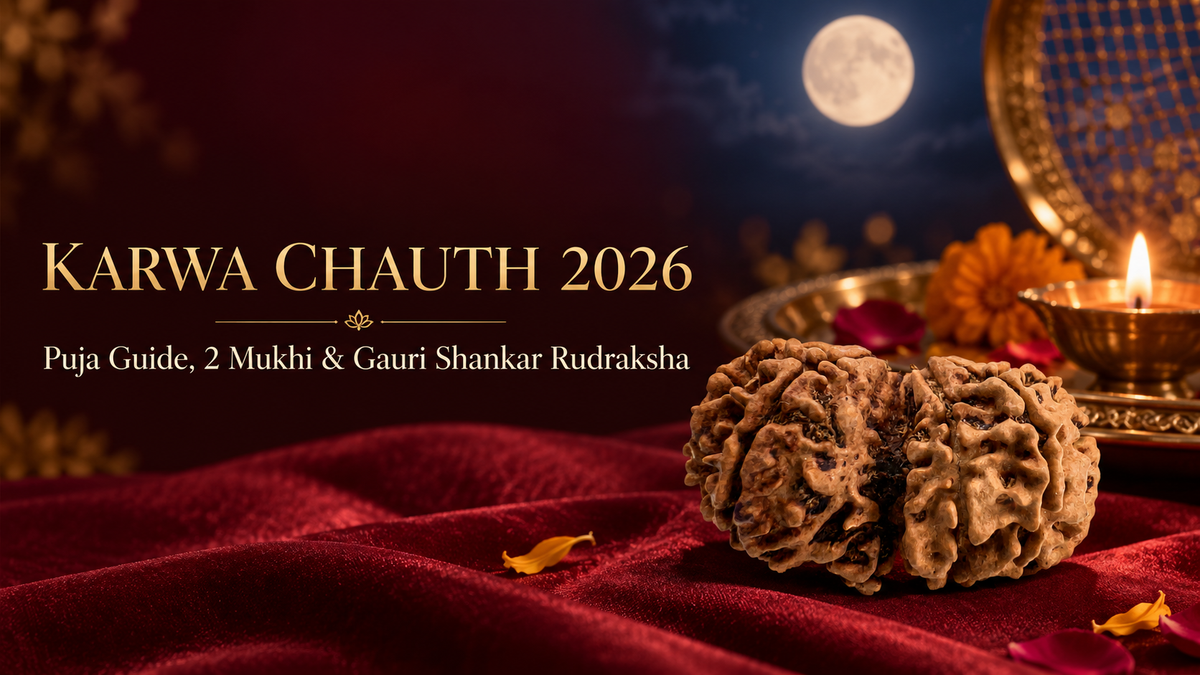
Karwa Chauth 2026: Puja Guide, 2 Mukhi & Gauri Shankar Rudraksha
Karwa Chauth is often pictured through a decorated thali, a sieve held against the moon and a beautifully dressed couple. Yet the most meaningful part of the day is usually quieter: waking before sunrise, remembering the care that holds a relationship together and ending the fast with gratitude rather than performance.
In 2026, Karwa Chauth falls on Thursday, 29 October 2026. Traditionally observed on Krishna Paksha Chaturthi in the month of Kartik according to the commonly followed North Indian calendar, the festival is especially prominent in North India. Married women commonly observe a fast from sunrise until moonrise and pray for the well-being and longevity of their husbands. Family practices differ, and in many contemporary homes the day is also understood as a celebration of mutual love, responsibility and respect.
For devotees who include Rudraksha in their spiritual practice, two sacred formations connect naturally with this theme of union: 2 Mukhi Rudraksha, traditionally associated with Ardhanareeshwara, and Gauri Shankar Rudraksha, the naturally joined twin formation associated with Lord Shiva and Goddess Parvati. A 2 Mukhi Rudraksha Japa Mala may also be used for mantra chanting and regular meditation.
This guide explains the date, vrat routine, puja vidhi, moon worship, relationship-centred meaning of the festival and how to choose between an individual 2 Mukhi bead, Gauri Shankar Rudraksha and a 108+1 bead 2 Mukhi Japa Mala without turning faith into a promise of a perfect marriage.
Date, puja and moonrise note: Karwa Chauth is observed according to Chaturthi tithi and local moonrise. In 2026, the festival date is Thursday, 29 October. Exact puja time, fasting duration and moonrise vary by city, elevation, weather and Panchang calculation. Check a Panchang prepared for your location on the festival day; do not use a Delhi moonrise time automatically for another city or country.
Karwa Chauth 2026: Quick Answer
| Detail | Answer |
|---|---|
| Festival | Karwa Chauth or Karaka Chaturthi |
| Date in 2026 | Thursday, 29 October 2026 |
| Hindu tithi | Kartik Krishna Chaturthi in the commonly followed North Indian calendar |
| Common worship | Lord Shiva, Goddess Parvati, Lord Ganesha, Lord Kartikeya and Chandra Deva |
| Traditional observance | Fast from sunrise until moonrise, evening puja, katha and moon offering |
| Rudraksha associated with divine union | 2 Mukhi Rudraksha |
| Naturally joined Shiva–Parvati formation | Gauri Shankar Rudraksha |
| Japa option | 2 Mukhi Indonesian Rudraksha Japa Mala with 108+1 beads |
What Is Karwa Chauth?
Karwa Chauth is a Hindu festival observed primarily by married women in Punjab, Haryana, Delhi, Rajasthan, Uttar Pradesh, Himachal Pradesh and other parts of North India. The word karwa refers to an earthen pot used in the ritual, while chauth means the fourth lunar day.
The traditional fast begins after the pre-dawn meal and continues until the moon is seen at night. In the evening, women gather for puja, listen to the Karwa Chauth katha and exchange or rotate decorated thalis according to regional practice. After moonrise, water is offered to the moon, the devotee looks at the moon and then at her husband—often through a sieve—and the fast is opened.
No two households perform every step in precisely the same way. Some families receive sargi from the mother-in-law; some prepare baya for the mother-in-law; some gather for community katha; and others perform a small puja at home. These differences are part of living tradition, not evidence that one family’s devotion is more correct than another’s.
When Is Karwa Chauth in 2026?
Karwa Chauth will be observed on Thursday, 29 October 2026.
The vrat follows Krishna Paksha Chaturthi and concludes after moonrise. Published times often show a single moonrise for “India,” but moonrise is always location-dependent. Even within the Delhi–NCR region, the visible moon may be delayed by buildings, haze or clouds.
Use a trusted Panchang with your city selected for:
-
Chaturthi tithi beginning and ending
-
Evening puja muhurat
-
Local moonrise time
-
Sunrise and fasting duration
If clouds hide the moon, follow your family tradition or seek guidance from your priest rather than relying on an unrelated city’s live video or social-media post.
The Meaning of Karwa Chauth Beyond the Fast
The festival is traditionally connected with a wife’s prayer for her husband’s long life and well-being. That devotional intention deserves respect, but it should not become a reason to ignore the daily work that makes a marriage healthy.
Love is expressed not only by one difficult fast. It is also expressed when responsibilities are shared, health is taken seriously, harsh words are corrected and one partner does not take the other’s labour for granted.
A thoughtful modern observance can retain the spiritual tradition while making mutual care visible. A husband may support the vrat by managing household work, preparing the evening meal, ensuring the fasting partner can rest and not pressuring her to perform for photographs. Some couples choose to fast together; others do not. The choice should be voluntary and safe.
This is also the right way to understand relationship-associated Rudraksha. A bead may become a sacred reminder of patience and unity, but it cannot repair dishonesty, disrespect or abuse. Spiritual symbolism should support responsible conduct, never replace it.
What Is Sargi?
Sargi is the pre-dawn meal traditionally prepared or gifted by the mother-in-law to the daughter-in-law. It is eaten before sunrise and commonly includes fruits, dry fruits, sweets, paratha, another filling dish and fluids according to family custom.
The emotional meaning of sargi can be as important as the food: it carries affection, blessing and the feeling that the woman observing the vrat is supported by the family.
Practical preparation matters:
-
Eat a balanced pre-dawn meal rather than only sweets.
-
Include foods that provide steady energy according to your dietary needs.
-
Hydrate adequately before the fast begins if your tradition permits.
-
Avoid excessive salty or heavily fried food that may increase thirst.
-
Keep any prescribed medicines on schedule unless a qualified clinician advises otherwise.
Family members should never shame someone whose medical needs require a modified fast.
Karwa Chauth Fasting and Health
Many devotees observe a nirjala fast without food or water, but a strict fast is not safe for everyone. Spiritual sincerity is not measured by risking illness.
Pregnant or breastfeeding women, people with diabetes, kidney disease, a history of fainting or eating disorders, older adults, adolescents and anyone taking regular medication should seek individual medical guidance before fasting. A person who becomes dizzy, confused, severely weak, dehydrated or unwell should prioritise safety and obtain help.
If your health requires fruit, water or medication, discuss a modified observance with your family, priest and healthcare professional. Prayer, charity, mantra japa or a simplified vrat may preserve the spiritual intention without avoidable harm.
This medical caution is not a judgement on tradition. Caring for the body is also a form of responsibility.
Karwa Chauth Puja Samagri
The exact puja list varies by household. A simple arrangement may include:
-
Karwa or earthen pot
-
Puja thali
-
Diya and cotton wick
-
Roli or kumkum
-
Akshat or unbroken rice
-
Clean water in a lota
-
Flowers
-
Sweets, fruit or customary prasad
-
Channi or sieve
-
Image or murti of Shiva–Parvati, Lord Ganesha and Kartikeya, according to tradition
-
Karwa Chauth katha text
-
Red thread, cloth or other customary items used in the family
Avoid last-minute purchases made only because an online list appears longer than your family’s practice. A clean, complete and manageable puja is better than a crowded arrangement of unfamiliar objects.
Simple Karwa Chauth Puja Vidhi at Home
Follow the vidhi passed down in your family where one exists. A simple sequence may be observed as follows:
-
Wake before sunrise, bathe if customary and take sargi before the fast begins.
-
Make a clear sankalp for the vrat according to your tradition and personal capacity.
-
During the day, keep activity manageable and avoid unnecessary physical strain.
-
Prepare the puja area in the afternoon and arrange the karwa, thali, diya, water, roli, akshat, flowers and prasad.
-
Place an image or murti of Lord Shiva, Goddess Parvati, Lord Ganesha and Lord Kartikeya according to family tradition.
-
Dress for the puja in a way that is comfortable and meaningful; elaborate clothing is not compulsory.
-
Light the diya safely and begin by remembering Lord Ganesha.
-
Offer prayer to Shiva and Parvati for wisdom, patience, mutual respect and family well-being.
-
Listen to or recite the Karwa Chauth katha.
-
Participate in thali exchange or community ritual if this belongs to your regional practice.
-
After local moonrise, offer arghya to Chandra Deva using the method followed in your home.
-
Look at the moon and then at your spouse through the sieve if this is your custom.
-
Open the fast with water and food carefully, avoiding a very heavy meal immediately after a long fast.
The puja should not become a race against photographs, makeup or social-media timing. Give the prayer enough quiet to feel personal.
Karwa Chauth Mantras
For Lord Shiva and Goddess Parvati:
ॐ नमः शिवाय
Om Namah Shivaya
For Shiva–Parvati union:
ॐ गौरीशंकराय नमः
Om Gauri Shankaraya Namah
For Chandra Deva:
ॐ सोमाय नमः
Om Somaya Namah
For the 2 Mukhi Rudraksha practice listed by Mahadev Mala:
ॐ नमः
Om Namah
Chant 11, 27 or 108 repetitions according to your capacity. If a guru has given you a particular mantra or pronunciation, follow that guidance.
Is Rudraksha Required for Karwa Chauth?
No. Karwa Chauth can be observed fully without buying or wearing Rudraksha. The fast, puja, katha, moon offering and personal intention stand on their own.
Rudraksha becomes relevant for someone who already follows a Shiva-related practice or wishes to begin a consistent spiritual routine connected with unity and balance. It should be chosen because its symbolism is personally meaningful—not because a festival advertisement creates fear or urgency.
For an overview of Mukhi types and how traditional associations differ, read the complete Rudraksha benefits and selection guide.
Why Is 2 Mukhi Rudraksha Relevant to Karwa Chauth?
The 2 Mukhi Rudraksha is traditionally associated with Ardhanareeshwara—the unified form of Lord Shiva and Goddess Shakti. Its two natural faces symbolise harmony within oneness, which gives it a clear devotional connection with a festival centred on marital well-being.
This symbolism is deeper than the idea that two people should become identical. A balanced relationship allows two individuals to remain distinct while building trust, patience and shared responsibility.
According to spiritual tradition, 2 Mukhi Rudraksha is valued in connection with:
-
Harmony and unity
-
Mutual understanding
-
Emotional balance
-
Compassion and patience
-
A deeper Shiva–Shakti devotional practice
These are traditional beliefs—not guaranteed relationship outcomes. A Rudraksha cannot make another person behave differently or solve a conflict without honest communication and action.
Mahadev Mala offers a natural Indian 2 Mukhi Rudraksha, individually lab certified and traditionally energised before dispatch.
What Is Gauri Shankar Rudraksha?
The Gauri Shankar Rudraksha is a naturally joined twin formation created when two Rudraksha beads grow together. It is traditionally associated with Lord Shiva and Goddess Parvati—Gauri and Shankar—and symbolises divine union, harmony and spiritual completeness.
Its relevance to Karwa Chauth is direct but distinct from 2 Mukhi Rudraksha. Two Mukhi refers to one bead with two natural faces. Gauri Shankar refers to two beads naturally joined in a twin formation. They should not be marketed as the same product.
Devotees traditionally value Gauri Shankar Rudraksha as a symbol of:
-
Shiva–Parvati devotion
-
Balance between complementary qualities
-
Patience and understanding
-
Family harmony
-
Spiritual completeness
A couple may place it in the puja space, while an individual devotee may wear it or include it in meditation according to personal tradition. It is not a charm that guarantees marriage, prevents separation or removes every disagreement.
Those drawn to the Shiva–Parvati symbolism may explore the natural certified Nepali Gauri Shankar Rudraksha.
2 Mukhi Rudraksha vs Gauri Shankar: Which Should You Choose?
| Point of comparison | 2 Mukhi Rudraksha | Gauri Shankar Rudraksha |
|---|---|---|
| Natural formation | One bead with two natural faces | Two naturally joined Rudraksha beads |
| Traditional deity association | Ardhanareeshwara, the union of Shiva and Shakti | Lord Shiva and Goddess Parvati |
| Main symbolism | Unity, balance and harmony | Divine partnership, completeness and togetherness |
| Mahadev Mala origin | India | Nepal |
| Practical choice | Suitable as an individual daily-wear bead | A distinctive twin formation for wearing or puja |
| Mantra in this guide | Om Namah | Om Gauri Shankaraya Namah |
Neither is automatically “more powerful.” Choose according to the formation and spiritual symbolism that genuinely speaks to you. Buying both is not required.
2 Mukhi Rudraksha Japa Mala for Daily Prayer
For devotees who want mantra counting rather than only an individual wearing bead, Mahadev Mala’s 2 Mukhi Rudraksha Japa Mala offers a separate practice option.
The mala is handcrafted using 108 natural Indonesian 2 Mukhi Rudraksha beads plus one Guru bead, creating the traditional 108+1 arrangement. The beads are approximately 11 mm and the mala weighs approximately 33.53 g. It is strung on durable thread, completed with a traditional red tassel, supplied with laboratory certification and traditionally energised before dispatch.
Its Indonesian beads make a full 108-bead mala more practical than attempting to string together a large number of heavier individual Indian beads. Both origins can be natural; they simply serve different practical preferences.
The 2 Mukhi Japa Mala may be used for:
-
Om Namah japa
-
Om Namah Shivaya
-
Shiva–Parvati prayer
-
Meditation focused on patience and mutual understanding
-
A regular post-festival spiritual routine
It may also be worn if its length and weight are comfortable and this agrees with personal tradition. Some devotees reserve one mala exclusively for japa. Either approach can be respectful when the mala is kept clean and handled carefully.
Individual Bead, Gauri Shankar or Japa Mala?
| Your main intention | Suitable choice | Why |
|---|---|---|
| A simple Ardhanareeshwara-linked wearing bead | 2 Mukhi Indian Rudraksha | Individual bead with two natural faces |
| Shiva–Parvati symbolism in one natural formation | Nepali Gauri Shankar Rudraksha | Two naturally joined beads |
| Counting 108 mantra repetitions | 2 Mukhi Indonesian Japa Mala | Full 108+1 arrangement for japa |
| A sacred object for the couple’s puja space | Gauri Shankar Rudraksha | Strong visual and devotional symbolism of union |
| A regular daily prayer routine | 2 Mukhi Japa Mala | Supports consistent mantra counting |
The right choice depends on use, not on which item has the highest price. A person who does not practise 108-count japa may be better served by one carefully chosen bead.
How to Use the 2 Mukhi Japa Mala
-
Sit in a clean, quiet place and settle your breathing.
-
Hold the mala using the method followed in your tradition.
-
Begin with the bead next to the Guru bead; do not count the Guru bead as one repetition.
-
Recite your chosen mantra once for each bead.
-
Move the beads gently without pulling the thread.
-
Stop when you return to the Guru bead after 108 repetitions.
-
If starting another round, turn the mala around instead of crossing over the Guru bead.
-
Store it in a clean, dry pouch or puja space after use.
During Karwa Chauth, completing 11 or 27 repetitions may be more realistic if the devotee is fasting and tired. Japa should not become another physical burden.
Can You Begin Wearing Rudraksha on Karwa Chauth?
Yes. A devotee may include a natural 2 Mukhi or Gauri Shankar Rudraksha in the evening puja and begin wearing it afterwards. However, waiting for Karwa Chauth is not compulsory. Monday is also traditionally considered suitable for beginning Rudraksha wear.
A simple method is enough:
-
Check that the Rudraksha is natural, clean and undamaged.
-
Rinse it gently with clean water if needed and wipe it dry with a soft cloth.
-
Place it before Shiva and Parvati during the puja.
-
Offer a flower and state a sincere intention for patience, respect and harmony.
-
Chant Om Namah Shivaya or the relevant mantra 11 times.
-
Wear it in clean cotton or silk thread, or in a suitable metal setting that does not damage the natural surface.
Avoid prolonged soaking in milk, ghee, oil or water. Do not repeatedly cover the bead with kumkum, perfume or chemical products.
Can Both Partners Wear Rudraksha?
Yes. Men and women may wear natural Rudraksha. Both partners may choose to wear a bead if the practice feels meaningful to them. They do not have to wear matching products, and one person’s decision to wear Rudraksha should not be forced on the other.
Some couples may select 2 Mukhi or Gauri Shankar for its symbolism. Others may prefer a 5 Mukhi bead for general daily prayer. Personal spiritual practice should remain voluntary.
Children should wear a bead only with responsible adult supervision and a safe thread or setting.
How to Check Authenticity Before Buying
Relationship-related products are sometimes sold with emotional pressure: “wear this and your marriage cannot fail,” “buy this before the vrat,” or “guaranteed partner return.” These are not responsible claims.
Before buying 2 Mukhi or Gauri Shankar Rudraksha, check:
-
Whether the natural faces or joined formation are clearly visible
-
Whether the origin is stated honestly
-
Whether the actual product type is described correctly
-
Whether an independent lab certificate is included
-
Whether X-ray examination is available when internal verification is desired
-
Whether the seller publishes contact, shipping and return information
-
Whether the page avoids guaranteed relationship or medical outcomes
For Gauri Shankar, pay particular attention to the natural junction between the two beads. It should not be a crudely glued or artificially joined pair.
Water-floating, copper-coin and colour tests cannot conclusively establish authenticity. Read how to identify an original Rudraksha and understand misleading home tests before purchasing.
The 2 Mukhi individual bead on Mahadev Mala is Indian, the Gauri Shankar is Nepali and the full 2 Mukhi Japa Mala is Indonesian. These origins are not interchangeable labels. See the guide to Nepali vs Indonesian Rudraksha to understand how typical size and surface appearance differ.
Mahadev Mala supplies its Rudraksha products with independent laboratory certification, with optional X-ray reporting available for eligible items. Review the Rudraksha certification and authenticity process before ordering.
Rudraksha Care After Karwa Chauth
-
Keep the bead or mala away from soap, shampoo, perfume and chemical cleaners.
-
Remove it before swimming or activities that may expose it to impact.
-
Wipe it gently with a clean, soft and dry cloth after sweat or moisture exposure.
-
Do not scrape, polish or artificially deepen the Mukhi lines.
-
Handle a Gauri Shankar formation carefully at the natural junction.
-
Do not pull the Japa Mala thread tightly while counting.
-
Check the thread and knots periodically.
-
Store Rudraksha in a clean, dry place when it is not being worn or used.
Natural differences in shape, shade, size and surface texture are expected. Two genuine Rudraksha beads will not necessarily look identical.
A Relationship Sankalp That Continues After the Vrat
Karwa Chauth becomes more meaningful when its intention remains after the moon has been seen and the thali has been put away.
Choose one mutual practice for the next 40 days:
-
Listen without interrupting during one difficult conversation.
-
Divide one household responsibility more fairly.
-
Speak appreciation aloud instead of assuming it is understood.
-
Correct one pattern of harsh or dismissive communication.
-
Keep a weekly hour free from phones and work interruptions.
-
Make one shared health appointment or practical plan that has been delayed.
-
Chant 11 repetitions of a chosen mantra together or separately.
If Rudraksha is part of the practice, touching it can become a reminder of the sankalp. The bead supports remembrance; respect must still be shown through action.
Frequently Asked Questions
When is Karwa Chauth in 2026?
Karwa Chauth falls on Thursday, 29 October 2026. Check the exact puja muhurat and moonrise for your city through a local Panchang.
Is the Karwa Chauth moonrise time the same across India?
No. Moonrise changes by location and can also be affected by visibility, buildings and weather. Do not use one nationwide time without selecting your city.
Which deities are worshipped on Karwa Chauth?
Lord Shiva, Goddess Parvati, Lord Ganesha, Lord Kartikeya and Chandra Deva are commonly worshipped according to family and regional tradition.
Which Rudraksha is associated with harmony in marriage?
The 2 Mukhi Rudraksha is traditionally associated with Ardhanareeshwara and symbolises unity and balance. Gauri Shankar Rudraksha is associated with Lord Shiva and Goddess Parvati and symbolises divine union.
Are 2 Mukhi and Gauri Shankar Rudraksha the same?
No. A 2 Mukhi is one bead with two natural faces. Gauri Shankar is a twin formation in which two Rudraksha beads have naturally grown together.
Can Gauri Shankar Rudraksha guarantee a happy marriage?
No. No bead can guarantee a relationship outcome. Its significance belongs to spiritual tradition. A healthy relationship still depends on honesty, communication, safety, responsibility and mutual effort.
Can I wear Rudraksha while observing Karwa Chauth?
Yes. A devotee may wear natural Rudraksha during the vrat or begin wearing it after puja. Personal or family traditions may be followed where specific guidance has been received.
What is a 2 Mukhi Rudraksha Japa Mala?
It is a mantra-counting mala made from 2 Mukhi Rudraksha beads. Mahadev Mala’s version contains 108 natural Indonesian beads plus one Guru bead.
Which mantra can be chanted with a 2 Mukhi Japa Mala?
Om Namah, Om Namah Shivaya or a Shiva–Parvati mantra taught in your practice may be used. Follow a guru’s instruction where one has been received.
Can the 2 Mukhi Japa Mala be worn?
Yes, it may be worn if it is comfortable and this agrees with personal tradition. Some devotees keep a dedicated Japa Mala only for chanting.
Can an unmarried person wear 2 Mukhi or Gauri Shankar Rudraksha?
Yes. These Rudraksha formations are not limited to married people. A devotee may choose them for Shiva–Shakti worship, emotional balance, meditation or the symbolism of inner harmony.
Should someone with a medical condition keep a nirjala fast?
A strict fast is not safe for everyone. Anyone who is pregnant, breastfeeding, taking medication or living with a health condition should seek individual medical advice and consider a modified observance if needed.
Let Devotion Become Mutual Care
Karwa Chauth carries the beauty of an old tradition, but its most valuable message is not endurance for display. It is the decision to care for a relationship with patience, responsibility and gratitude.
If you want an individual Ardhanareeshwara-linked bead, consider the natural Indian 2 Mukhi Rudraksha. For the distinctive symbolism of Shiva and Parvati as a naturally joined pair, explore the Nepali Gauri Shankar Rudraksha. If 108-count mantra japa is part of your intended routine, the 2 Mukhi Indonesian Rudraksha Japa Mala offers a practical full-mala option.
Choose one item according to use and faith rather than festival pressure. Verify authenticity, understand the natural formation and allow the spiritual symbol to support conduct that is already rooted in respect.
May Karwa Chauth bring health, patience, understanding and enduring affection to your home.
Disclaimer: Rudraksha is a natural spiritual product and an article of faith within Hindu and Vedic traditions. The spiritual and astrological benefits described in this article are based on traditional beliefs and are not scientifically proven. Rudraksha does not diagnose, treat, cure or prevent any disease, and no specific result is guaranteed. Individual experiences may vary.