
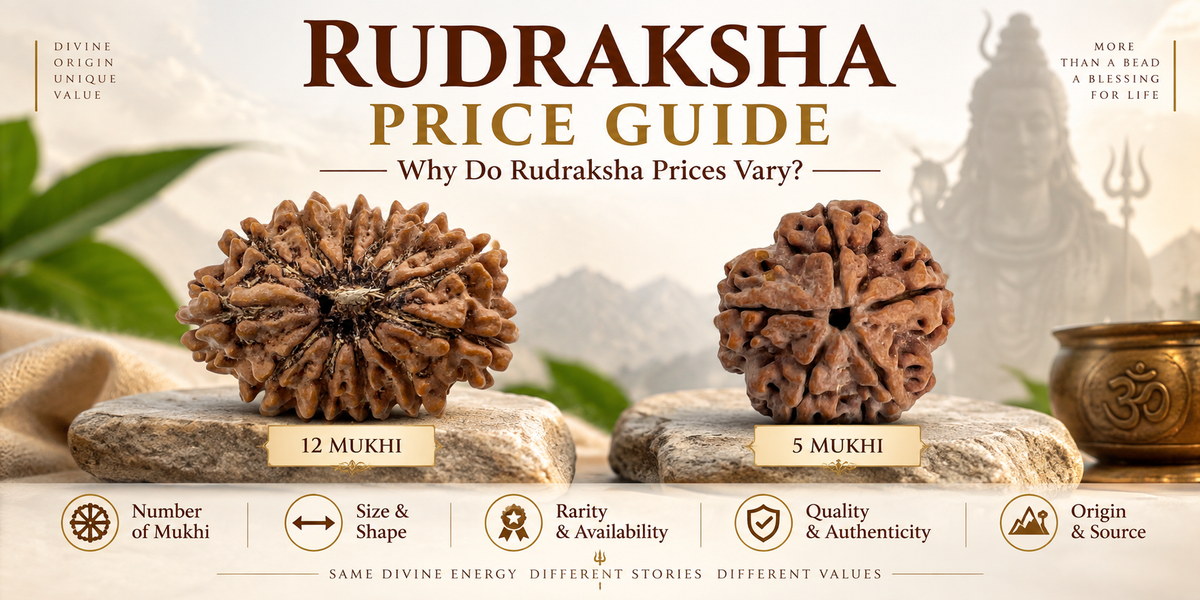
Rudraksha Price Guide – Why Do Prices Vary?
If you have compared Rudraksha prices online, you have probably noticed a confusing difference: one bead may be affordable, while another can cost several thousand rupees or more.
The reason is simple—Rudraksha is not priced by Mukhi count alone. Origin, size, natural availability, formation, condition, verification, product type and jewellery work can all affect the final price.
This is why two products described as “5 Mukhi Rudraksha” may have very different prices without being equivalent products.
One rule is worth remembering:
A higher price does not prove that a Rudraksha is original, and a lower price does not automatically mean it is fake.
The right approach is to understand exactly what you are buying and compare like with like.
Quick Answer: Why Do Rudraksha Prices Vary?
The main pricing factors are:
-
Mukhi and natural availability
-
origin, such as Nepal or Indonesia
-
bead size
-
natural formation and physical condition
-
special formations such as Gauri Shankar, Garbh Gauri or Ganesh Rudraksha
-
independent laboratory certification
-
optional X-Ray verification
-
single bead, bracelet, kavach or 108+1 mala format
-
silver, gold or other jewellery work
-
selection, grading, craftsmanship, packaging and retail services
Natural rarity can be a major driver, but the word “rare” should be supported by clear product information—not used as a vague reason for a high price.
There Is No Single Fixed Price for Every Rudraksha
Rudraksha is a natural botanical product, not a factory-made item with identical specifications. Two genuine beads of the same Mukhi can differ in diameter, weight, shape, surface texture, Mukhi definition, condition and origin.
Sellers may also use different grading systems. One seller's “Large” may overlap with another seller's “Medium.” One price may include certification, while another may cover only the loose bead.
Instead of asking, “What is the correct price of Rudraksha?” ask:
What is a reasonable price for this Mukhi, origin, size, formation, condition and level of verification?
That produces a much more useful comparison.
1. Mukhi Availability Is a Major Price Factor
The number of natural longitudinal faces or divisions on a Rudraksha is called its Mukhi. Different Mukhi formations do not occur in equal quantities.
The widely available 5 Mukhi is generally more accessible than many uncommon Mukhis and special natural formations. Lower availability can therefore create a higher market value.
This does not mean that a higher Mukhi is spiritually “better.” Different Mukhis have different traditional associations, and the most expensive option is not automatically the right choice.
If you are new to the subject, the 5 Mukhi Rudraksha Complete Guide is a useful starting point.
2. Origin Can Change the Price
Two Rudraksha with the same Mukhi can be priced differently because their origins and physical characteristics differ.
Nepali Rudraksha
Nepali Rudraksha is generally known for a larger size, deeper surface texture, prominent Mukhi lines and a heavier physical presence. Large, well-formed specimens can command a substantial premium.
Indonesian or Java Rudraksha
Indonesian Rudraksha is usually smaller, lighter and finer in texture. Its compact size often makes it practical for bracelets and 108+1 japa malas.
A small Indonesian bead should not be assumed to be fake merely because it looks different from a larger Nepali bead.
For a detailed comparison, read Nepali vs Indonesian Rudraksha: Difference, Size, Quality & Which to Choose.
Compare Nepali with Nepali and Indonesian with Indonesian before deciding whether a price is high or low.
3. Size Can Affect Rudraksha Price
Within the same Mukhi and origin, unusually large, healthy and well-formed beads may be less commonly available. That scarcity can create a size premium.
Mahadev Mala uses grades such as Regular, Medium, Large and Rare to distinguish available specimens within a product range. These are not universal grades followed identically by every seller.
A larger bead may cost more because it is harder to source at that size. However, bigger does not automatically mean more powerful. Size can affect rarity, appearance, weight, comfort and price, but it does not guarantee stronger spiritual results.
Before paying a size premium, read Rudraksha Size Guide: Does Size Really Matter?.
4. Natural Formation and Condition Matter
Two beads of the same Mukhi, origin and approximate size may still differ in value. Factors such as clear natural divisions, structural integrity, major cracks, broken areas, insect damage and overall formation can affect grading.
Natural irregularity is not automatically a defect. Rudraksha is a seed and should not be expected to resemble a perfectly manufactured sphere.
A “rare-size 5 Mukhi” and a “rare Mukhi” are also different ideas. The first may refer to an unusually large specimen within a common category; the second refers to lower natural availability of the Mukhi formation itself.
Whenever a listing says “Rare,” ask: rare because of the Mukhi, size, origin, formation or individual specimen quality?
5. Special Natural Formations Can Cost More
Some Rudraksha appear as distinctive natural formations:
-
Gauri Shankar Rudraksha: a naturally joined formation traditionally associated with Shiva and Parvati
-
Garbh Gauri Rudraksha: a joined formation traditionally interpreted as representing mother and child
-
Ganesh Rudraksha: a bead with a natural trunk-like protrusion traditionally associated with Lord Ganesha
Their prices can depend on natural availability, Mukhi, origin, size, condition and verification. A glued or artificially modified imitation should not be valued as a genuine natural formation.
6. Certification Adds Verification, Not Spiritual Power
Independent laboratory examination involves a real cost. At Mahadev Mala, every Rudraksha product includes an independent laboratory certificate at no additional cost.
The certificate records the laboratory's findings within the scope of its examination. It does not make the Rudraksha spiritually stronger and does not guarantee personal outcomes.
The value of certification is documentation and transparency. You can read the current Mahadev Mala Certification & Authenticity process.
7. X-Ray Verification May Add to the Cost
A laboratory certificate and an X-Ray are not necessarily the same thing. A certificate is a report, while an X-Ray is an imaging method used to examine internal structure.
At Mahadev Mala, the independent laboratory certificate is included, while X-Ray verification is an optional paid add-on for eligible Rudraksha products.
For a common bead, the included documentation may be enough for many buyers. For an uncommon, high-value or collector specimen, some buyers may prefer the additional internal examination.
Read Rudraksha Certificate vs X-Ray: What Is the Difference? before deciding whether it is useful for your purchase.
8. Product Format Changes the Final Price
A single loose bead, bracelet, kavach and 108+1 mala cannot be compared by price alone.
A traditional japa mala may include 108 counting beads plus one Guru or Meru bead. Its price may reflect the number of natural beads, origin, size consistency, selection, threading, knotting, Guru bead, tassel and craftsmanship.
A bracelet requires several selected beads. A kavach may combine different Mukhis. Their prices reflect the complete product, not just one bead.
For the structure and use of a prayer mala, read Rudraksha Mala Guide: 108+1 Beads, Benefits & How to Use.
9. Silver, Gold and Craftsmanship Affect Price
Some Rudraksha are sold loose. Others include silver capping, pendant fittings, metal chains, gold work, decorative spacers, custom threading or premium jewellery construction.
The metal and craftsmanship are separate value components. A loose bead and a finished silver pendant are not equivalent products.
Before comparing prices, check whether the listing covers:
-
Rudraksha only, or
-
Rudraksha plus jewellery and construction
10. Wholesale and Retail Prices Are Different
A wholesale lot and a retail-ready individual specimen are not the same commercial product.
Wholesale buying may involve bulk quantities, mixed grades, limited individual selection, simpler packaging, different certification arrangements and buyer-side sorting.
Retail preparation may include sourcing, hand selection, Mukhi examination, grading, measurement, cleaning, testing, photography, cataloguing, storage, protective packaging and customer support.
These steps do not justify an unlimited markup, but they explain why a finished retail price is usually higher than a bulk-market quote. The useful question is: Is the premium reasonable for what is actually included?
Why Can Two 5 Mukhi Rudraksha Have Very Different Prices?
Suppose both listings say “5 Mukhi Rudraksha.” One may be an 8 mm Indonesian bead used in a mala. The other may be a 25 mm or larger Nepali specimen, individually selected and sold as a prominent single bead.
Both can be genuine, but they are not equivalent products. Mukhi alone is not enough to establish price.
5 Mukhi is generally more affordable because it is widely available. That does not make it spiritually unimportant. Market availability and devotional significance are different subjects.
Why Are Some Higher Mukhi Rudraksha More Expensive?
Some Mukhi formations are less commonly available. The sourcing challenge increases when the buyer also wants a particular origin, desirable size, clear natural formation, good condition and suitable verification.
A Mukhi may be uncommon, but a large, well-formed and properly documented specimen can be even harder to source. Value should therefore be assessed at the specimen level—not only by Mukhi number.
Does a Higher Price Mean More Spiritual Power?
No. Price is a market value influenced by scarcity, physical characteristics, verification, craftsmanship and retail costs. Spiritual significance belongs to traditional belief and personal practice.
A rare Rudraksha may cost more because fewer specimens are available. That does not make a common 5 Mukhi spiritually meaningless. Price should not become a spiritual ranking system.
Does a Cheap Rudraksha Mean It Is Fake?
No. A common Mukhi, smaller bead or Indonesian origin can naturally be more affordable.
However, an unusually low price combined with an extraordinary rarity claim deserves careful checking. If a seller offers an exceptionally rare Mukhi, unusual size or collector-grade formation at a surprisingly low price, ask for clear evidence before treating it as a bargain.
Does an Expensive Rudraksha Prove It Is Original?
No. A fake or misrepresented product can also be given a high price. Price cannot verify the Mukhi, origin, natural formation, internal structure or certificate.
The safer order is:
Verify first → understand the specifications → compare similar products → then judge the price.
For a detailed buying check, read Original Rudraksha Kaise Pehchane: Real vs Fake.
Be Careful With “Too Rare to Verify” Marketing
Rarity should increase the need for evidence, not reduce it. For a high-value Rudraksha, ask:
-
What is the exact Mukhi?
-
What is the stated origin and size?
-
Is this the exact bead I will receive?
-
Is an independent laboratory certificate included?
-
What does the report state?
-
Is optional X-Ray verification available?
-
Is a claimed special formation natural?
-
What specifically explains the premium?
A high-value purchase should become clearer as questions are answered—not more mysterious.
Do Rashi, Astrology or Energization Change the Price?
Your Rashi does not change the market price of a bead. A traditional recommendation may lead you to a Mukhi that happens to be more or less available, but that is a product-supply issue, not personalised pricing.
If you are choosing through Vedic Rashi associations, read Which Rudraksha Should You Wear According to Your Rashi?.
Traditional energization should also be understood separately from physical verification and market value. Spiritual preparation should not be used as a vague justification for an unexplained extreme premium.
What Should You Compare Before Buying?
Use this checklist:
| Factor | What to compare |
|---|---|
| Mukhi | Are both products the same Mukhi? |
| Origin | Are both Nepali, both Indonesian or different? |
| Size | Compare actual millimetres, not only grade names. |
| Product type | Single bead, bracelet, kavach or 108+1 mala? |
| Formation | Is either product a special natural formation? |
| Condition | Are the specimens structurally comparable? |
| Certification | Is independent laboratory documentation included? |
| X-Ray | Is it included, optional or unavailable? |
| Jewellery | Does either include silver, gold or other fittings? |
| Exact specimen | Will you receive the photographed bead or a representative piece? |
| Seller policies | Check shipping, returns, support and product-description terms. |
Only after these points are reasonably similar does direct price comparison become meaningful.
A Simple Rudraksha Pricing Model
There is no official mathematical formula, but this framework helps:
Mukhi availability + origin + size rarity + formation and condition + verification + product construction + retail services = final retail price
Different sellers may weigh these factors differently. That is why a single universal Rudraksha price list cannot explain every product.
How to Recognise a Possible Overpricing Problem
A higher price may be understandable when the bead is genuinely scarce, unusually large within its origin, a special natural formation, well formed, independently certified, additionally X-rayed or supplied with valuable jewellery work.
The premium becomes harder to justify when the only explanation is vague language such as:
-
“most powerful”
-
“instant result”
-
“VIP Rudraksha”
-
“guaranteed wealth”
-
“1000x energy”
without clear physical specifications or documentation.
Pay for what can be explained.
How to Compare Rudraksha Prices Online in Five Minutes
-
Confirm the Mukhi.
-
Confirm the origin.
-
Check the size in millimetres.
-
Check whether it is a single bead or multi-bead product.
-
Read what certification is included.
-
Check whether X-Ray is included, optional or unavailable.
-
Review special formation claims.
-
Check jewellery and material additions.
-
Read the seller's policies.
-
Compare only genuinely equivalent products.
This is more useful than sorting search results from cheapest to most expensive.
Should You Buy the Cheapest or Most Expensive Rudraksha?
Neither price extreme should make the decision for you.
The cheapest choice may not be worthwhile if its origin, Mukhi, verification and seller accountability are unclear. At the same time, you do not need the most expensive bead to prove devotion.
For daily Shiva devotion, meditation or beginning a japa practice, a rare collector specimen may not be necessary. A natural, correctly identified and appropriately verified Rudraksha that suits your purpose and budget can be the better purchase.
If you are new to wearing Rudraksha, read Rudraksha Kaise Pehne? Complete Vidhi, Mantra & Best Day. For regular use and care, see Rudraksha Wearing Rules: Do's & Don'ts for Daily Wear.
Why Transparent Pricing Matters
Rudraksha is both a natural product and an article of faith. That makes transparent selling especially important.
A buyer should be able to understand whether a higher price comes from a larger size, lower availability, Nepali origin, special formation, complete mala construction, independent certification, optional X-Ray or jewellery work.
What should be avoided is using spiritual anxiety to push someone towards the highest-priced option.
Devotion is not measured by how much money someone spends.
How Mahadev Mala Approaches Rudraksha Value
Mahadev Mala offers Rudraksha across different Mukhis, sizes and formats, including individual beads, malas, bracelets and kavach.
The buying principle is simple:
Choose the right product first. Understand its specifications. Verify it. Then evaluate the price.
Every Rudraksha product includes an independent laboratory certificate at no additional cost. Optional paid X-Ray verification is available for eligible products.
You can explore natural certified Rudraksha at Mahadev Mala and compare currently available Mukhi and size options.
Frequently Asked Questions About Rudraksha Price
Why is Rudraksha so expensive?
Not every Rudraksha is expensive. Price depends on availability, Mukhi, origin, size, condition, formation, verification and product format. Scarce or unusually large verified specimens may cost more than common varieties.
Which Rudraksha is generally more affordable?
5 Mukhi is widely available and generally among the more accessible varieties. Its price still changes with origin, size, condition and product type.
Is Nepali Rudraksha more expensive than Indonesian Rudraksha?
Large, well-formed Nepali specimens often command higher prices. Indonesian beads are generally smaller and practical for malas and bracelets. Compare the same Mukhi and product format before judging price.
Does a bigger Rudraksha mean better?
No. A larger bead may be rarer and more prominent, but size alone does not prove authenticity or guarantee stronger spiritual results.
Does a certificate increase Rudraksha price?
Laboratory examination involves a cost, but seller policies differ. At Mahadev Mala, every Rudraksha product includes an independent laboratory certificate at no additional cost.
Is X-Ray included in the Rudraksha price?
At Mahadev Mala, X-Ray verification is an optional paid add-on for eligible products. See the Certificate vs X-Ray guide for the distinction.
Is Rare size the same as a rare Mukhi?
No. Rare size can describe an unusually large specimen within a category. A rare Mukhi refers to the lower natural availability of that Mukhi formation.
How can I judge whether a price is reasonable?
Compare the same Mukhi, origin, approximate size, condition, verification level and product type across credible sellers. If one costs substantially more, identify the specific feature that explains the premium.
Final Takeaway
Rudraksha prices vary because the products themselves vary. A common 5 Mukhi and an uncommon Mukhi do not have the same natural availability. A small Indonesian bead and a large Nepali bead are physically different. A single bead and a 108+1 mala also involve different quantities and craftsmanship.
Before buying, follow this order:
Choose the Mukhi → Check the origin → Check the size and formation → Review verification → Understand what is included → Then compare the price.
Do not buy only because a Rudraksha is the cheapest or the most expensive. Choose a natural, correctly identified and appropriately verified product that suits your spiritual practice, wearing preference and budget.
Price Note: Rudraksha prices are not universally fixed and may change with availability, origin, size, natural formation, grading, testing, craftsmanship, seller costs and market conditions.
Disclaimer: Rudraksha is a natural spiritual product and an article of faith within Hindu and Vedic traditions. Spiritual and astrological associations are based on traditional beliefs and are not scientifically proven. Rudraksha does not diagnose, treat, cure or prevent disease, and no specific medical, financial, academic, relationship or personal result is guaranteed. Laboratory reports and X-Ray examinations should be understood according to the scope and methods of the issuing laboratory.


