
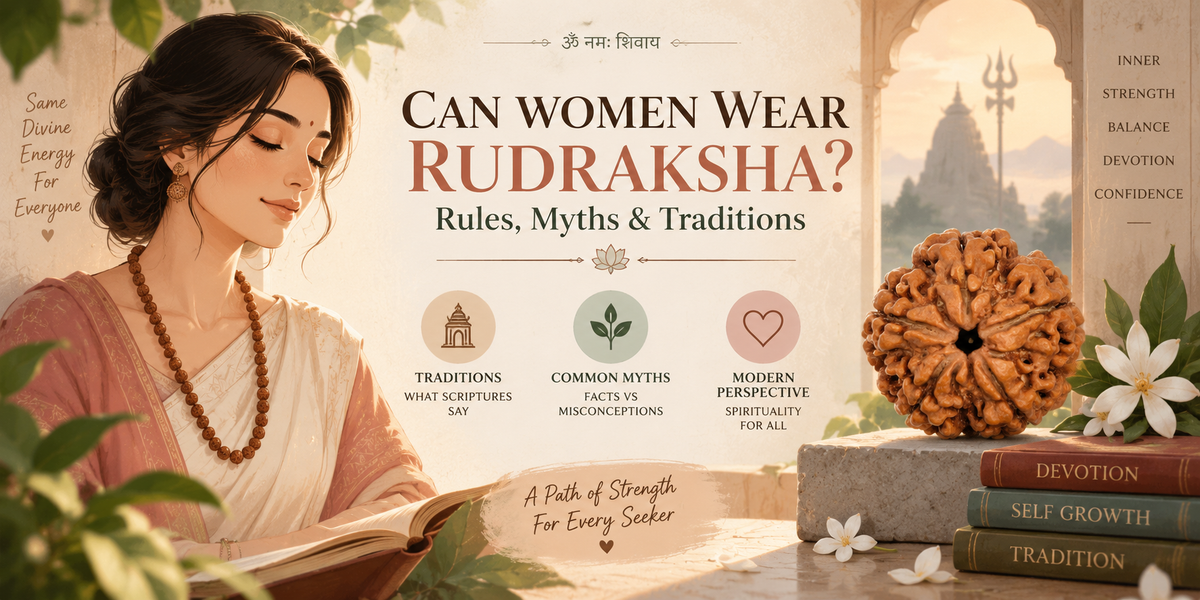
Can Women Wear Rudraksha? Rules, Myths & Traditions
Quick answer: Yes, women can wear Rudraksha. The Shiva Purana includes women among those who may wear Rudraksha. Much of the confusion around this subject comes from differences between scripture, family customs, temple practices and individual spiritual lineages rather than from one universal rule.
Once that basic question is answered, several practical questions usually follow. Can women wear Rudraksha every day? What about during periods? Can married and unmarried women wear it? Is there a special Rudraksha for women? Should it be removed while sleeping or bathing?
This guide looks at these questions carefully, separating scriptural references from customs and commonly repeated beliefs.
Can Women Wear Rudraksha According to Hindu Tradition?
Yes, women can wear Rudraksha.
Rudraksha has long been associated with Lord Shiva, mantra japa, meditation and devotional practice. Its use is not traditionally limited only to men or ascetics.
An important reference appears in the Shiva Purana, Vidyeshvara Samhita, Chapter 25, verse 47. The passage includes women among those who may wear Rudraksha.
This is worth noting because statements such as “Rudraksha is only for men” or “only sadhus should wear Rudraksha” are sometimes presented as universal rules. The scriptural picture is broader.
A woman may wear Rudraksha as a single bead, pendant, bracelet or mala depending on her spiritual practice, comfort and the tradition she follows.
If you are new to Rudraksha, our complete guide to Rudraksha benefits, types and how to choose is a useful place to begin.
Why Do Some People Say Women Should Not Wear Rudraksha?
The confusion often comes from treating a local, family or lineage-specific practice as a rule followed by everyone.
One family may observe a particular custom, while a guru or sampradaya may teach something different. Temple traditions can also have their own disciplines.
It helps to distinguish between four things:
-
A scriptural reference
-
A guru or sampradaya instruction
-
A family custom
-
A seller's claim
They are not necessarily the same.
If your family or spiritual teacher follows a particular discipline around Rudraksha, you may choose to respect that practice. At the same time, the broad statement that women are universally forbidden from wearing Rudraksha does not match the Shiva Purana passage discussed above.
Can Women Wear Rudraksha During Periods?
This is one of the most common questions, but there is no single practice followed by every Hindu family or spiritual lineage.
Some women continue wearing Rudraksha during menstruation. Some households traditionally remove sacred malas or avoid certain forms of puja during those days. Different gurus and sampradayas may also give different instructions.
Because these practices vary, a family or lineage-specific observance should not automatically be presented as a universal rule for every woman.
If you follow a guru, temple tradition or established family practice, follow that guidance consistently. If your tradition does not prescribe a particular restriction, there is no need to assume that accidentally touching or wearing Rudraksha during menstruation permanently affects the bead.
Can Married Women Wear Rudraksha?
Yes. Marriage by itself does not prevent a woman from wearing Rudraksha.
Rudraksha is not restricted only to renunciates. Householders also use it for Shiva devotion, mantra practice, meditation and other traditional spiritual purposes.
The same applies to unmarried women. Marital status does not need to be treated as a universal eligibility test for wearing Rudraksha.
Can Girls and Students Wear Rudraksha?
Rudraksha is not inherently restricted to adults. A girl or student may wear it as part of prayer, meditation or a family spiritual practice.
For students, the more useful question is why a particular Mukhi is being chosen. Avoid buying a bead simply because someone promises guaranteed marks, concentration or academic success.
For commonly discussed traditional associations, read our Rudraksha for Students: Focus and Study Guide.
Is There a Special Rudraksha Only for Women?
There is no single Mukhi that needs to be treated as a universal “women's Rudraksha.”
Women can wear different Mukhis just as men can. Traditionally, selection may depend on spiritual practice, deity association, purpose, astrological tradition or guidance from a teacher rather than gender alone.
Some commonly discussed traditional associations include:
-
2 Mukhi: associated with unity, harmony and Ardhanarishvara
-
4 Mukhi: associated with knowledge, learning and communication
-
5 Mukhi: commonly used for Shiva devotion, japa and everyday spiritual practice
-
6 Mukhi: associated with Lord Kartikeya, discipline and confidence
-
7 Mukhi: associated with Mahalakshmi and prosperity-related traditions
These are traditional spiritual associations, not guaranteed outcomes.
If you are unsure where to begin, our 1–14 Mukhi Rudraksha selection guide provides a broader overview. It is generally more useful than choosing a bead simply because it has been marketed as being “for women.”
Can Women Wear 5 Mukhi Rudraksha?
Yes. Women can wear 5 Mukhi Rudraksha.
5 Mukhi is one of the most commonly used Rudraksha types and is widely chosen for daily spiritual practice, Shiva devotion and mantra japa.
It may be worn as a single bead, pendant, bracelet or mala depending on personal preference and comfort.
Can Women Wear a Rudraksha Mala?
Yes. A woman may wear a Rudraksha mala around the neck or use one for mantra japa according to the tradition she follows.
A traditional japa mala commonly contains 108 beads plus one Guru bead. Some practitioners prefer to keep the mala used specifically for japa separate from the mala they wear.
For more detail, read our guide on why Rudraksha malas use 108+1 beads and how to use them.
Does Rudraksha Have to Touch the Skin?
Not necessarily.
Rudraksha may be worn in cotton or silk thread, as a pendant, in an appropriate metal setting or as part of a mala. There is no need to make the bead uncomfortable simply to maintain constant skin contact.
From a practical point of view, keeping the Rudraksha secure, clean and protected from unnecessary chemical exposure matters more.
Can Women Wear Rudraksha While Sleeping?
Practices differ. Some people keep Rudraksha on continuously, while others remove it before sleeping.
From a bead-care perspective, removing it before sleep can be sensible if the bead, thread or setting is likely to be pressed, pulled or damaged during the night.
This is a practical recommendation rather than a claim that sleeping while wearing Rudraksha is universally forbidden.
If you remove it, keep it respectfully in a clean and dry place.
Should Rudraksha Be Removed While Bathing?
If you use soap, shampoo, perfume, hot water or other personal-care products, removing Rudraksha before bathing is a practical way to protect the natural bead.
Rudraksha is a natural seed. Repeated exposure to detergents, cosmetics and prolonged moisture may affect its surface and condition over time.
For a broader everyday routine, see our Rudraksha Wearing Rules: Dos and Don'ts.
Simple Rudraksha Wearing Guidelines for Women
There does not need to be a complicated set of gender-specific rules for ordinary daily wear. A simple routine is easier to follow:
-
Keep the Rudraksha clean and handle it respectfully.
-
Avoid direct exposure to soap, shampoo, perfume and harsh chemicals.
-
Follow your guru, sampradaya or family tradition if you have one.
-
If you unintentionally miss a customary practice, simply return to the routine you normally follow.
-
Keep the bead in a clean, dry place whenever you remove it.
-
Choose a natural Rudraksha based on a clear purpose rather than exaggerated promises.
-
Give more importance to sincere spiritual practice than to fear-based claims surrounding the bead.
For the first-wearing process, including a simple puja, mantra and traditional day, see our guide on How to Wear Rudraksha: Vidhi, Mantra and Best Day.
What Mantra Can Women Chant While Wearing Rudraksha?
A simple and widely used Shiva mantra is:
ॐ नमः शिवाय — Om Namah Shivaya
Women may chant it as part of Shiva devotion and Rudraksha practice.
Individual Mukhis may also have traditional mantras associated with them. If you have received a mantra from a guru or follow a particular spiritual lineage, that instruction should take priority over a generic list found online.
Common Myths About Women and Rudraksha
Myth: Rudraksha Is Only for Men
The Shiva Purana passage discussed above specifically includes women among those who may wear Rudraksha.
Myth: Only Sadhus Can Wear Rudraksha
Rudraksha is also used by householders. Renouncing family or professional life is not a universal requirement for wearing it.
Myth: Married Women Should Not Wear Rudraksha
Marriage itself is not a general prohibition.
Myth: Every Woman Must Remove Rudraksha During Periods
Practices around menstruation differ between families, teachers and spiritual lineages. A particular observance should be understood in the context of that tradition rather than automatically applied to everyone.
Myth: A Bigger Rudraksha Is Always Spiritually Better
Size affects appearance, comfort, availability and price. A larger bead should not automatically be treated as spiritually superior.
Read our Rudraksha Size Guide: Does Size Matter? for a detailed explanation.
Myth: A More Expensive Rudraksha Must Be More Powerful
Rudraksha prices vary because of factors such as Mukhi, origin, size, rarity, natural formation, availability and verification.
Price alone does not establish authenticity or suitability. Our Rudraksha Price Guide explains these factors in more detail.
Authenticity Matters More Than Gender-Based Marketing
Once the question “Can women wear Rudraksha?” is answered, a more practical buying question is:
Is the Rudraksha natural and correctly identified?
Be cautious with products promoted mainly through labels such as “Rudraksha for ladies,” “instant success Rudraksha” or other guaranteed-result claims.
Instead, look at factors such as:
-
Natural Mukhi formation
-
Overall bead condition
-
Correct Mukhi identification
-
Origin information where available
-
Independent laboratory examination
-
Clear seller and return policies
A laboratory certificate and an X-Ray examination do not serve exactly the same purpose. Our Rudraksha Certificate vs X-Ray Guide explains the difference.
At Mahadev Mala, Rudraksha products are supplied with an independent laboratory certificate for authenticity and Mukhi verification. Optional X-Ray examination is available for eligible Rudraksha products when additional internal-structure verification is requested.
Choosing Rudraksha for Study, Career or Daily Spiritual Practice
Women do not need a separate selection system simply because of gender.
A student may be interested in traditional associations connected with study and disciplined effort. A working professional may explore associations related to confidence, communication or discipline. Someone else may simply prefer 5 Mukhi for everyday Shiva devotion and mantra japa.
The purpose should come first.
For work-related traditional associations, see our Rudraksha for Career and Confidence Guide.
Rudraksha can be part of a personal spiritual practice, but it should not replace preparation, skill development, professional decisions or other practical effort.
Frequently Asked Questions
Can women wear Rudraksha every day?
Yes. Women may wear Rudraksha daily if it suits their spiritual practice. Keep the bead clean, protect it from chemicals and follow any specific discipline given by your guru or family tradition.
Can women wear Rudraksha during menstruation?
Practices vary. Some women continue wearing it, while some families and spiritual lineages observe removal during menstruation. If you follow a particular tradition, follow its guidance rather than treating one custom as universal.
Can unmarried girls wear Rudraksha?
Yes. Being unmarried is not a general restriction on wearing Rudraksha.
Can married women wear Rudraksha?
Yes. Marriage and household life do not by themselves prevent a woman from wearing Rudraksha.
Can women chant Om Namah Shivaya while wearing Rudraksha?
Yes. Om Namah Shivaya is widely used in Shiva devotion. Anyone following a specific initiated mantra should follow the guidance of their teacher.
Which Rudraksha is best for women?
There is no single Mukhi universally best for all women. Selection can depend on the intended spiritual practice, traditional association, comfort and personal guidance rather than gender alone.
Can a woman wear more than one Rudraksha?
Yes. Multiple beads and Mukhi combinations are used in some traditions. A combination should have a clear purpose rather than being chosen on the assumption that wearing more beads automatically produces stronger results.
What Women Should Keep in Mind
Women can wear Rudraksha. The idea that Rudraksha belongs only to men or ascetics does not reflect the Shiva Purana passage that explicitly includes women.
What can vary is the practice surrounding it. Family customs, menstrual observances, mantra traditions and daily disciplines are not identical across every Hindu lineage.
A sensible approach is to understand the tradition you follow, avoid exaggerated or fear-based claims, choose an authentic Rudraksha and know why you are wearing it.
If you are still deciding which Mukhi fits your purpose, begin with our complete 1–14 Mukhi Rudraksha guide and explore Mahadev Mala's natural, independently certified Rudraksha.
Traditional Context & Disclaimer
Traditional context: The Shiva Purana, Vidyeshvara Samhita, Chapter 25, verse 47 includes women among those who may wear Rudraksha. Practices surrounding Rudraksha may nevertheless vary between families, teachers, sampradayas and spiritual lineages.
Disclaimer: Rudraksha is a natural spiritual product and an article of faith within Hindu and Vedic traditions. Spiritual and astrological associations described in this article are based on traditional beliefs and are not scientifically proven. Rudraksha does not diagnose, treat, cure or prevent disease, and no specific result is guaranteed. Individual practices and traditions may vary.


