11 Mukhi Rudraksha Complete Guide – Benefits, Mantra, Meaning & Wearing Rules
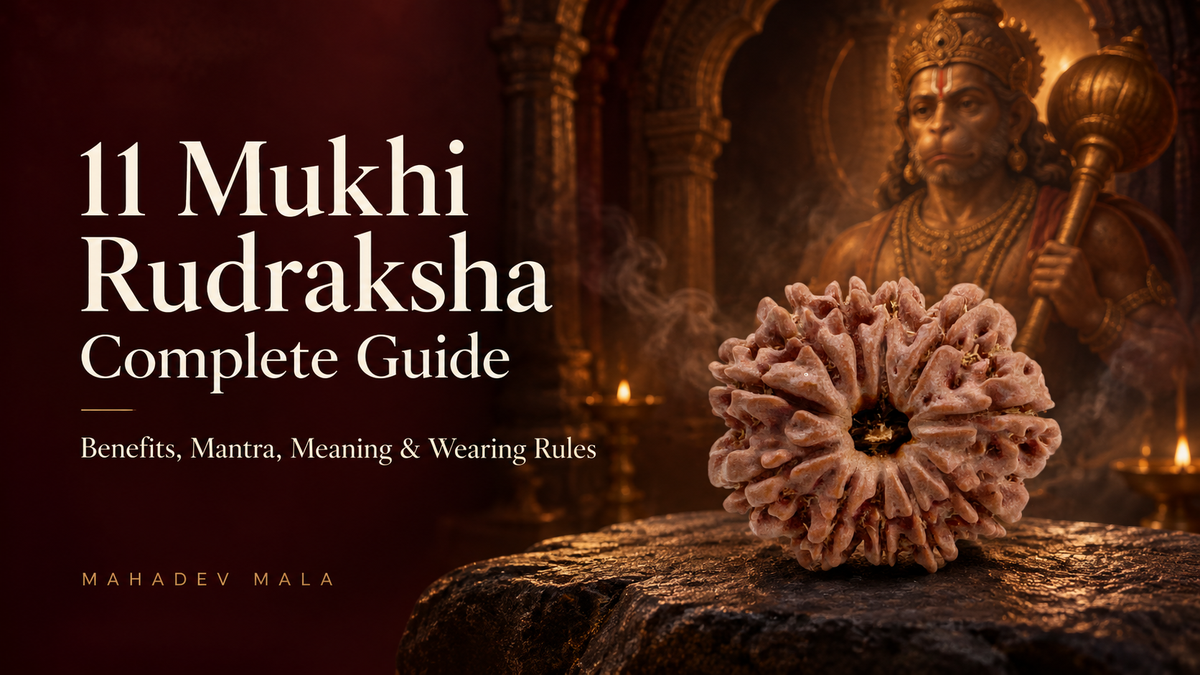
An 11 Mukhi Rudraksha is traditionally associated with Lord Hanuman and Ekadasha Rudra — the eleven forms of Rudra. It is commonly chosen by devotees whose spiritual intention centres on courage, discipline, determination, devotion and the strength to remain steady when responsibility becomes difficult.
The most useful way to understand this bead is not as a shortcut to becoming fearless or powerful. Hanuman's symbolism combines strength with humility, courage with devotion, and action with self-control. That makes 11 Mukhi especially meaningful for people who want their confidence to be guided by discipline rather than impulse.
Unlike the commonly followed 1–9 Mukhi sequence, 11 Mukhi does not have one universally agreed ruling planet. Some modern traditions connect it with Mars, while others describe it as having no single planetary ruler or associate it more broadly with the Navagraha. Mahadev Mala currently lists it under “All Planets (Traditionally Associated with the Navagrahas)”. Because these mappings vary, it is better not to present one modern planetary attribution as a universal rule.
Mahadev Mala's 11 Mukhi is a natural, lab-certified Nepali Rudraksha. The current product page shows Regular and Large selectable variants, and the Beej Mantra followed by Mahadev Mala is ॐ ह्रीं हुं नमः — Om Hreem Hum Namah.
This guide explains its Hanuman and Ekadasha Rudra meaning, traditional benefits, mantra, wearing method, planetary interpretations, who may consider it, Nepali origin, size, authenticity, certification, X-Ray, care and practical buying checks.
11 Mukhi Rudraksha at a Glance
| Feature | Traditional / Practical Information |
|---|---|
| Mukhi | 11 natural faces |
| Also called | Eleven Mukhi / Gyarah Mukhi / Ekadasha Mukhi Rudraksha |
| Primary deity | Lord Hanuman |
| Deeper traditional association | Ekadasha Rudra — eleven forms of Rudra |
| Planetary association | Traditions vary; Mahadev Mala lists all planets / Navagraha association |
| Common traditional themes | Courage, discipline, devotion, determination, confidence and spiritual strength |
| Mahadev Mala origin | Nepal |
| Current selectable sizes | Regular and Large |
| Beej Mantra | ॐ ह्रीं हुं नमः — Om Hreem Hum Namah |
| Common format | Single bead / pendant |
| Certification | Lab certified |
| General Rudraksha wearing day | Monday |
| Hanuman-focused practice | Tuesday is also commonly chosen in Hanuman-centred traditions |
These are traditional spiritual associations, not scientifically established or guaranteed medical, financial, academic, relationship or personal outcomes.
What Is an 11 Mukhi Rudraksha?
An 11 Mukhi Rudraksha is a natural Rudraksha seed with eleven longitudinal divisions, or Mukhis, running along its outer surface.
Those eleven naturally formed faces determine its classification.
A genuine Rudraksha is a botanical seed, so natural beads can differ in:
-
shape,
-
diameter,
-
weight,
-
colour,
-
texture,
-
depth of the Mukhi lines,
-
and overall surface formation.
Two genuine 11 Mukhi beads do not have to look identical.
Perfect symmetry is not proof of authenticity, and an irregular natural shape is not automatically a defect. What matters more is whether the eleven divisions appear naturally formed and whether there are signs of artificial carving, joining, filling or modification.
For a practical authenticity framework, read Original Rudraksha Kaise Pehchane – Real vs Fake.
Which God Is Associated With 11 Mukhi Rudraksha?
11 Mukhi Rudraksha is widely associated with Lord Hanuman.
Hanuman represents a combination that is easy to admire but difficult to practise:
-
courage without arrogance,
-
strength without misuse of power,
-
intelligence without pride,
-
action without loss of discipline,
-
and devotion without weakness.
This is why 11 Mukhi should not be reduced to a simple “power bead.”
Its deeper symbolism is strength under control.
A person may be physically capable, professionally successful or naturally confident and still lack discipline. Hanuman's example reminds the devotee that real strength is most useful when it serves a higher purpose.
What Is the Connection Between 11 Mukhi Rudraksha and Ekadasha Rudra?
“Ekadasha” means eleven.
Traditional Rudraksha literature associates the eleven-faced Rudraksha with Ekadasha Rudra, or the eleven forms of Rudra. Hanuman is also widely revered in later devotional tradition as an aspect or incarnation connected with Rudra, which explains why both associations appear together in descriptions of 11 Mukhi.
This gives the bead two closely related layers of symbolism:
Hanuman represents devotion, courage, discipline and service.
Ekadasha Rudra connects the bead more directly with Rudra-Shiva tradition.
These are not necessarily competing interpretations. In common devotional practice, they often reinforce one another.
Is 11 Mukhi Rudraksha Mentioned in Traditional Texts?
Traditional Rudraksha literature describes the eleven-faced bead in connection with Ekadasha Rudra.
For example, the Rudraksha Jabala Upanishad is commonly cited in discussions of the eleven-faced Rudraksha as a form associated with the eleven Rudras. Later devotional interpretations frequently connect this symbolism with Lord Hanuman.
The exact benefits and ritual instructions attributed to ancient texts can vary considerably across translations, editions and modern retellings. For that reason, it is better to preserve the broad traditional association than to turn highly specific scriptural claims into guaranteed modern outcomes.
Which Planet Rules 11 Mukhi Rudraksha?
There is no single universally agreed planetary mapping for 11 Mukhi Rudraksha.
This is worth stating clearly because different sellers and traditions give different answers.
You may encounter three common approaches:
-
No single ruling planet — 11 Mukhi is treated primarily as Hanuman / Ekadasha Rudra.
-
All planets or Navagraha association — this is the approach currently used on Mahadev Mala's 11 Mukhi product page.
-
Mars (Mangal) — some modern Rudraksha traditions connect 11 Mukhi with Mars because of themes such as courage, strength and action.
The commonly followed primary Navagraha sequence itself is already complete with 1–9 Mukhi:
-
1 Mukhi — Surya
-
2 Mukhi — Chandra
-
3 Mukhi — Mangal
-
4 Mukhi — Budh
-
5 Mukhi — Guru
-
6 Mukhi — Shukra
-
7 Mukhi — Shani
-
8 Mukhi — Rahu
-
9 Mukhi — Ketu
10 Mukhi is commonly used for an overall Navagraha-protection tradition, while higher-Mukhi planetary mappings vary more between lineages.
For that reason, choose 11 Mukhi primarily for its Hanuman / Ekadasha Rudra significance unless you have received a specific astrological recommendation.
For the wider framework, read Which Rudraksha to Wear According to Your Planet? Navagraha Guide.
Traditional Benefits of 11 Mukhi Rudraksha
The following are traditional spiritual associations. They should not be treated as scientifically proven or guaranteed outcomes.
1. Courage
Courage is one of the strongest themes associated with Lord Hanuman.
But courage does not mean that fear disappears.
A more useful interpretation is the ability to recognise fear, prepare properly and still do what responsibility requires.
For someone facing a difficult conversation, new role, demanding project or uncertain phase, the bead can become a devotional reminder of that quality.
2. Self-Discipline
Hanuman's strength is inseparable from discipline.
11 Mukhi is therefore often chosen by people who want to become more consistent in:
-
spiritual practice,
-
work,
-
exercise,
-
study,
-
personal commitments,
-
or daily routines.
The Rudraksha cannot create discipline automatically. It can serve as a physical reminder of the discipline the wearer intends to practise.
3. Determination
Starting is often easier than continuing.
The traditional symbolism of 11 Mukhi fits people who want to remain committed after initial motivation fades.
Determination here means staying with a worthwhile task without becoming rigid or reckless.
4. Devotion
Hanuman is one of the strongest symbols of bhakti in Hindu tradition.
For a devotee, 11 Mukhi can represent:
-
surrender,
-
loyalty to one's spiritual path,
-
service,
-
humility,
-
and remembering that ability should be used responsibly.
5. Confidence With Humility
Confidence becomes more useful when it is not dependent on proving superiority over others.
11 Mukhi is traditionally connected with a form of confidence rooted in preparedness, devotion and self-control.
That distinction makes it relevant to people in leadership or high-responsibility roles.
6. Spiritual Strength
11 Mukhi is also chosen by meditators and spiritual seekers who connect with Rudra or Hanuman worship.
Its meaning can support a practice centred on:
-
mantra,
-
meditation,
-
disciplined living,
-
and consistent sadhana.
Is 11 Mukhi Rudraksha a “Fearlessness” Rudraksha?
It is often described that way because of Lord Hanuman.
But fearlessness should not be interpreted as the absence of all fear.
Fear has a practical role. It can warn us about genuine danger.
A healthier spiritual interpretation is courage with awareness: do not let unnecessary fear control every decision, but do not ignore real risks either.
11 Mukhi is not a substitute for professional help with severe anxiety, panic, trauma or other mental-health concerns.
Is 11 Mukhi Rudraksha Used for Protection?
Protection is part of Hanuman and Rudra symbolism in many traditions.
Spiritually, this may mean:
-
feeling anchored in devotion,
-
developing courage,
-
maintaining discipline,
-
strengthening one's resolve,
-
and approaching uncertainty with prayer rather than panic.
It should not be marketed as guaranteed protection from:
-
accidents,
-
illness,
-
crime,
-
legal problems,
-
financial loss,
-
enemies,
-
or supernatural harm.
A sacred bead can be part of faith. It is not a replacement for real-world safety.
Which Rashi Can Wear 11 Mukhi Rudraksha?
11 Mukhi is not restricted to one Rashi.
Because its planetary mapping varies between traditions, it is especially unsuitable to make a rigid claim such as “only one zodiac sign should wear 11 Mukhi.”
A person of any Rashi may consider it according to:
-
devotion to Lord Hanuman,
-
Ekadasha Rudra practice,
-
courage and discipline as a spiritual intention,
-
a Guru's recommendation,
-
or personalised astrological guidance.
If you are choosing primarily according to your Moon sign, use the Rudraksha guide for all 12 Rashi.
Who Can Wear 11 Mukhi Rudraksha?
11 Mukhi may appeal to:
-
devotees of Lord Hanuman,
-
Shiva and Rudra devotees,
-
people working on courage and self-discipline,
-
professionals carrying significant responsibility,
-
business owners and leaders,
-
students who want greater consistency,
-
athletes or people following disciplined training,
-
meditators,
-
and spiritual seekers maintaining regular sadhana.
There is no requirement to belong to one profession, gender or Rashi.
If you are still comparing Mukhis, the 1–14 Mukhi Rudraksha guide gives a useful overview.
Can Women Wear 11 Mukhi Rudraksha?
Yes.
Women and men may wear 11 Mukhi Rudraksha.
Its association with Lord Hanuman does not make the bead male-only.
Some families, temples or lineages may follow their own devotional customs around Hanuman worship. Those practices can be respected without turning a particular custom into a universal ban on women wearing Rudraksha.
For the broader discussion, read Can Women Wear Rudraksha? Rules, Myths & Traditions.
11 Mukhi Rudraksha Mantra
The Beej Mantra followed by Mahadev Mala for 11 Mukhi is:
ॐ ह्रीं हुं नमः
Om Hreem Hum Namah
A Hanuman devotee may also chant a Hanuman mantra or recite the Hanuman Chalisa according to personal practice.
For general Rudraksha practice, Om Namah Shivaya remains a simple Shiva mantra.
You do not need to chant every mantra you find online.
If your Guru or spiritual lineage has given a specific mantra, follow that guidance.
Which Day Is Best to Wear 11 Mukhi Rudraksha?
There are two practical traditional approaches.
Monday
Monday is widely followed for general Shiva-centred Rudraksha wearing and is a simple choice for any Rudraksha.
Tuesday
Because 11 Mukhi is strongly associated with Lord Hanuman, Tuesday is also commonly chosen in Hanuman-centred practice.
Some traditions also observe Saturday for Hanuman worship, but there is no need to keep changing the wearing day.
Choose one coherent practice.
If a Guru or astrologer has given a specific method, follow that instruction.
For the general process, read Rudraksha Kaise Pehne? Complete Vidhi, Mantra & Best Day.
How to Wear 11 Mukhi Rudraksha for the First Time
A simple devotional routine is enough.
-
Inspect the bead and its thread or pendant setting.
-
Clean it gently if required and dry it properly.
-
Place it respectfully in your puja space.
-
Remember Lord Shiva and Lord Hanuman.
-
Chant ॐ ह्रीं हुं नमः — Om Hreem Hum Namah according to your practice.
-
Wear it comfortably in a clean thread, cord or suitable metal setting.
You may include Hanuman Chalisa or another established prayer if that is already part of your devotion.
The first-wear ritual is about sankalp and reverence, not anxiety over performing every step identically.
How Should 11 Mukhi Rudraksha Be Worn?
A natural Nepali 11 Mukhi works well as a single bead or pendant.
Common options include:
-
cotton or silk thread,
-
a suitable cord,
-
silver,
-
gold,
-
or another secure setting.
The setting should hold the bead without crushing, carving or altering its natural surface.
For daily wear, comfort matters. A bead that is physically uncomfortable is less likely to become part of a consistent practice.
Single 11 Mukhi Bead, Mala or Combination?
Mahadev Mala's current standalone 11 Mukhi product is a single natural Nepali bead.
That is the most straightforward format if you specifically want to wear 11 Mukhi.
Mahadev Mala also offers a Siddha Mala containing 1 to 14 Mukhi Indonesian Rudraksha, so 11 Mukhi can also appear as part of a broader multi-Mukhi combination.
These formats have different purposes:
Single 11 Mukhi
Best suited to someone whose main intention is the Hanuman / Ekadasha Rudra symbolism of 11 Mukhi.
Multi-Mukhi Combination
A Siddha-style combination is for someone intentionally choosing a wider set of Mukhis rather than one specific bead.
More Mukhis do not automatically mean more benefit. Choose the format according to purpose, not quantity.
For a broader comparison of wearing formats, read Rudraksha Mala vs Bracelet vs Single Bead.
Is 11 Mukhi a Good First Rudraksha?
Yes, if its meaning matches your purpose.
You do not have to begin at 1 Mukhi or move through the numbers in order.
11 Mukhi may be a meaningful first Rudraksha if you specifically connect with:
-
Lord Hanuman,
-
courage,
-
self-discipline,
-
devotion,
-
determination,
-
or Ekadasha Rudra symbolism.
If you simply want a widely used bead for general daily spiritual practice, 5 Mukhi is usually a simpler and more economical starting point.
Read Which Rudraksha Is Best for Beginners? before assuming that a rarer Mukhi is automatically better.
Nepali 11 Mukhi Rudraksha
Mahadev Mala's 11 Mukhi is a natural Nepali Rudraksha.
Nepali Rudraksha is generally recognised for:
-
larger physical size,
-
deeper surface texture,
-
prominent Mukhi divisions,
-
and a substantial appearance when worn as a single bead.
Mahadev Mala's current product selector shows Regular and Large variants.
Natural variation in exact diameter, shape, colour, weight and surface texture should be expected.
A botanical seed should not be rejected merely because it is not perfectly symmetrical.
Nepali vs Indonesian 11 Mukhi Rudraksha
Both Nepali and Indonesian Rudraksha can be natural.
Nepali 11 Mukhi
Generally:
-
larger,
-
more deeply textured,
-
easier to visually inspect,
-
and well suited to a single pendant.
Indonesian 11 Mukhi
Generally:
-
smaller,
-
lighter,
-
subtler in surface texture,
-
and practical in multi-bead malas and combinations.
Origin alone does not prove authenticity or spiritual superiority.
Mahadev Mala's standalone 11 Mukhi is Nepali, while its 1–14 Mukhi Siddha Mala uses natural Indonesian Rudraksha.
For the broader origin comparison, read Nepali vs Indonesian Rudraksha.
Does the Size of 11 Mukhi Rudraksha Matter?
Size matters physically and commercially.
It can affect:
-
appearance,
-
weight,
-
wearing comfort,
-
rarity,
-
availability,
-
and price.
A larger Nepali 11 Mukhi may therefore be more expensive.
That does not establish that it carries “more Hanuman energy” or guarantees stronger spiritual results.
Choose according to:
-
authenticity,
-
comfort,
-
natural formation,
-
budget,
-
and intended use.
Read Rudraksha Size Guide – Does Size Really Matter? and the Nepali Rudraksha Size & Grading Guide for more detail.
11 Mukhi vs 10 Mukhi Rudraksha
These neighbouring Mukhis have different traditional meanings.
10 Mukhi
10 Mukhi is associated with Lord Vishnu / Janardana and is commonly discussed in relation to overall Navagraha protection, peace and balance.
11 Mukhi
11 Mukhi is associated with Lord Hanuman / Ekadasha Rudra and commonly centres on:
-
courage,
-
discipline,
-
devotion,
-
determination,
-
and strength with humility.
Someone seeking a Vishnu-centred general protection and balance bead may connect more directly with 10 Mukhi.
Someone whose intention centres on Hanuman, disciplined courage and determination may connect more directly with 11 Mukhi.
For the previous article in this series, read the 10 Mukhi Rudraksha Complete Guide.
11 Mukhi vs 9 Mukhi Rudraksha
9 Mukhi and 11 Mukhi both include courage in their traditional descriptions, but their symbolism is different.
9 Mukhi
9 Mukhi is associated with Goddess Durga and Ketu.
Its themes include:
-
Shakti,
-
resilience,
-
courage,
-
spiritual introspection,
-
and inner strength during change.
11 Mukhi
11 Mukhi is associated with Lord Hanuman and Ekadasha Rudra.
Its themes include:
-
disciplined courage,
-
devotion,
-
determination,
-
self-control,
-
and strength used responsibly.
If Durga devotion and resilience through change are central, 9 Mukhi may align more closely.
If Hanuman devotion and disciplined action are central, 11 Mukhi may align more closely.
Read the 9 Mukhi Rudraksha Complete Guide for the full comparison point.
11 Mukhi vs 6 Mukhi Rudraksha
6 Mukhi and 11 Mukhi can both appear in searches for confidence and discipline.
6 Mukhi
6 Mukhi is associated with Lord Kartikeya and, in commonly followed Rudraksha astrology, Shukra (Venus).
It is often chosen for:
-
confidence,
-
discipline,
-
responsibility,
-
creativity,
-
and focused action.
11 Mukhi
11 Mukhi is associated with Hanuman / Ekadasha Rudra and places greater emphasis on:
-
courage,
-
devotion,
-
determination,
-
self-control,
-
and spiritual strength.
For someone primarily interested in the Kartikeya/Venus framework, 6 Mukhi may be more relevant.
For someone specifically drawn to Hanuman's disciplined strength, 11 Mukhi may be the clearer choice.
Read the 6 Mukhi Rudraksha Complete Guide for the detailed 6 Mukhi interpretation.
Is 11 Mukhi Rudraksha Good for Career?
11 Mukhi may be meaningful when the professional challenge involves:
-
taking responsibility,
-
remaining disciplined,
-
speaking or acting with confidence,
-
handling pressure,
-
continuing after setbacks,
-
or leading without becoming impulsive.
But it should not be marketed as a guaranteed promotion or job-success bead.
Professional growth still depends on skill, preparation, communication, judgement and opportunity.
For a purpose-based comparison, read Rudraksha for Career & Confidence.
Is 11 Mukhi Rudraksha Good for Business and Leadership?
It can be meaningful for business owners and leaders because Hanuman's symbolism is not merely about strength.
Leadership also requires:
-
responsibility,
-
discipline,
-
courage under pressure,
-
consistency,
-
humility,
-
and service.
Those themes fit 11 Mukhi well.
But no Rudraksha guarantees customers, revenue, profit, investment or successful negotiations.
For a broader comparison of Mukhis used in business-related traditional practice, read Rudraksha for Business, Leadership & Success.
Is 11 Mukhi Rudraksha Good for Students?
A student may choose 11 Mukhi when the intention centres on:
-
discipline,
-
courage,
-
consistency,
-
determination,
-
and remaining committed during demanding periods.
However, 11 Mukhi should not be sold as a guaranteed exam-success bead.
For study-specific traditional associations, 4 Mukhi and 6 Mukhi are often discussed more directly for learning, communication, confidence and discipline.
Read Rudraksha for Students – Focus & Study Guide.
11 Mukhi Rudraksha for Athletes and Physically Demanding Work
Hanuman's symbolism naturally appeals to people who value strength, endurance and discipline.
An athlete, fitness practitioner or person in physically demanding work may therefore connect with 11 Mukhi as a spiritual reminder of:
-
training consistency,
-
courage,
-
self-control,
-
and perseverance.
The bead does not increase muscle strength, stamina or athletic performance in a medically proven way.
Training, recovery, nutrition and appropriate professional guidance remain the practical foundations.
11 Mukhi Rudraksha for Meditation and Sadhana
11 Mukhi is not only for outward action.
The Ekadasha Rudra association also gives it a strong place in spiritual practice.
A person may wear it during:
-
meditation,
-
mantra japa,
-
Hanuman worship,
-
Shiva worship,
-
or regular sadhana.
The Beej Mantra ॐ ह्रीं हुं नमः may be used according to one's practice.
For general guidance on using Rudraksha during meditation and japa, read Rudraksha for Meditation & Mantra Japa.
Can 11 Mukhi Rudraksha Be Worn With Other Rudraksha?
Yes.
11 Mukhi can be worn alone or as part of a carefully chosen combination.
It can also appear in traditional multi-Mukhi arrangements such as Siddha Mala.
But there is no need to combine several beads simply because each one has an attractive list of benefits.
Ask one practical question:
What purpose does each bead serve in my practice?
If the answer is unclear, a simpler arrangement may be better.
If a Guru or astrologer has prescribed a combination, follow that guidance.
11 Mukhi Rudraksha and Hanuman Chalisa
A devotee may recite the Hanuman Chalisa while wearing or worshipping an 11 Mukhi Rudraksha.
The Rudraksha does not require Hanuman Chalisa recitation to remain “active.”
Rather, the two may be brought together because both belong naturally within Hanuman-centred devotion.
If you already have a regular Hanuman practice, there is no need to abandon it in favour of a complicated new ritual.
Consistency is more meaningful than collecting rituals.
How to Identify an Original 11 Mukhi Rudraksha
No single home test can conclusively prove authenticity.
Use several checks together.
Count the Eleven Natural Faces
The bead should have eleven naturally formed longitudinal divisions.
Examine the Surface
Natural Rudraksha has organic texture. Be cautious of grooves that look freshly cut or mechanically uniform.
Accept Natural Variation
A genuine bead does not have to be perfectly round.
Check for Artificial Modification
Look carefully for:
-
carved lines,
-
suspicious cuts,
-
glue,
-
filler,
-
artificial joining,
-
or altered areas.
Confirm Origin
The seller should clearly identify the origin.
Review Laboratory Documentation
Understand what the issuing laboratory has actually examined and reported.
Consider X-Ray When Additional Internal Examination Is Desired
X-Ray can provide additional information about internal structure without cutting the bead open.
Do Not Depend on the Water Test
Floating or sinking is not conclusive proof of authenticity.
Laboratory Certificate vs X-Ray for 11 Mukhi Rudraksha
Mahadev Mala's 11 Mukhi product is listed as lab certified.
A laboratory certificate can document identification and observations according to the methods used by the issuing laboratory.
An X-Ray is different.
It can provide additional information about internal structure without physically cutting the Rudraksha.
These terms should not be treated as interchangeable.
Because 11 Mukhi is a higher-value category than common 5 Mukhi beads, buyers may reasonably want to understand the documentation more carefully.
Read Rudraksha Certificate vs X-Ray for the detailed distinction.
Why Does 11 Mukhi Rudraksha Price Vary?
Price can vary because of:
-
origin,
-
physical size,
-
natural formation,
-
condition,
-
rarity,
-
availability,
-
laboratory documentation,
-
optional additional examination,
-
pendant work,
-
and seller costs.
A larger natural Nepali 11 Mukhi may be less commonly available and therefore cost more.
That is a rarity and market factor.
It does not mean the expensive bead guarantees more courage, greater protection or faster spiritual results.
For a detailed explanation, read Rudraksha Price Guide – Why Do Prices Vary?.
Can You Wear 11 Mukhi Rudraksha Every Day?
Yes.
For daily wear:
-
keep harsh chemicals away,
-
avoid prolonged exposure to soap and shampoo,
-
protect the bead from unnecessary impact,
-
do not scrape its natural grooves,
-
and inspect the thread or pendant setting periodically.
Spiritual discipline should be practical enough to continue.
The Rudraksha Wearing Rules: Do's & Don'ts explains common devotional customs and practical care in more detail.
Can You Sleep Wearing 11 Mukhi Rudraksha?
Practices vary.
Some devotees wear Rudraksha continuously. Others remove it before sleeping.
A larger Nepali bead can be uncomfortable at night or may place unnecessary pressure on the thread or setting.
If you remove it, keep it respectfully in a clean, dry place.
Read Can We Wear Rudraksha While Sleeping? for the fuller discussion.
Can You Bathe With 11 Mukhi Rudraksha?
For practical bead care, repeated exposure to:
-
soap,
-
shampoo,
-
conditioner,
-
body wash,
-
perfume,
-
chlorine,
-
and harsh chemicals
is best avoided.
Many wearers therefore remove Rudraksha before a normal shower involving toiletries.
If the bead becomes wet occasionally, dry it properly.
For detailed guidance, read Can Rudraksha Get Wet? Complete Care Guide.
How to Clean and Maintain 11 Mukhi Rudraksha
Keep the routine simple.
-
Wipe surface dust gently with a soft cloth.
-
Keep harsh chemicals away.
-
Do not store the bead while damp.
-
Avoid aggressive scraping of its grooves.
-
Check the thread or metal setting periodically.
-
Keep it in a clean, dry place when not in use.
For a complete routine, see How to Clean & Maintain Rudraksha.
How Long Does an 11 Mukhi Rudraksha Last?
A natural Rudraksha can remain usable for many years when cared for properly.
Its physical condition depends on:
-
moisture,
-
chemicals,
-
handling,
-
impact,
-
storage,
-
and frequency of wear.
There is no universal expiry date after which an 11 Mukhi suddenly loses spiritual significance.
Inspect the actual bead.
Read How Long Does Rudraksha Last? for more detail.
What to Check Before Buying 11 Mukhi Rudraksha Online
Before placing an order, check the following.
Eleven Natural Mukhi Lines
The faces should appear naturally formed rather than artificially carved.
Origin
The listing should clearly state whether the bead is Nepali, Indonesian or another origin.
Size
Check the current physical size or variant rather than assuming a generic grade.
Natural Variation
Do not expect a botanical seed to look identical to every photograph online.
Certification
Check whether laboratory documentation is included and what it actually reports.
X-Ray or Additional Examination
If additional internal examination matters to you, ask whether it is available for the exact bead.
Responsible Spiritual Claims
Avoid sellers promising guaranteed fearlessness, invincibility, victory over enemies, legal success, medical improvement or financial results.
Clear Planetary Language
Be cautious when a seller presents one disputed planetary mapping as if every tradition agrees with it.
Store Policies
Review shipping, return and seller-contact information before paying.
You can review Mahadev Mala's 11 Mukhi Rudraksha – Natural Certified Nepali Rudraksha Bead for current specifications, available variants and product information.
Common Mistakes When Choosing 11 Mukhi Rudraksha
Mistake 1: Treating Courage as the Absence of Fear
Courage means acting wisely despite fear, not ignoring danger.
Mistake 2: Assuming Hanuman Symbolism Means Physical Invincibility
A sacred bead does not replace real-world safety.
Mistake 3: Forcing One Planetary Rule on Every Tradition
11 Mukhi planetary mappings vary. Its Hanuman / Ekadasha Rudra association is the more stable traditional reference point.
Mistake 4: Assuming a Higher Mukhi Number Is Better
Mukhi count describes natural formation, not a spiritual ranking.
Mistake 5: Choosing the Largest Bead Because It Must Be More Powerful
Size affects appearance, rarity, comfort and price, not guaranteed spiritual strength.
Mistake 6: Depending on a Water Test
Floating or sinking is not conclusive proof of authenticity.
Mistake 7: Confusing Certificate With X-Ray
They can provide different types of information.
Mistake 8: Buying Because of Fear-Based Claims
A spiritual purchase should not depend on threats that something bad will happen if you do not buy a particular bead.
11 Mukhi Rudraksha Buying Checklist
Before buying, ask:
-
Does the bead have eleven natural Mukhi divisions?
-
Is the origin clearly stated?
-
Are current size details provided?
-
Does the bead show normal botanical variation?
-
Is laboratory documentation included?
-
What exactly does the report verify?
-
Is optional X-Ray available if desired?
-
Is Lord Hanuman / Ekadasha Rudra clearly identified?
-
Is the varying planetary interpretation explained responsibly?
-
Does the seller avoid guaranteed outcome claims?
-
Are shipping and return policies clear?
-
Does 11 Mukhi genuinely match my spiritual purpose?
A rarer Rudraksha is not automatically a more suitable Rudraksha.
So, Should You Choose an 11 Mukhi Rudraksha?
An 11 Mukhi Rudraksha may be a meaningful choice when your intention centres on Lord Hanuman, Ekadasha Rudra, courage, self-discipline, devotion, determination and strength guided by humility.
Its strongest symbolism is not raw power.
It is the ability to act with courage while remaining disciplined.
That makes it especially relevant to someone who wants spiritual practice to support responsibility rather than ego.
But 11 Mukhi is not automatically the right bead for every purpose.
If your main intention is overall Vishnu-centred protection and Navagraha balance, 10 Mukhi may be a closer traditional fit. If your intention centres on Durga, resilience and Ketu, 9 Mukhi may be more relevant. If you want a simple bead for everyday japa and spiritual practice, 5 Mukhi may be sufficient.
Choose according to purpose, natural formation, verification and the spiritual tradition you actually follow.
For a broader comparison, read Rudraksha Benefits: Types, Uses & How to Choose the Right One.
Frequently Asked Questions
What is an 11 Mukhi Rudraksha?
An 11 Mukhi Rudraksha is a naturally formed Rudraksha with eleven longitudinal faces. It is traditionally associated with Lord Hanuman and Ekadasha Rudra.
Which God is associated with 11 Mukhi Rudraksha?
Lord Hanuman is the most common devotional association. Traditional Rudraksha literature also connects the eleven-faced bead with the eleven Rudras.
What does Ekadasha Rudra mean?
Ekadasha means eleven. Ekadasha Rudra refers to the eleven forms of Rudra in Hindu tradition.
Which planet rules 11 Mukhi Rudraksha?
There is no universally agreed single planetary ruler. Some traditions say none, some use a broader Navagraha association, and some modern systems connect it with Mars. Mahadev Mala currently lists all planets / Navagraha association.
What are the traditional benefits of 11 Mukhi Rudraksha?
It is traditionally associated with courage, discipline, determination, devotion, confidence and spiritual strength. These are belief-based associations, not guaranteed outcomes.
What is the mantra for 11 Mukhi Rudraksha?
Mahadev Mala follows ॐ ह्रीं हुं नमः — Om Hreem Hum Namah.
Which day should I wear 11 Mukhi Rudraksha?
Monday is a simple general Rudraksha-wearing day. Tuesday is also commonly chosen in Hanuman-centred practice.
Who can wear 11 Mukhi Rudraksha?
Men and women may wear it. It is commonly considered by Hanuman devotees, spiritual seekers and people whose intention centres on courage, discipline and determination.
Can women wear 11 Mukhi Rudraksha?
Yes. Women may wear 11 Mukhi Rudraksha. Individual family or lineage customs may differ.
Which Rashi should wear 11 Mukhi Rudraksha?
11 Mukhi is not restricted to one Rashi. It may be chosen according to devotion, purpose or personalised guidance.
Is 11 Mukhi Rudraksha related to Mars?
Some modern traditions connect it with Mars, while others say it has no single ruling planet or use a broader Navagraha association. The Hanuman / Ekadasha Rudra association is more consistent across traditions.
Is 11 Mukhi Rudraksha good for courage?
Courage is one of its main traditional themes because of its association with Lord Hanuman. It should not be interpreted as a guarantee that fear will disappear.
Is 11 Mukhi Rudraksha good for protection?
Spiritual protection is a common traditional theme. It should not be interpreted as guaranteed physical protection from accidents, illness, crime or other real-world risks.
Is 11 Mukhi Rudraksha good for business?
Business owners may connect with its themes of discipline, courage, responsibility and determination, but it does not guarantee revenue, profit or business success.
Is 11 Mukhi Rudraksha good for career?
It may be meaningful for professionals working on confidence, discipline and responsibility. It does not guarantee a job, promotion or career result.
Can students wear 11 Mukhi Rudraksha?
Yes. Students may wear it for personal spiritual practice, particularly if discipline and determination are their main intentions. It does not replace study or preparation.
Can athletes wear 11 Mukhi Rudraksha?
Yes. Athletes may connect with Hanuman's symbolism of disciplined strength and perseverance, but Rudraksha is not a scientifically proven performance enhancer.
Can I chant Hanuman Chalisa while wearing 11 Mukhi?
Yes. A Hanuman devotee may recite Hanuman Chalisa as part of personal practice while wearing or worshipping 11 Mukhi Rudraksha.
What is the difference between 10 Mukhi and 11 Mukhi Rudraksha?
10 Mukhi is associated with Lord Vishnu / Janardana and overall Navagraha protection and balance. 11 Mukhi is associated with Lord Hanuman / Ekadasha Rudra and centres more strongly on courage, discipline and devotion.
What is the difference between 9 Mukhi and 11 Mukhi Rudraksha?
9 Mukhi is associated with Goddess Durga and Ketu and traditionally centres on Shakti and resilience. 11 Mukhi is associated with Hanuman / Ekadasha Rudra and centres on disciplined courage, devotion and determination.
What is the difference between 6 Mukhi and 11 Mukhi Rudraksha?
6 Mukhi is associated with Lord Kartikeya and Venus and commonly relates to confidence, discipline and focused action. 11 Mukhi is associated with Hanuman / Ekadasha Rudra and emphasises courage, devotion and determined self-control.
Is Nepali 11 Mukhi Rudraksha better than Indonesian?
Nepali beads are generally larger and more deeply textured, while Indonesian beads are generally smaller and lighter. Both can be natural. Origin alone does not establish spiritual superiority.
Does a bigger 11 Mukhi Rudraksha work better?
There is no responsible basis for claiming that a larger bead guarantees stronger spiritual results. Size mainly affects appearance, comfort, rarity and price.
Does 11 Mukhi Rudraksha need a laboratory certificate?
For a higher-value Rudraksha bought online, laboratory documentation can provide useful verification information. Its value depends on what the issuing laboratory actually examined and reported.
Is X-Ray necessary for 11 Mukhi Rudraksha?
X-Ray is an additional examination where available. It may provide information about internal structure without cutting the bead, but it should be understood according to the scope of the examination.
Can I wear 11 Mukhi Rudraksha every day?
Yes. Keep it away from harsh chemicals and prolonged moisture, handle it carefully and inspect its thread or setting periodically.
Can I sleep wearing 11 Mukhi Rudraksha?
Practices vary. You may remove it respectfully if it is uncomfortable or if you prefer to protect the bead while sleeping.
Can 11 Mukhi be worn with other Rudraksha?
Yes. It may be worn alone or as part of a purposeful combination. More beads do not automatically mean greater benefit.
Where can I buy a certified 11 Mukhi Rudraksha?
Choose a seller that clearly states the Mukhi, origin, size, certification and policies and avoids guaranteed outcome claims. Mahadev Mala offers a natural lab-certified Nepali 11 Mukhi Rudraksha.
Disclaimer: Rudraksha is a natural spiritual product and an article of faith within Hindu and Vedic traditions. Spiritual and astrological associations are based on traditional beliefs and are not scientifically proven. Rudraksha does not diagnose, treat, cure or prevent disease, and no specific medical, financial, academic, relationship or personal result is guaranteed. Laboratory reports and X-Ray examinations should be understood according to the scope and methods of the issuing laboratory.