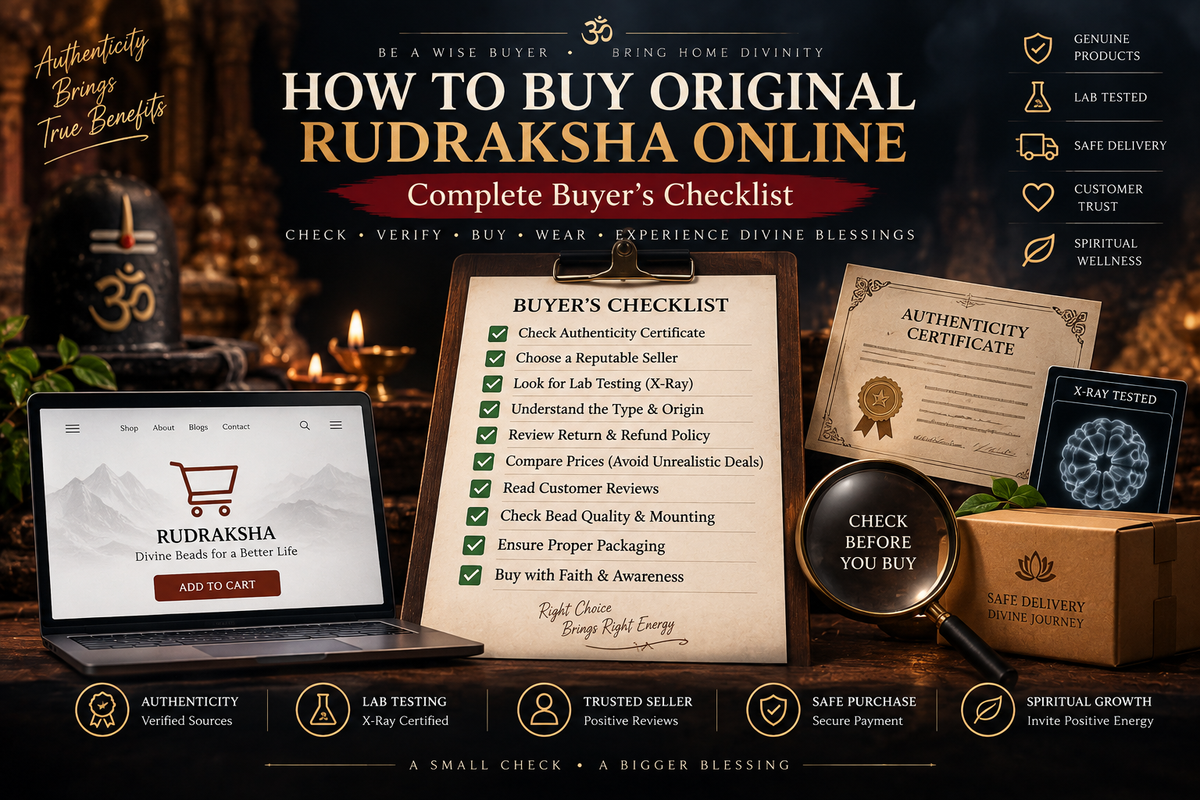
How to Buy Original Rudraksha Online – Complete Buyer’s Checklist
Buying Rudraksha online can be convenient, but it also removes one advantage you have in a physical store: you cannot hold the bead and inspect it before paying.
That makes clear product information and verification especially important.
To buy an original Rudraksha online, do not rely only on a beautiful photograph, a home test or the word “certified.” Look at the Mukhi, natural formation, origin, actual size, condition, photographs, laboratory report, seller information and return policy together.
A useful question to ask before buying is:
What evidence supports the claims being made about this particular Rudraksha?
If that answer is clear, you are already in a much better position to make an informed purchase.
Quick Checklist: What to Check Before Buying Rudraksha Online
Before placing an order, check whether:
-
The Mukhi is clearly stated
-
The origin is disclosed
-
Actual size or dimensions are provided
-
Natural variations are explained
-
Rare or individually priced pieces show the actual Rudraksha
-
Mukhi lines appear naturally formed
-
There are no obvious signs of carving, glue, filler or artificial joining
-
Independent laboratory certification is included or clearly explained
-
Certificate details can be matched to the bead where applicable
-
X-Ray availability and purpose are explained
-
Price makes sense for the Mukhi, origin, size and rarity
-
Seller contact and business information are visible
-
Shipping and return conditions are available before checkout
-
Medical, financial or other guaranteed outcomes are not being promised
If several of these details are missing, ask questions before paying.
For a deeper look at physical authenticity, read our Original Rudraksha Kaise Pehchane? Real vs Fake Guide.
1. Decide Which Rudraksha You Actually Need
Do this before comparing prices.
A common mistake is starting with questions such as:
“Which is the most powerful Rudraksha?”
That is rarely the most useful way to choose.
Different Mukhi and special Rudraksha formations have different traditional associations, physical characteristics and practical uses. A higher Mukhi number does not automatically make one Rudraksha right for everyone.
Consider:
-
Are you looking for general Shiva devotion?
-
Do you already have a specific Mukhi in mind?
-
Was a Rudraksha recommended in your spiritual tradition?
-
Do you want a single bead, bracelet or mala?
-
Is daily wearing comfort important?
-
Are you interested in a special formation such as Gauri Shankar or Ganesh Rudraksha?
-
What is your realistic budget?
If you are still deciding, our Rudraksha Benefits, Types & How to Choose guide gives a broader overview.
Choosing the category first also makes it easier to compare similar products instead of being persuaded into something more expensive simply because it is described as “stronger” or “more powerful.”
2. Understand What “Original Rudraksha” Really Means
The word original is used very loosely online.
For a buyer, it should mean more than simply confirming that the object came from a Rudraksha tree.
The characteristics being sold should also be genuine.
For example:
A natural 5 Mukhi Rudraksha with extra grooves manually carved into it should not be sold as a naturally formed higher Mukhi.
Two genuine Rudraksha beads glued together should not be represented as a naturally joined Gauri Shankar.
An Indonesian Rudraksha should not be sold as Nepali merely because Nepali origin may command a higher price.
So instead of asking only:
“Is this Rudraksha real?”
also ask:
“Are the Mukhi, formation, origin and other premium claims about this bead properly supported?”
That distinction is important when buying rare or higher-value Rudraksha.
3. Examine the Natural Mukhi Lines
Mukhi lines are one of the first features buyers notice.
They are the natural longitudinal divisions or grooves visible on the surface of a Rudraksha.
Be cautious if lines appear:
-
Freshly cut
-
Mechanically uniform
-
Unusually sharp compared with the surrounding surface
-
Different in texture from natural grooves
-
Interrupted unnaturally
-
Filled or reconstructed
At the same time, photographs have limits.
The goal is not to become an amateur laboratory examiner from one enlarged product photo. The goal is to recognise what deserves closer verification.
For valuable Rudraksha, physical examination and appropriate independent testing provide more useful information than visual guesswork alone.
4. Do Not Expect Factory-Perfect Shape
Rudraksha is a natural seed.
Genuine beads can differ in:
-
Shape
-
Size
-
Weight
-
Colour
-
Surface texture
-
Ridge development
-
Mukhi definition
-
Symmetry
A natural Rudraksha may be round, oval, flattened or irregular.
Perfect symmetry is not an authenticity requirement.
Natural variation is normal.
But the opposite is also important: an unusual-looking bead is not automatically rare or valuable simply because it looks different.
Unusual does not automatically mean rare, and rare does not automatically mean genuine.
5. Check Whether You Are Seeing the Actual Rudraksha
This becomes increasingly important as the price and rarity increase.
For common Rudraksha sold in graded batches, representative photography may sometimes be used as long as natural variation is clearly disclosed.
For an expensive, individually priced Rudraksha, actual-piece photographs are much more valuable.
Useful photographs may show:
-
Front view
-
Back view
-
Side views
-
Mukhi lines
-
Natural poles
-
Drill hole where relevant
-
Special projection or joined formation
-
Certificate where available
A polished lifestyle photograph can make a product look attractive.
It should not be the only photograph supporting a high-value natural-product claim.
6. Check the Actual Size, Not Only the Grade Name
Terms such as:
-
Regular
-
Medium
-
Large
-
Collector
-
Rare
are useful for organising products, but they are not one universal Rudraksha grading standard used identically by every seller.
If size affects the price, look for the measurement in millimetres.
This is especially important when paying a premium for an unusually large bead.
Our Rudraksha Size Guide explains why size, authenticity, rarity and spiritual significance should not be treated as the same thing.
7. Do Not Use Size Alone to Decide Origin
Nepali Rudraksha are generally known for being larger, heavier and more deeply textured, while Indonesian or Java Rudraksha are often smaller and finer in texture.
These are useful general tendencies.
They are not proof of geographical origin.
There can be overlap between natural specimens.
If origin is part of the reason for a higher price, the seller should disclose it instead of expecting the customer to infer origin from appearance alone.
Read our Nepali vs Indonesian Rudraksha guide before paying a premium based only on size or texture.
8. Bigger Does Not Automatically Mean Better
Size can affect:
-
Visual presence
-
Wearing comfort
-
Availability
-
Rarity within a comparable category
-
Price
Size alone does not establish:
-
Authenticity
-
Mukhi count
-
Origin
-
Quality
-
Spiritual effectiveness
A smaller properly identified and verified Rudraksha may be a better purchase than a much larger bead carrying unsupported claims.
If you want to understand why Nepali beads often appear larger, read Why Are Nepali Rudraksha Bigger?.
9. Look for Artificial Carving, Filling or Joining
This deserves particular attention with expensive Mukhi and special formations.
Check for signs such as:
-
Artificially cut grooves
-
Resin
-
Glue
-
Filled areas
-
Suspicious seams
-
Reconstructed surfaces
-
Attached material
-
Unusual modifications around drill holes
For special formations, verify the exact natural feature for which you are paying a premium.
Gauri Shankar Rudraksha
A genuine Gauri Shankar consists of two Rudraksha sections that developed naturally joined.
Two completed beads glued together do not become a genuine natural Gauri Shankar.
You can read the Gauri Shankar Rudraksha Complete Guide for a more detailed explanation.
Ganesh Rudraksha
Ganesh Rudraksha is recognised by a naturally developed trunk-like projection.
That projection should not be carved or artificially attached.
The wider buying principle is simple:
Verify the feature for which you are paying extra.
10. Do Not Rely on the Water Test
One of the most repeated claims about Rudraksha is:
“Put it in water. If it sinks, it is original.”
This should not be treated as conclusive proof.
Floating or sinking by itself cannot establish:
-
Natural Mukhi count
-
Origin
-
Whether grooves were carved
-
Whether two sections were artificially joined
-
Whether a special formation developed naturally
The same caution applies to popular home tests involving coins, milk or claims that a Rudraksha must rotate in a certain way.
Home observation can help you inspect a bead.
It should not be treated as a substitute for proper examination and documentation.
11. Understand the Laboratory Certificate
The word certified is useful only when you understand what was actually examined.
Depending on the laboratory and testing method, a Rudraksha report may include information such as:
-
Mukhi count
-
Dimensions
-
Weight
-
Shape
-
Natural surface observations
-
Origin statement
-
Photograph
-
Report number
-
Examination method
-
X-Ray findings where performed
Not every laboratory certificate contains every field, so check the scope of the report.
Match the Certificate to the Rudraksha
Where identifying information is available, compare the report with the actual bead.
Check:
-
Does the Mukhi match?
-
Does the photograph resemble the Rudraksha?
-
Do dimensions correspond?
-
Does the weight correspond where listed?
-
Is there a report number?
-
Is there a verification method?
A certificate is most useful when it can be connected to the Rudraksha being sold.
Check Who Issued It
Do not judge a laboratory report only by a decorative border, hologram or the word “certified.”
Look for:
-
Laboratory name
-
Report number
-
Identification details
-
Testing information
-
Verification instructions where available
Independent testing is useful because it adds information beyond the seller's own assertion.
12. Certificate and X-Ray Are Not the Same Thing
This distinction is important.
Laboratory Certificate
A laboratory certificate records observations made during examination.
Depending on the laboratory, it may document the Mukhi, dimensions, weight, surface characteristics and other identifying information.
X-Ray Examination
An X-Ray provides an internal view of the Rudraksha without cutting the bead open.
It may provide useful additional information for:
-
Rare Mukhi
-
Higher-value Rudraksha
-
Difficult-to-assess specimens
-
Cases where internal compartment structure is relevant
An X-Ray should support the wider assessment, not replace every other check.
External alteration, physical condition, origin, certificate matching and seller transparency still matter.
Mahadev Mala's current Certification & Authenticity process states that every Rudraksha product includes an independent laboratory certificate at no additional cost, while X-Ray verification is an optional paid add-on for eligible products.
13. Verify the Certificate Where Possible
If the laboratory provides an official verification method, use it.
A practical routine is:
-
Find the laboratory name.
-
Find the report or document number.
-
Scan the QR code or use the laboratory's official verification method where available.
-
Compare the result with the physical certificate.
-
Compare identifying details with the bead.
A report without online verification is not automatically false.
But you should still be able to understand who issued it and what was examined.
14. Understand Why Rudraksha Prices Vary
Rudraksha pricing does not depend on Mukhi count alone.
Price can vary because of:
-
Mukhi and natural availability
-
Origin
-
Size
-
Condition
-
Natural formation
-
Individual specimen quality
-
Market availability
-
Verification
-
Product format
-
Jewellery or craftsmanship
This creates two common mistakes.
“Expensive Means Original”
Not necessarily.
A high price can still be attached to a weak or unsupported claim.
“The Cheapest One Is the Smartest Deal”
Also not necessarily.
If a supposedly rare, large, certified Nepali Rudraksha is being sold far below comparable verified specimens, understand why before assuming you found a bargain.
A better sequence is:
Verify → Understand rarity → Compare condition and size → Evaluate price
For a detailed breakdown, read our Rudraksha Price Guide.
15. Check the Seller as Carefully as the Rudraksha
A good-looking bead on an anonymous website is still an anonymous purchase.
Before ordering, look for:
-
Business or brand identity
-
Working contact information
-
Email
-
Phone or WhatsApp where offered
-
Shipping information
-
Return and refund policy
-
Privacy and terms pages
-
Secure checkout
-
Consistent product information
-
Visible certification or authenticity process
No single website feature proves trustworthiness.
What matters is whether you can clearly understand who is selling, what is being sold and what happens if there is a problem.
16. Read the Return and Authenticity Policy Before Paying
Do this before checkout, particularly for an expensive Rudraksha.
Look for answers to questions such as:
-
How long do you have to raise a claim?
-
What happens if the wrong product arrives?
-
What happens if the bead arrives damaged?
-
How are authenticity disputes handled?
-
Does the certificate need to be returned?
-
Is an unboxing video required?
-
Who pays return shipping?
-
Does drilling, capping or modifying the bead affect return eligibility?
A strict return policy does not automatically mean a seller is unreliable.
A generous policy does not automatically prove authenticity either.
The important thing is that the conditions are clear before purchase.
17. Record an Unboxing Video for Valuable Orders
For a costly or individually identified Rudraksha, recording the unboxing is a practical precaution.
Record one continuous video showing:
-
Sealed package
-
Shipping label
-
Opening of the parcel
-
Rudraksha inside
-
Certificate
-
Visible condition
Do this before removing tags, changing the setting, drilling or otherwise modifying the product.
The video may help document transit damage, wrong-item delivery or a material difference between the ordered and received specimen.
18. Compare the Delivered Rudraksha With the Listing
Do not throw away the packaging immediately.
Check the received product against:
-
Mukhi
-
Shape
-
Size
-
Visible markings
-
Actual-piece photographs where applicable
-
Certificate photograph
-
Certificate number
-
Dimensions or weight where supplied
-
Origin claim
-
Included accessories
If something important does not match, contact the seller promptly and follow the published claim procedure.
19. Authentication and Energization Are Different
These terms answer different questions.
Authentication asks:
Is the physical Rudraksha and the claimed Mukhi or formation correctly identified?
Energization asks:
Has a spiritual or ritual process been performed according to a particular tradition?
A Rudraksha does not become physically authentic merely because it is described as energized.
Likewise, a laboratory report does not certify spiritual power.
A transparent seller should keep these ideas separate.
20. Be Careful With Guaranteed Results
Rudraksha is an article of faith and spiritual tradition.
Traditional associations may be explained responsibly.
Be cautious when a product promises that simply wearing a Rudraksha will:
-
Cure a disease
-
Guarantee pregnancy
-
Fix a marriage
-
Guarantee a job
-
Guarantee exam results
-
Double business income
-
Remove debt within a fixed period
-
Control another person's behaviour
Traditional belief and guaranteed outcome claims are not the same thing.
Good product information should help you understand the Rudraksha without using fear or unrealistic promises to force a purchase.
21. Choose a Format You Will Actually Use
Authenticity is important, but practical use matters too.
Single Rudraksha or Pendant
Suitable when you want one specific Mukhi or special formation.
Bracelet
Convenient for wrist wear, although size, fit, threading and bead arrangement should be considered.
Rudraksha Mala
Traditionally used for mantra japa. A japa mala commonly has 108 counting beads plus the Guru or Sumeru bead.
If you are unsure which format suits you, compare them in our Rudraksha Mala vs Bracelet vs Single Bead guide.
Buying the right format reduces the chance that an expensive Rudraksha remains unused simply because it is uncomfortable.
22. Understand Basic Rudraksha Care Before Buying
Rudraksha is a natural seed, not a maintenance-free stone or metal product.
Avoid unnecessary long-term exposure to:
-
Harsh soap
-
Shampoo
-
Perfume
-
Chemical cleaners
-
Chlorinated water
-
Very hot water
-
Prolonged dampness
-
Heavy impact
Our How to Clean & Maintain Rudraksha guide explains a simple cleaning and storage routine in detail.
Taking care of the bead matters particularly when you have paid a premium for an uncommon natural specimen.
Red Flags When Buying Rudraksha Online
One warning sign does not automatically prove fraud, but several together are a reason to slow down.
Be cautious if you see:
-
“100% original” without any explanation of verification
-
Rare Rudraksha shown only through generic photographs
-
No Mukhi information
-
No size information
-
No disclosed origin despite charging an origin premium
-
Certificate without a clearly identified issuer
-
Seller unwilling to explain testing
-
Water test presented as final proof
-
Artificially perfect rare formations
-
Visible glue or reconstruction
-
Huge discounts on supposedly extremely rare pieces without explanation
-
“Bigger means more powerful”
-
Guaranteed health, wealth, marriage or pregnancy claims
-
No visible return or authenticity policy
-
No meaningful business contact information
-
Pressure-based messages designed to force an immediate purchase
A spiritual purchase should not require panic buying.
A 60-Second Check Before You Pay
If you remember nothing else from this guide, use these ten questions:
-
Mukhi: What exactly am I buying?
-
Origin: Is Nepal, Indonesia, India or another origin clearly stated?
-
Actual bead: Am I seeing the exact rare specimen or a representative image?
-
Size: What are the measurements in millimetres?
-
Formation: Do the Mukhi lines or special features appear natural?
-
Certificate: Who issued it, and does it correspond to this bead?
-
X-Ray: Would additional internal examination be useful for this purchase?
-
Price: Does the premium make sense for the rarity, size, origin and condition?
-
Seller: Are contact information and policies clearly visible?
-
Claims: Am I buying a documented natural product—or being sold a guaranteed result?
If those answers are clear, you have much better information on which to base your decision.
How Mahadev Mala Approaches Online Rudraksha Buying
At Mahadev Mala, the buying process is built around making the physical product and verification process understandable.
The current Certification & Authenticity process covers natural sourcing, hand selection, quality inspection and independent laboratory certification.
Every Mahadev Mala Rudraksha product includes an independent laboratory certificate at no additional cost. Optional X-Ray verification is available as a paid add-on for eligible products when additional internal-structure examination is requested.
Our approach can be summarised as:
Natural Rudraksha → Clear Product Information → Independent Verification → Visible Policies → Responsible Claims
If you are ready to compare available Mukhi and size options, you can explore the Mahadev Mala Rudraksha collection. The current collection includes individual Rudraksha across multiple Mukhi and special formations.
Frequently Asked Questions
How can I buy an original Rudraksha online?
Choose the Mukhi first, inspect the natural formation and product information, check the origin and dimensions, review independent laboratory documentation, verify the seller and read the return policy before paying.
How do I know whether an online Rudraksha is original?
Look at the natural Mukhi structure, signs of alteration, actual-product photographs where relevant, origin, dimensions and independent laboratory documentation. No single home test should be treated as final proof.
Is a laboratory certificate enough?
A legitimate independent certificate is useful supporting evidence, but check what the laboratory examined and whether the report corresponds to the Rudraksha being purchased.
For selected high-value pieces, an X-Ray may provide additional information about internal structure.
How can I verify a Rudraksha certificate?
Check the laboratory name, report number, photograph, Mukhi and other identifying details. If an official QR code or report-verification facility is provided, use it and compare the result with the certificate and Rudraksha.
Is X-Ray necessary for every Rudraksha?
No.
Its usefulness depends on the bead and the level of verification required. It may be particularly useful as additional internal examination for rare, high-value or difficult-to-assess Rudraksha.
Can the water test prove a Rudraksha is original?
No. Floating or sinking alone cannot prove the natural Mukhi count, geographical origin, absence of alteration or authenticity of a special formation.
How can I identify fake Mukhi lines?
Artificially cut or mechanically uniform grooves may deserve closer examination, but one photograph is not enough for a definitive conclusion. Appropriate laboratory examination is more reliable than relying on one visual sign.
Should I buy Nepali or Indonesian Rudraksha?
Both can be genuine.
Nepali Rudraksha are generally larger and more deeply textured, while Indonesian or Java beads are generally smaller and lighter. Choose according to the Mukhi, verification, wearing preference and budget rather than assuming one origin is automatically superior.
Is a bigger Rudraksha better?
Not automatically.
Size may affect appearance, comfort, rarity and price, but it does not independently prove authenticity or greater spiritual effect.
Why are some Rudraksha expensive?
Natural availability, Mukhi, origin, size, condition, formation, market demand and verification can all affect price.
High price alone is not evidence of authenticity.
Should rare Rudraksha have actual product photographs?
For an expensive individually priced specimen, actual-piece photographs from useful angles are preferable to relying only on generic catalogue photographs.
What should I check when the order arrives?
Inspect the Rudraksha's condition and compare the Mukhi, specimen photographs where applicable, certificate, report number, dimensions and other identifying details with the listing.
For valuable orders, recording the unboxing is sensible.
Does “energized Rudraksha” mean it is authentic?
No.
Energization refers to spiritual practice. Authentication concerns the physical identity and characteristics of the Rudraksha. One does not prove the other.
Can a seller guarantee Rudraksha results?
A seller can explain traditional spiritual associations, but specific medical, financial, academic, relationship or other personal outcomes should not be guaranteed.
Final Buyer’s Rule
When buying Rudraksha online, do not stop at:
“Is this original?”
Ask a few more questions:
What is the Mukhi? What is the origin? What are the dimensions? Am I seeing the actual specimen? Is the formation natural? Who examined it? Does the certificate correspond to the bead? Is an X-Ray relevant? What happens if the delivered product does not match the listing?
A sound buying decision is built from several pieces of evidence rather than one dramatic test.
A simple sequence to remember is:
Choose → Inspect → Verify → Compare → Read the Policy → Then Buy
Rudraksha can hold deep spiritual meaning. Buying carefully does not reduce that faith—it simply helps you understand the natural product you are choosing.
Disclaimer: Rudraksha is a natural spiritual product and an article of faith within Hindu and Vedic traditions. Spiritual and astrological associations are based on traditional beliefs and are not scientifically proven. Rudraksha does not diagnose, treat, cure or prevent disease, and no specific medical, financial, academic, relationship or personal outcome is guaranteed. Laboratory reports and X-Ray examinations should be understood according to the scope and methods of the issuing laboratory.