Why Are Nepali Rudraksha Bigger?
Quick Answer
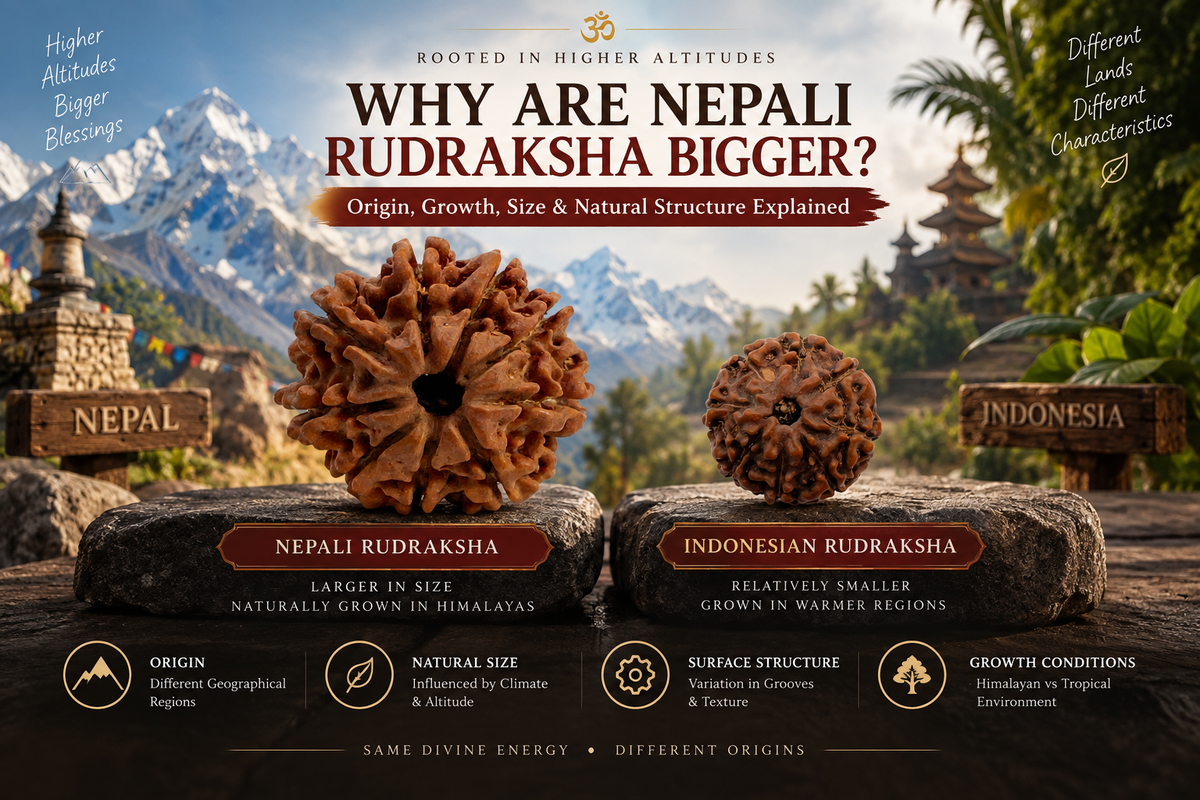
Nepali Rudraksha are generally bigger, heavier and more deeply textured than the smaller beads commonly sold as Indonesian or Java Rudraksha.
The difference is best understood as natural variation between growing populations, influenced by factors such as tree genetics, local growing conditions, fruit development, cultivation and selection over time.
It is often said that Nepali Rudraksha are bigger simply because they grow at a higher Himalayan altitude. That explanation is attractive, but the available botanical evidence does not support altitude as the single proven cause.
Size is also not a test of authenticity, spiritual power or quality.
Why Are Nepali Rudraksha Generally Bigger?
A Rudraksha bead is not manufactured to a fixed size. It develops naturally inside the fruit of the Rudraksha tree.
The part eventually cleaned and worn as Rudraksha is the hard, woody endocarp inside the fruit. Its final dimensions and surface formation can vary depending on the tree and the conditions in which the fruit develops.
In the Rudraksha trade, Nepali beads are commonly recognised for characteristics such as:
-
Larger overall dimensions
-
Greater weight
-
Deep natural grooves
-
Pronounced surface projections
-
Broad and clearly visible Mukhi lines
-
A substantial appearance when worn individually
Indonesian or Java Rudraksha commonly seen in the market tend to be smaller, lighter and smoother, with finer Mukhi lines.
These are general tendencies rather than fixed authenticity rules.
A smaller Nepali Rudraksha can exist, just as a comparatively larger Indonesian Rudraksha can exist.
For a broader comparison, read our Nepali vs Indonesian Rudraksha guide.
First, What Exactly Is the Rudraksha Bead?
Understanding the fruit makes the size difference easier to explain.
The blue outer fruit is not the bead that is eventually worn.
Inside it is a hard, highly lignified structure called the endocarp. After the fleshy portion of the fruit is removed and the inner structure is cleaned and prepared, this hard endocarp is what is commonly called Rudraksha.
Its ridges, grooves, Mukhi divisions, shape and dimensions develop naturally.
So when someone compares a 20 mm Nepali Rudraksha with a much smaller Java bead, they are comparing two naturally formed endocarps—not two products made to a standard specification.
Natural variation should therefore be expected.
Are Nepali Rudraksha Always Bigger Than Indonesian Rudraksha?
No.
Nepali Rudraksha are generally larger in commercial trade, but that should not be turned into an absolute rule.
Typical examples placed side by side often show an obvious difference. Nepali Rudraksha usually appear fuller, heavier and more rugged, while Java Rudraksha are usually more compact and finely textured.
But there can be exceptions.
Different Mukhi can also have different natural size ranges. This is why comparing an unrelated 5 Mukhi and 12 Mukhi only by diameter can be misleading.
The safer conclusion is:
Nepali Rudraksha are generally larger than the Indonesian or Java Rudraksha commonly encountered in the market, but size alone cannot prove geographical origin.
Is High Himalayan Altitude the Reason Nepali Rudraksha Are Bigger?
Not by itself.
You may often see claims such as:
“Nepali Rudraksha become bigger because they grow at high Himalayan altitude.”
The problem is that this turns a complex natural trait into a single-cause explanation.
Botanical references document Rudraksha in Nepal across elevations extending to around 1,400 metres, while research on Elaeocarpus ganitrus cultivation in Central Java has reported populations from lowlands up to around 1,300 metres.
The ranges therefore overlap considerably.
Altitude may form part of the growing environment of an individual tree, but the available evidence does not establish it as the sole explanation for the typical commercial size difference between Nepali and Java Rudraksha.
A more responsible explanation considers several interacting factors:
-
Variation between tree populations
-
Local climate
-
Soil and water conditions
-
Characteristics of individual trees
-
Fruit maturity and development
-
Cultivation and propagation
-
Sorting and selection after harvest
When research has not isolated one single factor, it is better not to present a popular theory as scientific fact.
Do Genetics and Growing Conditions Matter?
They may.
Fruit dimensions and morphology in plants can be influenced by inherited traits as well as the growing environment.
Geographically separated tree populations can develop recognisable physical tendencies over time. This may contribute to why traders and experienced buyers often recognise broad differences between Nepali and Java Rudraksha.
However, genetics should not be oversimplified either.
The botanical naming of Rudraksha has a complicated history. Elaeocarpus ganitrus and Elaeocarpus sphaericus have been treated synonymously in important botanical references.
For that reason, claims such as “Nepali and Indonesian Rudraksha are always completely different species” should be treated cautiously unless the actual botanical material has been properly identified.
For a buyer, clearly disclosed origin and the physical characteristics of the actual bead are more useful than simplified species claims.
Can Cultivation and Selection Affect the Sizes Seen in Shops?
Potentially, yes.
The Rudraksha reaching a retail store is not necessarily a perfectly random sample of every fruit produced by every tree.
Harvested beads may be:
-
Sorted by Mukhi
-
Separated by size
-
Graded by formation
-
Selected for appearance
-
Directed into different market categories
A particularly large and well-formed Nepali Rudraksha may enter a premium grade because buyers specifically value exceptional natural dimensions.
This means the appearance of Rudraksha in the marketplace can reflect both natural characteristics and commercial selection.
That is different from proving that selection itself causes the biological size difference.
Why Do Nepali Rudraksha Look More Deeply Textured?
Size is only part of their visual character.
Many Nepali Rudraksha show:
-
Deep longitudinal Mukhi lines
-
Pronounced ridges
-
Strong surface projections
-
Natural depressions
-
A rugged three-dimensional appearance
Java Rudraksha commonly have finer surface development and thinner Mukhi divisions.
This is one reason many buyers find Nepali beads easier to inspect visually.
But appearance still needs to be interpreted carefully.
Deep Mukhi lines do not automatically prove authenticity, and fine lines do not make a Java Rudraksha fake.
What Does Scientific Research Tell Us About Nepali Rudraksha Size?
There are useful measurements, although they should not be converted into universal size rules.
A Nepal forestry reference describes Elaeocarpus sphaericus—with E. ganitrus listed as a synonym—as producing spherical bluish-purple fruits approximately 18–25 mm in diameter.
A peer-reviewed materials study examined five-suture Elaeocarpus ganitrus endocarps collected from Gulmi, Nepal. The sample had an average endocarp diameter of approximately 20 ± 0.7 mm.
That gives us useful measured data from Nepali material.
It does not mean:
-
Every Nepali Rudraksha is around 20 mm
-
A 20 mm bead must come from Nepal
-
An Indonesian bead can never reach a similar size
-
Bigger Rudraksha have stronger spiritual effects
Scientific measurements are useful for understanding physical characteristics, not for creating new marketing claims.
Nepali vs Indonesian Rudraksha: Practical Size Difference
| Feature | Nepali Rudraksha | Indonesian / Java Rudraksha |
|---|---|---|
| Typical commercial size | Generally larger | Generally smaller |
| Weight | Usually heavier | Usually lighter |
| Surface | Deep, rugged texture | Finer, smoother appearance |
| Mukhi lines | Often broad and prominent | Often fine and shallow |
| Visual presence | Strong and noticeable | Compact and discreet |
| Single-bead pendant | Often well suited | Suitable for subtle wear |
| 108-bead mala | Can become large and heavy | Often lighter and more practical |
| Bracelet | Bold and substantial | Compact and comfortable |
| Authenticity | Size alone does not prove it | Small size does not make it fake |
These are practical tendencies, not rigid botanical laws.
Does Bigger Mean a Better Rudraksha?
No.
A bigger Rudraksha is first of all simply a bigger natural bead.
Within the same Mukhi and origin, unusually large specimens can sometimes be less commonly available and may therefore attract a premium.
But size should never be the only measure of quality.
Look at:
-
Natural Mukhi formation
-
Structural condition
-
Origin disclosure
-
Exact measurement
-
Natural shape
-
Surface integrity
-
Signs of artificial alteration
-
Appropriate verification
A damaged large bead is not automatically a better purchase than a smaller, naturally well-formed one.
Our Rudraksha Size Guide explains this in more detail.
Does Bigger Mean More Powerful?
There is no scientific evidence that increasing the diameter of a Rudraksha automatically increases a measurable spiritual effect.
This distinction is important because large Nepali Rudraksha can attract considerable attention and higher prices.
Traditional Rudraksha practices focus on factors such as the Mukhi, mantra, devotional use and spiritual tradition.
Size can influence:
-
Appearance
-
Rarity
-
Comfort
-
Weight
-
Price
It should not be turned into a guaranteed spiritual “power scale.”
A naturally unusual 25 mm bead may legitimately be more valuable as a rare physical specimen than a common 20 mm example.
That is different from promising stronger results simply because its diameter is larger.
Why Can Large Nepali Rudraksha Cost More?
Within the same Mukhi, origin and comparable condition, larger natural Nepali Rudraksha may sometimes command higher prices because exceptional sizes can be less commonly available and visually desirable.
But price depends on much more than size.
Other factors may include:
-
Mukhi
-
Natural rarity
-
Origin
-
Formation
-
Condition
-
Shape
-
Market availability
-
Verification
-
Demand
A large 5 Mukhi and a similar-sized 12 Mukhi should therefore not be expected to have the same market value.
Read our Rudraksha Price Guide for a fuller explanation.
Why Can the Same Mukhi Have Different Sizes?
Because Rudraksha is a natural product.
Two genuine Nepali 5 Mukhi Rudraksha do not have to look identical, even if they come from the same broad growing region.
Natural variation can affect:
-
Diameter
-
Height
-
Weight
-
Roundness
-
Ridge formation
-
Surface texture
-
Mukhi prominence
This variation is normal.
That is also why actual measurements are more useful than relying only on labels such as Regular, Medium, Large or Rare.
When shopping for an individually priced Rudraksha, check the measurement in millimetres whenever possible.
Is a 20 mm Nepali Rudraksha Considered Large?
It depends on the Mukhi.
There is no single diameter chart that should be applied equally to every Rudraksha.
A measurement that is substantial for one Mukhi may be relatively ordinary for another.
Different Mukhi can have different natural and commercial size distributions.
So size grading should ideally compare the same Mukhi and the same origin, rather than treating every Rudraksha as one category.
Can Size Tell You Whether a Rudraksha Is Nepali?
No.
Diameter can provide context, but it cannot establish geographical origin by itself.
A large bead should not automatically be labelled Nepali, and a small bead should not automatically be labelled Indonesian.
When buying online, consider the complete picture:
-
Seller's origin disclosure
-
Exact measurements
-
Clear photographs
-
Natural Mukhi formation
-
Physical condition
-
Certification information
-
Available laboratory observations
Do not buy an expensive Rudraksha simply because a ruler has been placed beside it and the listing calls it “original Nepal.”
Can Size Prove a Rudraksha Is Genuine?
No.
Size does not establish:
-
Whether the Mukhi are naturally formed
-
Internal structure
-
Absence of artificial carving
-
Geographical origin
-
Botanical identity
For higher-value Rudraksha, appropriate verification is more meaningful than size-based assumptions.
Our Rudraksha Certificate vs X-Ray Guide explains what these examinations can—and cannot—tell you.
Nepali or Java Rudraksha for a Mala?
The better physical format depends on how the Rudraksha will be used.
For a full 108-bead japa mala, smaller Java Rudraksha can be particularly practical because the finished mala remains lighter and easier to move through the fingers during japa.
Large Nepali beads can make a full mala noticeably longer and heavier.
Nepali Rudraksha may be particularly suitable when you want:
-
A prominent individual bead
-
A single-bead pendant
-
A bold bracelet
-
A selected feature bead
-
A collectible natural specimen
Java Rudraksha can be useful when you prefer:
-
Lightweight malas
-
Comfortable japa
-
Compact bracelets
-
Discreet daily wear
-
Multi-bead combinations
Smaller does not mean inferior. It simply creates a different physical experience.
What Should You Check Before Paying More for a Large Nepali Rudraksha?
If size is increasing the price, check exactly what you are paying for.
1. Exact Size
“Large” is a grading term.
A millimetre measurement gives you an actual physical reference.
2. Mukhi
Always judge size relative to the same Mukhi whenever possible.
3. Actual-Bead Photographs
For rare or individually priced pieces, photographs of the actual Rudraksha being purchased are more useful than generic catalogue images.
4. Natural Condition
Check for significant cracks, damage, filling or suspicious alteration.
5. Origin Disclosure
The listing should clearly state how the bead is being represented.
6. Verification
For valuable Mukhi, independent examination can provide more meaningful information than visual size alone.
7. Comfort
An exceptional size is not necessarily useful if the bead becomes uncomfortable for the way you intend to wear it.
Should You Buy the Biggest Rudraksha You Can Afford?
Not automatically.
Choose according to your intended use.
If you collect unusually large natural Rudraksha, an exceptional size may be exactly what you want.
If your priority is comfortable everyday wear, a moderate size may make more sense.
For a full japa mala, smaller beads may be easier to handle.
And if you are selecting Rudraksha according to traditional Mukhi associations, choose the appropriate Mukhi first rather than allowing diameter to make the entire decision.
If you are unsure about the different Mukhi, our 1 to 14 Mukhi Rudraksha Guide is a useful place to start.
Mahadev Mala's Approach to Rudraksha Size
At Mahadev Mala, we treat size as a physical characteristic, not as a shortcut for exaggerated spiritual claims.
A natural Nepali Rudraksha may be desirable for its prominent structure, visible Mukhi lines, individual formation, size and relative rarity.
But size should always be considered together with:
Mukhi + Origin + Exact Size + Natural Condition + Verification + Intended Use
For Rudraksha products supplied with laboratory verification, the certificate provides information relevant to the scope of that examination. X-Ray examination may also be available for eligible products when additional internal-structure verification is requested.
This gives a buyer more useful information than simply being told that a bead is “big and powerful.”
Common Myths About Large Nepali Rudraksha
Myth: Himalayan altitude is the only reason Nepali Rudraksha are bigger
Reality: Available evidence does not establish altitude as the sole cause. Natural population variation, growing conditions, fruit development, cultivation and selection may all contribute.
Myth: Every Nepali Rudraksha is bigger than every Indonesian Rudraksha
Reality: Nepali material is generally larger in commercial trade, but natural exceptions can occur.
Myth: Large size proves Nepal origin
Reality: Diameter alone cannot establish geographical origin.
Myth: Bigger means more powerful
Reality: There is no scientific evidence showing that spiritual effectiveness increases according to bead diameter.
Myth: Small Java Rudraksha are fake
Reality: Small size is a common physical characteristic of Java Rudraksha and is not, by itself, evidence of inauthenticity.
Myth: The largest grade is always the best purchase
Reality: Mukhi, natural formation, condition, comfort, verification and intended use can matter more than maximum diameter.
Frequently Asked Questions
Why are Nepali Rudraksha bigger than Indonesian Rudraksha?
Nepali Rudraksha are generally associated with naturally larger and more deeply textured endocarps than the compact Java Rudraksha commonly seen in trade. Differences between growing populations, local environment, fruit development, cultivation and selection may all contribute. Current evidence does not establish altitude alone as the cause.
Are Nepali Rudraksha naturally bigger?
Generally, Nepali Rudraksha seen in commercial trade are larger and more prominently textured. Individual variation still occurs.
Are Nepali Rudraksha bigger because they grow in the Himalayas?
That explanation is too simple. Rudraksha populations in Nepal and Central Java have been documented across partly overlapping altitude ranges, so altitude cannot reasonably be treated as the sole explanation.
What is the average size of Nepali Rudraksha?
There is no single average that applies to every Mukhi. A scientific study of five-suture endocarps collected in Gulmi, Nepal reported an average diameter of approximately 20 mm, while a Nepal forestry reference describes Rudraksha fruits approximately 18–25 mm in diameter. Different Mukhi and individual beads can vary considerably.
Is a bigger Rudraksha better?
Not automatically. Larger natural specimens can sometimes be rarer or visually more prominent, but Mukhi formation, condition, origin disclosure, comfort and verification also matter.
Is a bigger Rudraksha more powerful?
There is no scientific evidence demonstrating that increasing the diameter of a Rudraksha automatically increases spiritual effects.
Can a small Rudraksha come from Nepal?
Yes. Natural variation exists. Size alone cannot prove or disprove Nepal origin.
Can a larger Rudraksha be Indonesian?
Comparatively large Indonesian beads can occur. Origin should not be assigned solely from diameter.
Why are large Nepali Rudraksha more expensive?
Within the same Mukhi and comparable condition, unusually large natural pieces may be less commonly available and can attract greater demand. Mukhi rarity, formation, condition, origin, verification and market availability also influence price.
Which is better for a 108-bead mala: Nepali or Indonesian Rudraksha?
For a lightweight 108-bead japa mala, smaller Indonesian Rudraksha are often physically more practical. Nepali beads can also be used, but larger sizes create a heavier and more substantial mala.
Final Answer: Why Are Nepali Rudraksha Bigger?
Nepali Rudraksha are generally bigger, heavier and more deeply textured than the compact Java Rudraksha commonly encountered in the market.
The difference should not, however, be reduced to one convenient explanation such as “high Himalayan altitude.”
The more responsible interpretation is that the physical characteristics reflect natural variation between growing populations together with genetics, local environment, fruit development, cultivation and possible commercial selection.
And bigger does not automatically mean better.
A large Nepali Rudraksha may be visually striking and comparatively unusual within its Mukhi. A smaller Java Rudraksha may be ideal for a comfortable 108-bead japa mala.
When comparing Rudraksha, focus on what can actually be evaluated:
Mukhi → Origin → Exact Size → Natural Formation → Condition → Verification → Intended Use
That tells you far more about a bead than size alone.
Editorial Note: Prepared and reviewed by Mahadev Mala based on traditional Rudraksha practices, botanical references and published research. Scientific references in this article are used only for botanical and physical characteristics; spiritual associations belong to traditional belief and practice.
Disclaimer: Rudraksha is a natural spiritual product and an article of faith within Hindu and Vedic traditions. Spiritual and astrological associations described in this article are based on traditional beliefs and are not scientifically proven. Rudraksha does not diagnose, treat, cure or prevent disease, and no medical, financial, academic, relationship or personal result is guaranteed. Laboratory reports and X-Ray examinations should be understood according to the scope and methods of the issuing laboratory.