Garbha Gauri Rudraksha Complete Guide
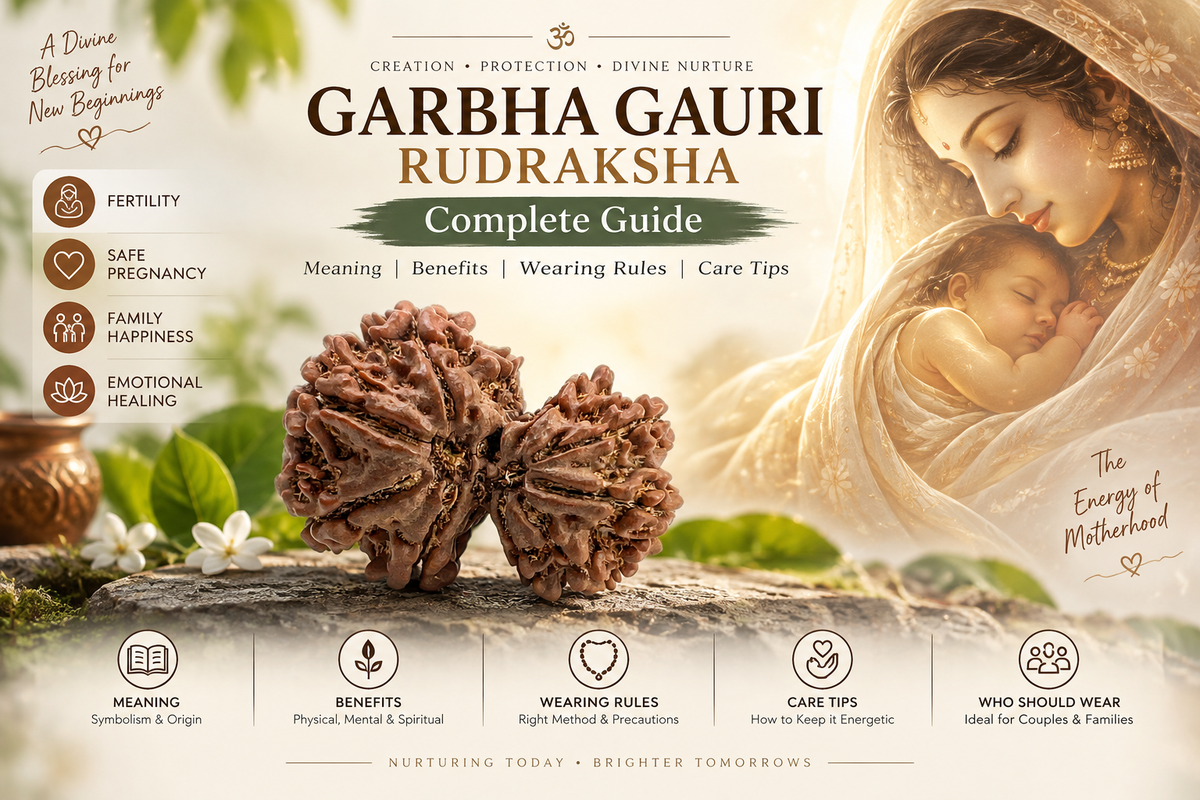
Garbha Gauri Rudraksha, also commonly written as Garbh Gauri Rudraksha, is a rare natural joined Rudraksha formation in which one section is noticeably larger and the other smaller.
In devotional tradition, the larger section represents Goddess Gauri or Parvati, while the smaller section represents the child, commonly Lord Ganesha. This distinctive formation gives Garbha Gauri its traditional association with motherhood, nurturing, the parent–child bond, family affection and devotion to Gauri and Ganesha.
The most important point when identifying Garbha Gauri is simple: the two sections should be naturally joined. Two separate Rudraksha beads that have been glued or artificially attached do not become a genuine Garbha Gauri.
Its spiritual meaning can be deeply personal, particularly for people praying around parenthood or family life. At the same time, traditional spiritual use should remain separate from medical claims. Garbha Gauri is not a fertility or pregnancy treatment and should not be presented as one.
If you are new to Rudraksha and want to understand Mukhi types, natural formations and how different Rudraksha are traditionally chosen, start with our Rudraksha Benefits, Types & How to Choose guide.
What Is Garbha Gauri Rudraksha?
Garbha Gauri is a special natural Rudraksha formation made up of two connected sections with a visible difference in size.
The larger portion is traditionally understood as Gauri or Goddess Parvati, while the smaller portion represents the child, most commonly Lord Ganesha.
This unequal mother-and-child appearance is one of its defining characteristics.
Unlike classifications such as 5 Mukhi, 7 Mukhi or 8 Mukhi, the term Garbha Gauri describes the natural formation of the Rudraksha rather than one fixed Mukhi count.
The actual Mukhi structure can vary from one natural piece to another.
Garbh Gauri or Garbha Gauri: Which Name Is Correct?
Both names are commonly used:
-
Garbh Gauri Rudraksha
-
Garbha Gauri Rudraksha
They generally refer to the same natural formation.
The Sanskrit word garbha is associated with the womb, embryo or something contained within. In everyday Hindi and Rudraksha usage, the shorter form Garbh Gauri is also widely used.
For practical purposes, both names can be understood as referring to the same special Rudraksha formation.
What Does Garbha Gauri Rudraksha Represent?
The central symbolism of Garbha Gauri is the relationship between a mother and child.
The larger section is associated with Mother Gauri or Parvati, while the smaller natural section represents the child.
Because of this, devotees commonly connect Garbha Gauri with:
-
Motherhood
-
Nurturing
-
Parent–child affection
-
Family bonds
-
Compassion
-
Patience and care
-
Prayer for children
-
Devotion to Goddess Parvati
-
Gauri–Ganesha worship
-
Family harmony
For many people, its importance comes as much from this symbolism as from the rarity of the physical formation itself.
Is Garbha Gauri Mentioned in Ancient Rudraksha Scriptures?
This question needs some care.
Classical Rudraksha traditions contain extensive descriptions of Mukhi-based Rudraksha. Special natural Rudraksha formations are also recognised in later and contemporary devotional practice.
However, there is no need to attribute every modern claim surrounding Garbha Gauri—particularly fertility, pregnancy or astrological claims—to ancient scripture without clear textual support.
A more accurate way to understand it is:
Garbha Gauri is a traditional special Rudraksha formation whose larger and smaller naturally joined sections are devotionally interpreted as Gauri and child.
This preserves its spiritual meaning without attaching unsupported claims to scripture.
Garbha Gauri vs Gauri Shankar Rudraksha
These two Rudraksha formations are often confused because both involve naturally joined sections.
The main difference is their proportion and symbolism.
| Feature | Garbha Gauri Rudraksha | Gauri Shankar Rudraksha |
|---|---|---|
| Natural structure | One clearly larger and one smaller joined section | Two naturally joined Rudraksha forming a pair |
| Traditional symbolism | Mother and child | Shiva and Parvati |
| Main devotional theme | Motherhood, nurturing and parent–child bond | Partnership, union and marital harmony |
| Common representation | Gauri with child, commonly Ganesha | Gauri and Shankar |
| Main authenticity concern | Large and small sections must be naturally joined | Both sections must be naturally joined |
A simple way to remember the distinction is:
Gauri Shankar → Shiva–Parvati union
Garbha Gauri → Mother and child
They should not be treated as two names for the same formation.
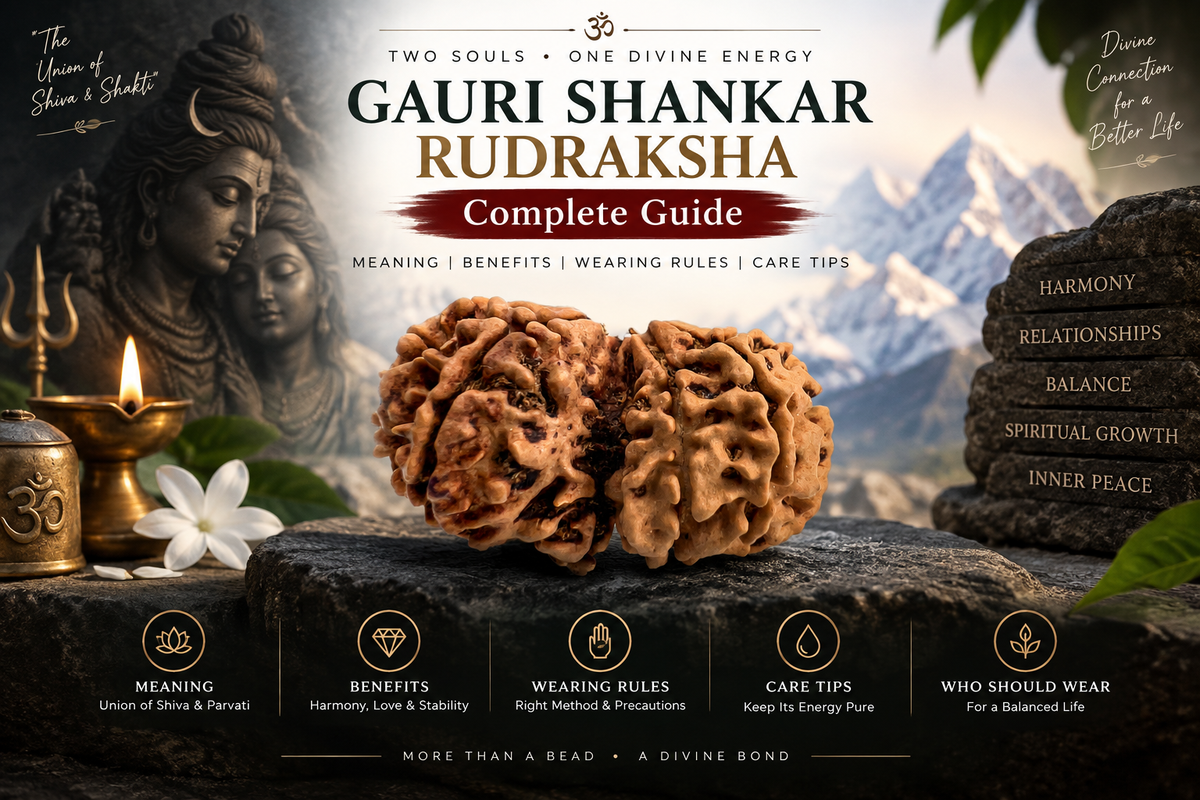
For a closer look at the twin formation, symbolism and authenticity checks, read our Gauri Shankar Rudraksha Complete Guide.
Garbha Gauri vs Ganesh Rudraksha
Garbha Gauri and Ganesh Rudraksha are also different.
| Feature | Garbha Gauri | Ganesh Rudraksha |
|---|---|---|
| Defining feature | Larger and smaller Rudraksha sections naturally joined | Natural protrusion resembling Ganesha's trunk |
| Traditional symbolism | Mother and child | Lord Ganesha |
| Main theme | Motherhood, nurturing and family bond | Wisdom, beginnings and overcoming obstacles |
| Formation | Joined formation | Natural projection on a Rudraksha |
| Mukhi count | Can vary | Can vary |
The smaller section of Garbha Gauri may traditionally represent Lord Ganesha, but that does not make the bead a Ganesh Rudraksha.
A Ganesh Rudraksha is recognised by its own naturally developed trunk-like projection.
Traditional Benefits and Spiritual Significance of Garbha Gauri Rudraksha
The benefits associated with Garbha Gauri belong to spiritual and devotional tradition rather than scientifically proven medical effects.
Mother–Child Bond
This is its strongest traditional association.
Its larger-and-smaller natural formation is seen as a sacred representation of mother and child and is commonly associated with affection, patience, nurturing and emotional connection within the family.
Motherhood and Nurturing
Garbha Gauri is closely connected with the nurturing aspect of Goddess Parvati.
Some devotees choose it during a stage of life when motherhood, parenting or family responsibilities hold particular spiritual meaning.
Prayer for Parenthood
Couples wishing to become parents sometimes include Garbha Gauri in prayer or devotional practice.
Its role here should be understood spiritually—as an object of prayer, intention and devotion rather than as a fertility treatment.
Family Harmony
The symbolism of Garbha Gauri extends beyond pregnancy or motherhood.
Parents and families may keep or wear it while praying for affection, patience, understanding and harmony at home.
Gauri and Ganesha Devotion
Someone does not need to be trying for a child to wear Garbha Gauri.
It may simply hold spiritual meaning for a devotee of Goddess Parvati or Lord Ganesha.
Compassion and Responsibility
The mother-and-child symbolism can also serve as a reminder of qualities such as:
-
Patience
-
Compassion
-
Protection
-
Responsibility
-
Care for others
These qualities make its symbolism relevant beyond parenthood alone.
Garbha Gauri, Fertility and Pregnancy
Because Garbha Gauri is associated with motherhood, it is often searched online in connection with fertility, conception and pregnancy.
Traditionally, some devotees include it in prayers concerning children and parenthood.
That spiritual practice can be meaningful, but it is important to distinguish it from medical treatment.
There is no scientific evidence that wearing Garbha Gauri can:
-
Cure infertility
-
Guarantee conception
-
Prevent miscarriage
-
Guarantee a healthy pregnancy
-
Replace fertility or pregnancy care
A person may choose prayer and spiritual practice alongside appropriate medical care; the two serve different purposes.
Can Garbha Gauri Be Worn During Pregnancy?
Some women choose to wear or keep Garbha Gauri during pregnancy because of its maternal symbolism.
There is no universal requirement that it must be worn directly on the body.
If a piece is large, heavy or uncomfortable, it may also be kept respectfully in a puja space and included in regular prayer.
Its devotional meaning does not depend on wearing it continuously.
Who Can Wear Garbha Gauri Rudraksha?
Although strongly associated with motherhood, Garbha Gauri is not exclusively for pregnant women.
It may be chosen by:
-
Mothers
-
Fathers
-
Parents
-
Couples praying for parenthood
-
Women devoted to Goddess Gauri
-
Men devoted to Gauri and Ganesha
-
Families
-
People who connect with its nurturing symbolism
Can Unmarried Women Wear Garbha Gauri?
Yes.
There is no universal rule that an unmarried woman cannot wear Garbha Gauri.
She may choose it for Goddess Parvati devotion, future family intentions, nurturing symbolism or simply because the formation holds spiritual meaning for her.
If a particular guru, family or sampradaya follows a different custom, that tradition can be respected.
For a broader discussion of traditional practices concerning women and Rudraksha, read Can Women Wear Rudraksha? Rules, Myths & Traditions.
Can Men Wear Garbha Gauri?
Yes.
The maternal symbolism of Garbha Gauri does not make it exclusively a women's Rudraksha.
A father, prospective parent or Gauri–Ganesha devotee may connect with its symbolism just as sincerely.
Which Deity Is Associated With Garbha Gauri?
The most common devotional interpretation is:
Larger section → Goddess Gauri or Parvati
Smaller section → Child, commonly Lord Ganesha
This is also why names such as Gauri Ganesh Rudraksha may sometimes be encountered.
Because terminology can vary between sellers and traditions, the actual natural formation should always be described clearly rather than relying on the product name alone.
Which Planet Rules Garbha Gauri Rudraksha?
There is no consistently agreed planetary association for Garbha Gauri across modern Rudraksha traditions.
Different sources assign different planets, so it is better not to present one planetary ruler as a universal fact.
Garbha Gauri is more clearly understood through its natural formation and devotional association with Gauri and child.
If it is being considered specifically as a Jyotish remedy, follow the system used by the astrologer or tradition you trust.
What Is the Mantra for Garbha Gauri Rudraksha?
Mantra recommendations can vary.
One commonly used devotional mantra is:
ॐ श्री गौरी गणेशाय नमः
Om Shri Gauri Ganeshaya Namah
A simple Shiva mantra may also be used:
ॐ नमः शिवाय
Om Namah Shivaya
If your guru, family or spiritual tradition follows a specific mantra, that practice can take priority.
How to Wear Garbha Gauri Rudraksha
There is no need to make the first-wearing process unnecessarily complicated.
A simple devotional method is enough.
1. Choose a Peaceful Time
Monday is commonly chosen for Rudraksha and Shiva–Parvati-centred practice.
A festival day, puja day or another spiritually meaningful time may also be chosen.
2. Clean the Rudraksha Gently
If cleaning is required, use clean water and handle the natural joint carefully.
Avoid harsh chemicals, detergents or perfume.
3. Place It in Your Puja Space
Keep the Rudraksha on a clean cloth or puja plate.
Offer your prayer to Goddess Gauri and Lord Ganesha according to your tradition.
4. Chant the Mantra
You may chant:
Om Shri Gauri Ganeshaya Namah
or
Om Namah Shivaya
5. Wear or Keep It Respectfully
Garbha Gauri may be worn as a pendant or kept in a clean puja space.
For general day-to-day practices, bathing, sleeping and care questions, see our Rudraksha Wearing Rules: Do's & Don'ts for Daily Wear.
Where Should Garbha Gauri Be Worn?
Because Garbha Gauri has an irregular joined shape, a single pendant is often more practical than forcing it into a tight bracelet or uniform mala.
A good setting should:
-
Support the Rudraksha without crushing it
-
Avoid excessive pressure on the natural joint
-
Keep the formation reasonably visible
-
Protect vulnerable drill holes or projections
Large, delicate or valuable pieces can also be kept in a home temple rather than worn every day.
Can Garbha Gauri Be Kept in the Puja Room?
Yes.
For rare or delicate pieces, this may actually be the more practical option.
A Rudraksha does not need to be worn continuously to remain meaningful in personal devotional practice.
Garbha Gauri may be kept respectfully in a clean puja space and included in Gauri, Shiva or Ganesha worship.
How to Identify an Original Garbha Gauri Rudraksha
When examining Garbha Gauri, the most important question is:
Did the larger and smaller sections develop together naturally?
Examine the Natural Join
The connection between the sections should appear organic rather than assembled.
Be cautious if you notice:
-
Glue
-
Resin
-
Filler material
-
An unnatural straight seam
-
A visible artificial gap
-
Excessive smoothing
-
Signs that two completed beads were attached later
Two genuine Rudraksha beads do not become a genuine Garbha Gauri simply because they have been joined artificially.
Look at the Size Difference
Garbha Gauri is traditionally recognised by its larger-and-smaller mother-and-child appearance.
If both sections form a relatively balanced pair, the piece may fit the description of Gauri Shankar more closely.
Natural Rudraksha vary, so this should not be reduced to a rigid mathematical ratio.
Check Surface Continuity
The surface around the junction should look naturally developed.
A genuine formation does not need to be perfectly symmetrical. Natural irregularity is expected.
Examine the Mukhi Structure
A special Rudraksha formation still has natural Mukhi morphology.
The seller should be able to describe the actual Rudraksha rather than relying only on the name “Garbha Gauri.”
Do Not Depend on the Water Test
Floating or sinking does not prove that the two Rudraksha sections developed together naturally.
For a rare formation, physical examination and appropriate verification are far more useful than popular home tests.
For more detailed authenticity checks and common fake-test myths, read Original Rudraksha Kaise Pehchane? Real vs Fake Guide.
Can X-Ray Verify Garbha Gauri?
X-Ray can provide additional information about the internal structure of a high-value joined Rudraksha.
However, it should not be treated as a single test that proves every claim about a Rudraksha.
For Garbha Gauri, verification may involve a combination of:
-
External morphological examination
-
Examination of the natural junction
-
Mukhi assessment
-
Condition assessment
-
Laboratory observations
-
X-Ray or other imaging where appropriate
A certificate and an X-Ray can answer different questions, so buyers should understand exactly what each report has examined.
You can review the Mahadev Mala Certification & Authenticity process for more information on laboratory examination and optional X-Ray verification.
Is a Lab Certificate Important?
For a rare or expensive Garbha Gauri, independent verification is sensible.
A useful report should give meaningful information about the bead instead of simply repeating the seller's product name.
When considering a Garbha Gauri online, look for transparency around:
-
Natural formation
-
Mukhi structure
-
Origin
-
Size
-
Condition
-
Actual photographs
-
Verification method
For higher-value Rudraksha, these details are often more useful than a dramatic authenticity claim alone.
Nepali vs Indonesian Garbha Gauri Rudraksha
Garbha Gauri formations can occur in Rudraksha from different origins.
Broadly, Nepali Rudraksha tend to be:
-
Larger
-
Heavier
-
More deeply textured
-
More visually prominent
Indonesian or Java Rudraksha tend to be:
-
Smaller
-
Lighter
-
Finer in texture
-
More compact for wearing
These are general tendencies, not authentication rules.
A small Indonesian Garbha Gauri may still be completely natural, while a large Nepali-looking joined bead could still have been artificially assembled.
Origin and authenticity should therefore be evaluated separately.
For a fuller comparison of appearance, size and practical use, read Nepali vs Indonesian Rudraksha: Differences & Which to Choose.
Does Garbha Gauri Have a Fixed Size?
No.
Its size depends on factors such as:
-
Origin
-
Underlying Rudraksha
-
Development of each section
-
Natural shape
-
Overall formation
Joined Rudraksha can also be harder to describe using one simple diameter.
For a serious purchase, actual measurements are more useful than broad terms such as Regular, Medium, Large, Rare or Collector.
Our Rudraksha Size Guide: Does Size Really Matter? explains why size should be understood in context rather than treated as a measure of spiritual quality.
Is a Bigger Garbha Gauri More Powerful?
There is no scientific evidence that a larger Garbha Gauri has greater spiritual power.
A large and well-developed natural formation may be rarer and therefore more expensive, but rarity and spiritual potency are not the same thing.
A better way to choose is to consider:
-
Natural formation
-
Authenticity
-
Condition
-
Devotional relevance
-
Practical comfort
-
Verification
Why Is Garbha Gauri Rudraksha Expensive?
Its price may depend on several factors:
-
Rarity of the natural joined formation
-
Clarity of the large–small proportion
-
Origin
-
Mukhi structure
-
Overall size
-
Condition
-
Visual quality
-
Market availability
-
Independent verification
A particularly clean and naturally developed formation may command a premium.
However, price alone is never proof of authenticity.
For a detailed explanation of why apparently similar Rudraksha can have very different prices, read our Rudraksha Price Guide: Why Do Rudraksha Prices Vary?
Garbha Gauri or Gauri Shankar: Which Should You Choose?
The two formations represent different devotional themes rather than different levels of spiritual “power.”
Gauri Shankar is traditionally associated with Shiva–Parvati union, partnership and marital harmony.
Garbha Gauri is associated more closely with motherhood, nurturing, parent–child affection and Gauri-and-child symbolism.
The more useful question is therefore not which is stronger, but which symbolism connects more naturally with your spiritual intention.
Can Garbha Gauri Be Worn With Other Rudraksha?
Many devotees wear more than one Rudraksha.
There is no need to assume that Garbha Gauri automatically conflicts with another Mukhi.
However, if you are following a specific guru-prescribed or astrological combination, it is better to follow that system consistently rather than continually adding Rudraksha based on different online lists.
More Rudraksha does not automatically mean greater benefit.
Daily Wear and Care
Because Garbha Gauri consists of naturally joined sections, a little extra care around the junction is sensible.
Can You Wear It Every Day?
Yes, provided the formation is comfortable and adequately protected.
Avoid:
-
Heavy impact
-
Repeated pulling
-
Excessive pressure from metal fittings
-
Harsh chemicals
-
Prolonged dampness
-
Rough cleaning
A secure pendant setting is often more practical than a tightly compressed design.
Can Garbha Gauri Get Wet?
Brief contact with clean water is different from repeatedly soaking a natural seed.
Avoid unnecessary exposure to:
-
Soap
-
Shampoo
-
Chlorinated swimming-pool water
-
Perfume
-
Harsh cleaners
-
Very hot water
If it becomes wet, allow it to dry properly before storing or wearing it again.
How Should It Be Cleaned?
Use a conservative cleaning method:
-
Use clean lukewarm water only when necessary.
-
Gently clean grooves with a soft brush.
-
Do not bend or force the joined sections.
-
Avoid harsh soap and chemical cleaners.
-
Allow the Rudraksha to dry completely in a shaded, ventilated area.
-
Inspect the junction, drill holes and setting before wearing it again.
For detailed cleaning and storage guidance, read How to Clean & Maintain Rudraksha: Complete Care Guide.
Can You Sleep Wearing Garbha Gauri?
You can, but practicality matters.
An irregular joined formation can experience pressure when you move during sleep.
If the Rudraksha is large, valuable or mounted in a rigid pendant, removing it respectfully before sleeping can reduce unnecessary stress on the natural joint.
How Long Does Garbha Gauri Last?
A natural Rudraksha does not have a fixed retail expiry date.
With appropriate care, it can last for many years.
Pay particular attention to:
-
The natural junction
-
Drill holes
-
Thread
-
Metal fittings
-
Deep cracks
-
Repeated moisture exposure
Often, a thread or pendant setting needs maintenance before the natural Rudraksha itself does.
What Should You Check Before Buying Garbha Gauri Online?
Rare Rudraksha should not be purchased only because of a dramatic product name.
Before buying, check the following.
Is the Join Natural?
This is the first and most important question.
Is One Section Clearly Smaller?
The characteristic difference in proportion helps distinguish Garbha Gauri from a more balanced Gauri Shankar formation.
Are You Seeing the Actual Piece?
For rare, individually priced Rudraksha, clear photographs from multiple angles are valuable.
What Is the Origin?
Check whether the piece is represented as Nepali, Indonesian or another origin.
What Are the Actual Dimensions?
Ask for real measurements instead of relying entirely on broad size grades.
What Is the Mukhi Structure?
A special natural formation should still be properly described.
What Verification Is Included?
Understand exactly what the laboratory or imaging report has examined.
Are Unrealistic Results Being Promised?
Guaranteed pregnancy, miscarriage prevention or similar medical promises should be treated with caution.
The spiritual importance of a Rudraksha does not depend on guaranteed medical outcomes.
Mahadev Mala's Approach to Garbha Gauri Rudraksha
For a special formation such as Garbha Gauri, we believe the bead should first be understood through characteristics that can actually be examined:
Natural Joined Formation → Large–Small Proportion → Mukhi Structure → Origin → Size → Condition → Verification → Intended Use
Its traditional mother-and-child symbolism can then be explained respectfully without turning devotional belief into an unrealistic guarantee.
Mahadev Mala Rudraksha products are supplied with an independent laboratory certificate for authenticity and Mukhi verification where applicable.
Optional X-Ray examination is also available for eligible Rudraksha products when additional internal-structure verification is requested.
You can review our Certification & Authenticity process before purchasing.
For a rare Rudraksha like Garbha Gauri, understanding the formation and verification matters more than dramatic claims.
Common Myths About Garbha Gauri Rudraksha
Myth: Garbha Gauri and Gauri Shankar Are the Same
Reality: Both are naturally joined formations, but Garbha Gauri is distinguished by its larger-and-smaller mother-and-child appearance and symbolism.
Myth: Garbha Gauri Guarantees Pregnancy
Reality: It is used by some devotees in prayers concerning parenthood, but it is not a fertility treatment and cannot guarantee conception.
Myth: Only Women Can Wear It
Reality: Men may also wear or keep Garbha Gauri according to their devotional practice.
Myth: Only Pregnant Women Should Wear It
Reality: Its symbolism is broader than pregnancy and includes nurturing, family bonds, parenthood and Gauri–Ganesha devotion.
Myth: Two Glued Rudraksha Become Garbha Gauri
Reality: The joined formation must have developed naturally.
Myth: A Water Test Proves Authenticity
Reality: Floating or sinking cannot prove that the two sections grew together naturally.
Myth: Bigger Means More Powerful
Reality: A larger natural formation may be rarer, but size does not prove greater spiritual effect.
Myth: The Most Expensive Garbha Gauri Must Be the Best
Reality: Price may reflect rarity, origin, size and market demand, but authenticity should still be supported by examination and appropriate verification.
Frequently Asked Questions
What is Garbha Gauri Rudraksha?
Garbha Gauri is a naturally joined Rudraksha formation in which one section is noticeably larger and the other smaller. Traditionally, the larger section represents Goddess Gauri or Parvati and the smaller section represents the child, commonly Lord Ganesha.
Is Garbh Gauri the same as Garbha Gauri?
Yes. Both spellings are commonly used for the same type of Rudraksha formation.
What are the traditional benefits of Garbha Gauri Rudraksha?
It is traditionally associated with motherhood, nurturing, the parent–child bond, family affection, compassion and prayers concerning parenthood.
Is Garbha Gauri used for fertility prayers?
Some devotees include it in prayers concerning parenthood and conception. This is a spiritual practice rather than a fertility treatment.
Can Garbha Gauri be worn during pregnancy?
Some women choose it because of its maternal symbolism. It may also be kept respectfully in a puja space if wearing it is uncomfortable.
Who can wear Garbha Gauri Rudraksha?
Women, men, parents, prospective parents, families and devotees of Goddess Gauri and Lord Ganesha may choose it according to their spiritual practice.
Can unmarried women wear Garbha Gauri?
Yes. Marriage or pregnancy is not a universal requirement for wearing Garbha Gauri.
Can men wear Garbha Gauri?
Yes. Its mother-and-child symbolism does not make it exclusively female.
What is the difference between Garbha Gauri and Gauri Shankar?
Gauri Shankar represents Shiva–Parvati union and partnership. Garbha Gauri has a pronounced larger-and-smaller natural formation traditionally associated with mother and child.
What is the difference between Garbha Gauri and Ganesh Rudraksha?
Garbha Gauri has larger and smaller naturally joined sections. Ganesh Rudraksha is identified by a naturally developed trunk-like protrusion.
Which deity is associated with Garbha Gauri?
It is most commonly associated with Goddess Gauri or Parvati and the child, commonly Lord Ganesha.
What is the mantra for Garbha Gauri?
One commonly used devotional mantra is:
Om Shri Gauri Ganeshaya Namah
Om Namah Shivaya may also be used according to personal tradition.
Which day is commonly chosen to wear Garbha Gauri?
Monday is commonly chosen in Rudraksha and Shiva–Parvati-centred practice, although traditions may vary.
How can I identify an original Garbha Gauri?
Look for a naturally integrated larger-and-smaller joined formation, inspect the junction for artificial seams or adhesive and consider independent verification for valuable pieces.
Does Garbha Gauri need an X-Ray?
Not every Rudraksha requires the same testing, but X-Ray can provide additional internal-structure information for eligible high-value formations.
Is Nepali Garbha Gauri better than Indonesian?
Nepali Rudraksha are generally larger and more deeply textured, while Indonesian Rudraksha tend to be smaller and lighter. Origin alone does not determine authenticity or spiritual value.
Why is Garbha Gauri expensive?
Natural rarity, formation quality, origin, Mukhi structure, size, condition and verification can all influence its price.
Can Garbha Gauri be kept in a temple instead of worn?
Yes. It may be kept respectfully in a puja space and included in Gauri, Shiva or Ganesha worship.
Final Thoughts
Garbha Gauri is valued for its unusual natural mother-and-child formation and the devotional symbolism connected with it.
Its traditional themes include:
Motherhood → Nurturing → Parent–Child Bond → Family Affection → Gauri–Ganesha Devotion
When choosing one, focus first on whether the larger and smaller sections are naturally joined. Actual photographs, physical description, Mukhi structure, condition and appropriate verification are far more useful than dramatic marketing claims.
For devotees who connect with its symbolism, Garbha Gauri can hold a deeply personal place in prayer and spiritual practice.
Its spiritual significance does not depend on guaranteed results.
Disclaimer: Rudraksha is a natural spiritual product and an article of faith within Hindu and Vedic traditions. Spiritual associations described in this article are based on traditional and contemporary devotional beliefs and are not scientifically proven. Garbha Gauri Rudraksha is not a fertility or pregnancy treatment and does not guarantee conception, pregnancy, childbirth or any other medical outcome. Anyone with fertility, pregnancy or other health concerns should seek advice from an appropriately qualified healthcare professional. Individual spiritual practices may vary by guru, family, region and lineage.