
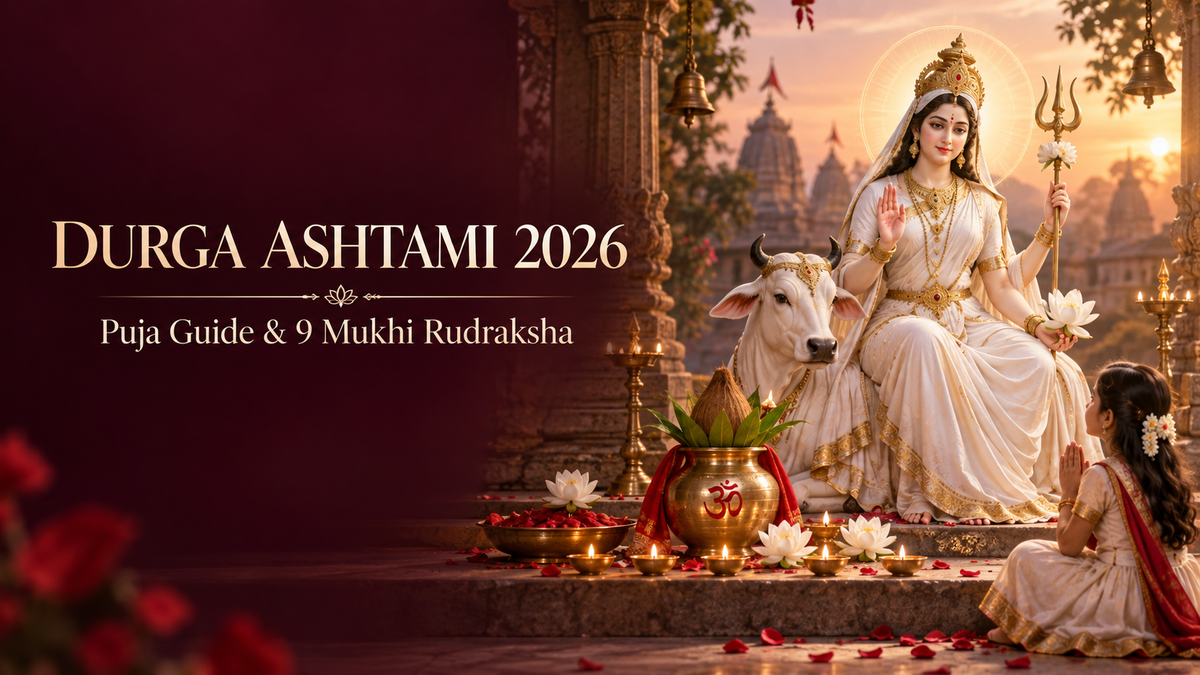
Durga Ashtami 2026: Puja Guide & 9 Mukhi Rudraksha
Durga Ashtami arrives when the energy of Navratri feels most intense. Homes that have been observing the festival for several days prepare for a deeper morning of prayer, many families arrange Kanya Pujan, and devotees turn their attention to Maa Mahagauri—the eighth form of Navadurga.
In 2026, Sharad Durga Ashtami falls on Monday, 19 October 2026. It is one of the most significant days of Sharad Navratri and is observed through puja, fasting, mantra japa, aarti, havan and Kanya Pujan according to family and regional tradition.
For devotees who include Rudraksha in their spiritual practice, Durga Ashtami also brings a natural question: Which Rudraksha is traditionally associated with Maa Durga? The answer most often given is the 9 Mukhi Rudraksha, a sacred bead associated in tradition with Navadurga and Shakti.
This guide explains the meaning of Durga Ashtami, a simple puja routine, Kanya Pujan, the traditional significance of 9 Mukhi Rudraksha and how a 108+1 Indonesian 9 Mukhi Rudraksha Japa Mala may be worn or used for mantra japa.
Date and muhurat note: Hindu festivals follow lunar tithi rather than only the civil calendar. Ashtami tithi, Sandhi Puja and Kanya Pujan timings can vary by city, sunrise and Panchang tradition. Before performing a time-specific sankalp, havan or Sandhi Puja, confirm the muhurat through a Panchang calculated for your location or consult your family priest.
Durga Ashtami 2026: Quick Answer
| Detail | Answer |
|---|---|
| Festival | Sharad Durga Ashtami, also called Maha Ashtami |
| Date in 2026 | Monday, 19 October 2026 |
| Navadurga form worshipped | Maa Mahagauri |
| Common observances | Puja, fasting, aarti, mantra japa, havan and Kanya Pujan |
| Rudraksha associated with Maa Durga | 9 Mukhi Rudraksha |
| Japa option | 9 Mukhi Indonesian Rudraksha Mala with 108+1 beads |
What Is Durga Ashtami?
Durga Ashtami is the sacred eighth tithi of Navratri and is dedicated to the worship of the Divine Mother. During Sharad Navratri, it is widely known as Maha Ashtami and is considered one of the festival’s most important days.
The day is associated with courage, purification and the victory of divine strength over fear and negativity. In many homes, Durga Ashtami is observed with a vrat, special bhog, Durga Chalisa, mantra chanting and Kanya Pujan. In Shakta and Durga Puja traditions, the observance may include more elaborate rituals, including Sandhi Puja at the transition between Ashtami and Navami tithi.
There is no single household routine followed everywhere in India. A family in Delhi may observe Ashtami differently from a family in Bengal, Gujarat or southern India. These differences do not reduce the devotion behind the practice; they reflect the richness of living traditions.
For the complete festival sequence, read the Sharad Navratri 2026 dates, puja and Rudraksha guide.
Which Form of Maa Durga Is Worshipped on Ashtami?
The eighth form of Navadurga is Maa Mahagauri. Her name combines Maha, meaning great, and Gauri, referring to radiance, purity or brightness. She is commonly depicted in white, seated on a bull, and is associated with serenity, compassion and purification.
After the fierce form of Maa Kalaratri worshipped on the seventh day, Maa Mahagauri represents calm after struggle. Her worship reminds devotees that strength does not always appear as force. It may also take the form of patience, clarity, forgiveness and the courage to begin again.
Devotees traditionally pray to Maa Mahagauri for:
-
Inner purity and peace
-
Strength to leave harmful habits behind
-
Harmony within the home
-
Patience during difficult periods
-
A more disciplined and sincere spiritual life
These are matters of spiritual faith and tradition. They should not be treated as guaranteed medical, financial or personal outcomes.
Simple Durga Ashtami Puja Vidhi at Home
A sincere home puja does not have to be complicated. If your family follows a specific vidhi, continue with that practice. Otherwise, this simple routine can help you observe the day respectfully.
-
Bathe, wear clean clothes and clean the puja space.
-
Place an image or murti of Maa Durga or Maa Mahagauri on a clean cloth.
-
Light a diya and offer water, flowers, roli, akshat and incense if used in your home.
-
Offer a simple sattvic bhog such as fruit, halwa, puri, chana, coconut or another preparation followed in your tradition.
-
Remember Lord Ganesha before beginning the main prayer.
-
Offer your prayer to Maa Mahagauri and state your sankalp quietly.
-
Recite Durga Chalisa, a familiar Devi stotra or your chosen mantra.
-
Perform aarti and sit silently for a few minutes before concluding.
-
Distribute prasad respectfully among family members and guests.
If you have not been able to follow every Navratri ritual, do not approach Ashtami with guilt. Begin with a clean heart and a manageable practice. Devotion is not measured by decoration or the length of a ritual.
Durga Ashtami Mantra
A simple mantra widely recited in devotion to Maa Durga is:
ॐ दुं दुर्गायै नमः
Om Dum Durgayai Namah
You may chant it 11, 27 or 108 times according to your capacity. If a guru has given you a particular mantra and method, follow that guidance instead of changing your practice for a festival trend.
A short prayer to Maa Mahagauri may also be recited:
श्वेते वृषे समारूढा श्वेताम्बरधरा शुचिः।
महागौरी शुभं दद्यान्महादेवप्रमोददा॥
Chant slowly and attentively. Correct pronunciation is valuable, but sincerity and steadiness are more meaningful than rushing to complete a large count.
What Is Kanya Pujan on Durga Ashtami?
Kanya Pujan, also called Kumari Puja or Kanjak Pujan in some regions, honours young girls as living symbols of the Divine Feminine. Families commonly observe it on Ashtami or Navami according to their tradition.
A simple Kanya Pujan usually includes:
-
Welcoming the children respectfully
-
Washing or symbolically honouring their feet according to family custom
-
Applying a tilak
-
Serving fresh sattvic food such as puri, kala chana and halwa
-
Offering fruit, a useful gift or dakshina
-
Seeking their blessings with humility
The spirit of Kanya Pujan matters as much as the ritual. Children should be treated with dignity, comfort and kindness—not as props for photographs. Ask the parents beforehand, maintain hygiene and never pressure a child to participate.
Durga Ashtami Fasting: Keep It Devotional, Not Punishing
Some devotees keep a nirjala fast, some take fruit or milk, and others follow a Navratri sattvic diet. There is no value in copying a strict fast that is unsuitable for your health.
-
Follow your family or sampradaya’s fasting practice.
-
Keep food simple and avoid waste.
-
Drink adequate water unless you have received safe, specific guidance otherwise.
-
Pregnant women, children, older adults, people taking medication and anyone with a health condition should seek appropriate medical guidance before fasting.
-
Do not judge another devotee by what they eat or how long they fast.
The purpose of vrat is restraint, remembrance and greater awareness—not physical harm.
What Is the Connection Between Durga Ashtami and 9 Mukhi Rudraksha?
The 9 Mukhi Rudraksha is traditionally associated with Maa Durga, Navadurga and the nine expressions of Shakti. For this reason, it has a particularly meaningful connection with Navratri and Durga Ashtami.
In spiritual tradition, the bead is associated with courage, resilience, willpower and the ability to move through fear with greater steadiness. Devotees may wear it as a sacred reminder of inner strength or include it in meditation and mantra practice.
A higher Mukhi number does not automatically make a Rudraksha “better.” Each Mukhi has its own traditional association. The reason 9 Mukhi is discussed here is its direct devotional connection with Maa Durga—not because every person must wear it during Navratri.
Those seeking an individual bead may explore the natural certified Nepali 9 Mukhi Rudraksha.
Traditional Significance of 9 Mukhi Rudraksha
The following benefits are based on spiritual and traditional belief. They are not promises or substitutes for personal effort, professional advice or medical care.
Courage During Difficult Situations
The 9 Mukhi Rudraksha is traditionally connected with fearlessness and inner strength. A devotee may wear it as a reminder to respond to challenges with patience rather than panic.
Resilience and Willpower
Because of its association with Shakti, the bead is often chosen by people who want greater discipline and emotional steadiness in their spiritual routine.
Support for Meditation and Prayer
Wearing a Rudraksha or using a mala can create a physical anchor for prayer. Touching the bead may gently bring the mind back when attention wanders.
Devotion to Maa Durga
For a devotee of Maa Durga, the 9 Mukhi Rudraksha can hold personal devotional meaning throughout Navratri and after the festival. It does not need to be stored away when Ashtami ends.
Nepali 9 Mukhi Bead or Indonesian 9 Mukhi Japa Mala?
Both can be natural Rudraksha, but they serve slightly different practical preferences.
| Feature | Nepali 9 Mukhi Rudraksha | Indonesian 9 Mukhi Japa Mala |
|---|---|---|
| Form | Usually worn as one prominent bead | Full mala made with 108+1 smaller beads |
| Appearance | Larger bead with deeper, more prominent surface texture | Smaller and smoother-looking beads suited to a complete mala |
| Common use | Individual wearing and personal worship | Mantra counting, meditation and wearing as a mala |
| Navratri relevance | Direct symbolic association with Maa Durga | Useful for a complete 108-count Navadurga japa practice |
| What matters most | Natural formation and correct Mukhi identification | Natural beads, correct Mukhi identification and sound stringing |
Nepali and Indonesian refer to origin and typical physical characteristics; one origin should not be labelled “fake” merely because its beads are smaller. Read the detailed Nepali vs Indonesian Rudraksha guide before deciding which format suits you.
9 Mukhi Indonesian Rudraksha Japa Mala: 108+1 Beads Explained
A natural certified Indonesian 9 Mukhi Rudraksha Japa Mala contains 108 prayer beads plus one Guru bead, commonly written as 108+1.
Mahadev Mala 9 Mukhi Japa Mala Specifications
| Specification | Product detail |
|---|---|
| Mukhi | 9 Mukhi |
| Origin | Indonesia |
| Bead count | 108 beads + 1 Guru bead |
| Approximate bead size | 11 mm |
| Approximate mala weight | 40.53 g |
| Thread and finish | Durable thread with traditional red tassel |
| Certification | Individual laboratory certification supplied |
| Intended use | Mantra japa, meditation, spiritual practice and respectful wearing |
Because every Rudraksha is naturally formed, minor variations in bead size, surface texture, shade and total weight are normal.
The 108 beads are used to count one complete round of mantra repetitions. The additional bead is called the Guru bead or Meru. It marks the point where one round ends.
When completing another round:
-
Stop when you reach the Guru bead.
-
Do not count or cross over it.
-
Turn the mala around.
-
Begin the next round in the opposite direction.
This keeps the japa movement deliberate and respectful. The mala may be used for the Durga mantra followed in your tradition or for another mantra given by your guru.
Can You Wear the 9 Mukhi Japa Mala?
Yes, a 9 Mukhi Rudraksha Japa Mala may be worn respectfully or used for mantra japa. Some devotees prefer to keep one mala exclusively for japa, while others wear their mala as part of daily spiritual practice. Both approaches exist.
If you want to use the same mala for wearing and chanting:
-
Keep it clean and handle it respectfully.
-
Avoid treating it as casual fashion jewellery.
-
Remove it when an activity may expose it to chemicals, impact or prolonged moisture.
-
Follow your family tradition or guru’s guidance if it prescribes a separate japa mala.
There is no need to buy both a single Nepali bead and a full Indonesian mala. Choose the form that matches your actual practice. A single bead is practical for wearing; a 108+1 mala is especially useful when regular mantra counting is the priority.
How to Begin Using 9 Mukhi Rudraksha on Durga Ashtami
Durga Ashtami can be chosen as a meaningful day to begin, although a genuine Rudraksha does not become unsuitable if first worn on another day.
-
Inspect the bead or mala and ensure that it is clean and undamaged.
-
Gently rinse it with clean water if needed and wipe it dry with a soft cloth.
-
Place it near the image of Maa Durga during your puja.
-
Offer flowers and a simple prayer without applying substances that may clog or damage the natural surface.
-
Chant Om Dum Durgayai Namah or the mantra followed in your tradition.
-
Wear the bead or begin your japa calmly.
Do not soak the mala for long periods or repeatedly cover it with oil, milk, kumkum or other materials. Respect does not require damaging the bead.
How to Use the Mala for 108 Durga Mantra Repetitions
-
Sit comfortably in a clean and quiet place.
-
Hold the mala gently in the hand used in your tradition.
-
Begin with the bead next to the Guru bead.
-
Recite the mantra once and move to the next bead.
-
Continue until all 108 beads have been counted.
-
Pause at the Guru bead and offer a moment of gratitude.
-
Turn the mala around if you wish to complete another round.
Speed is not the goal. A calm round completed with attention is more valuable than several hurried rounds performed only to reach a number.
How to Check Authenticity Before Buying
Navratri demand can encourage rushed purchases and exaggerated promises. Do not judge a Rudraksha only by colour, price or bead size.
Before buying, check:
-
Whether the seller clearly states Nepal or Indonesia as the origin.
-
Whether the Mukhi lines are naturally formed and identifiable.
-
Whether the actual bead or mala specifications are described.
-
Whether an independent laboratory certificate is supplied.
-
Whether X-ray verification is available when internal examination is required.
-
Whether the seller publishes clear contact, shipping and return information.
Water-floating, copper-coin and colour-based tests cannot conclusively prove authenticity. Read how to identify an original Rudraksha and understand misleading home tests before purchasing.
At Mahadev Mala, Rudraksha products are supplied with an independent laboratory certificate, and an X-ray report is available as an optional paid add-on for eligible products. You can review the complete certification and authenticity process before placing an order.
Care Guide for a 9 Mukhi Bead or Japa Mala
-
Keep the Rudraksha away from soap, shampoo, perfume and chemical cleaners.
-
Avoid wearing it while swimming or during activities that may pull or damage the string.
-
After exposure to sweat, wipe it gently with a soft, dry cloth.
-
Do not scrape the natural Mukhi lines.
-
Check the mala thread periodically for wear.
-
Store it in a clean, dry cloth pouch when not in use.
-
Keep your japa mala away from the floor and handle it with clean hands.
Natural beads may vary in shape, texture, size and shade. These differences are expected and should not automatically be treated as defects.
Common Mistakes to Avoid on Durga Ashtami
Buying Because of Fear
A seller should explain a Rudraksha, not frighten you into purchasing it. Avoid claims that predict immediate harm if you do not wear a particular bead.
Expecting Instant Results
Rudraksha is traditionally approached as part of prayer and disciplined living. It does not replace personal effort, medical treatment, financial planning or responsible decisions.
Choosing by Price Alone
An expensive or higher Mukhi bead is not automatically right for every person. Choose according to purpose, authenticity and the form you will actually use.
Forcing an Unsuitable Fast
Health and devotion are not opposites. Follow a safe fasting practice and seek medical guidance when needed.
Turning Kanya Pujan into a Photo Session
The children’s dignity, comfort and consent should remain more important than photographs or social-media content.
Frequently Asked Questions
When is Durga Ashtami in 2026?
Sharad Durga Ashtami falls on Monday, 19 October 2026. Because Hindu observances follow tithi and local sunrise, confirm Sandhi Puja, havan and Kanya Pujan timings through a Panchang for your city.
Which Goddess is worshipped on Durga Ashtami?
Maa Mahagauri, the eighth form of Navadurga, is worshipped on Ashtami. She is traditionally associated with purity, peace, compassion and renewal.
Which Rudraksha is associated with Maa Durga?
The 9 Mukhi Rudraksha is traditionally associated with Maa Durga, Navadurga and Shakti. It is commonly chosen by devotees seeking courage, resilience and a disciplined spiritual practice.
Can I wear 9 Mukhi Rudraksha on Durga Ashtami?
Yes. Durga Ashtami can be chosen as an auspicious day to begin wearing a natural 9 Mukhi Rudraksha. Clean it gently, include it in your puja and chant the mantra followed in your tradition.
Can women wear 9 Mukhi Rudraksha?
Yes, women may wear 9 Mukhi Rudraksha. Personal and family customs can differ, so devotees may also follow their own guru or lineage where specific guidance has been given.
Can a 9 Mukhi Rudraksha Mala be worn around the neck?
Yes, a 9 Mukhi Rudraksha mala may be worn respectfully. Some devotees reserve one mala only for japa, while others use the same mala for wearing and chanting. Follow a consistent practice and protect the mala from chemicals and physical damage.
Why does a Rudraksha Japa Mala have 108+1 beads?
The 108 beads count 108 mantra repetitions. The additional Guru bead marks the completion of one round. It is not crossed; the mala is turned around before starting another round.
Is Indonesian Rudraksha genuine even though it is smaller?
Yes, Indonesian Rudraksha can be natural and genuine. Indonesian beads are commonly smaller and subtler in texture than Nepali beads. Authenticity should be evaluated through natural formation, Mukhi identification and reliable certification—not size alone.
Can Rudraksha guarantee protection or success?
No. Traditional benefits are matters of spiritual belief and should not be presented as guaranteed outcomes. Rudraksha is best treated as a sacred support for prayer, discipline and mindful living.
Observe Durga Ashtami with Strength and Simplicity
Durga Ashtami is not about performing the most elaborate ritual. Its deeper invitation is to recognise Shakti—the courage to face what is difficult, the patience to remain steady and the clarity to leave behind what no longer serves you.
If a 9 Mukhi Rudraksha becomes part of that practice, choose it with care. A single Nepali bead can be worn as a personal symbol of devotion, while a 108+1 Indonesian 9 Mukhi Rudraksha Japa Mala can support regular mantra counting and may also be worn respectfully.
Choose natural Rudraksha, understand what you are buying and allow faith to work alongside consistent action. Explore Mahadev Mala’s natural, lab-certified Rudraksha collection when you are ready to select a bead or mala for your practice.
May Maa Durga bless your home with courage, clarity and peace. Jai Mata Di.
Disclaimer: Rudraksha is a natural spiritual product and an article of faith within Hindu and Vedic traditions. The spiritual and astrological benefits described in this article are based on traditional beliefs and are not scientifically proven. Rudraksha does not diagnose, treat, cure or prevent any disease, and no specific result is guaranteed. Individual experiences may vary.


