Article: Can You Wear More Than One Rudraksha Together?
Can You Wear More Than One Rudraksha Together?
Can You Wear More Than One Rudraksha Together? Combinations & Wearing Guide
Quick answer: Yes, you can wear more than one Rudraksha together. Many devotees wear multiple beads of the same Mukhi or combine different Mukhi Rudraksha in a pendant, bracelet or mala. The important part is choosing a combination that fits your spiritual intention, tradition and everyday comfort.
Perhaps you already wear a 5 Mukhi Rudraksha and have been thinking about adding a 7 Mukhi. Or someone has suggested a 3 Mukhi and 5 Mukhi combination, and you are wondering whether the two can be worn on the same thread.
These are reasonable questions. Once you begin exploring Rudraksha, you will hear different advice about which Mukhis can be worn together, how many beads are appropriate and whether one bead affects another.
Here is a clearer way to understand Rudraksha combinations, including examples, wearing methods and what to check before choosing one.
Can Different Mukhi Rudraksha Be Worn Together?
Yes. Wearing different Mukhi Rudraksha together is a recognised practice among many Rudraksha wearers. Mixed-Mukhi pendants, bracelets and malas are common examples. A Siddha Mala, traditionally assembled using different Mukhi varieties, is another example of multiple Rudraksha being worn in one arrangement.
Each Mukhi has its own traditional associations. Bringing them together is generally understood as combining those devotional meanings, not as creating a conflict between the beads.
If you wear Rudraksha as a specific astrological remedy or follow instructions from a Guru, your selection may be more individual.
Can You Wear Two or More Rudraksha of the Same Mukhi?
Absolutely. A 5 Mukhi mala itself demonstrates that many beads of the same Mukhi can be used together. You can also wear two 5 Mukhi beads in a pendant or a bracelet made with several 5 Mukhi beads.
There is no need to change the Mukhi each time you add another bead. A single bead may suit someone who prefers a minimal pendant, while multiple beads may suit someone who prefers a bracelet or uses a mala for mantra japa.
If you are new to Rudraksha, read our 5 Mukhi Rudraksha complete guide for its traditional meaning and everyday use.
Common Rudraksha Combinations and Their Traditional Meanings
The pairings below are examples of how people may bring together different spiritual associations.
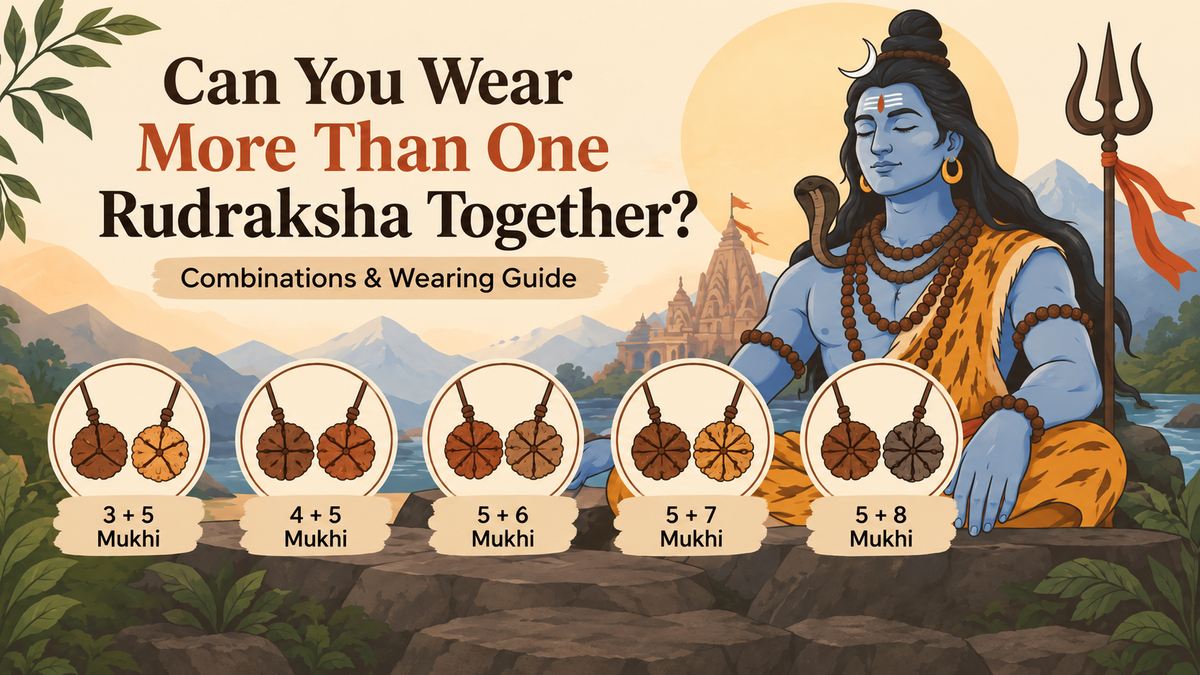
3 Mukhi + 5 Mukhi Rudraksha
The 3 Mukhi Rudraksha is traditionally linked with Agni Dev and the ideas of renewal, courage and transformation. The 5 Mukhi is associated with Kalagni Rudra, Shiva devotion, awareness and meditation.
This makes 3 Mukhi and 5 Mukhi a meaningful combination for someone drawn to both themes. For example, the Arogya Raksha Kavach – 3 & 5 Mukhi Rudraksha uses five beads in the sequence 5–3–5–3–5.
4 Mukhi + 5 Mukhi Rudraksha
The 4 Mukhi is traditionally associated with Brahma, knowledge and expression, while 5 Mukhi is closely connected with regular prayer and spiritual awareness.
This pairing may appeal to students, teachers, writers and anyone who values learning alongside a consistent devotional routine.
5 Mukhi + 6 Mukhi Rudraksha
The 6 Mukhi is traditionally associated with Lord Kartikeya and themes of discipline, determination and courage.
Worn alongside 5 Mukhi, it brings together those associations with the everyday spiritual practice represented by Panch Mukhi.
5 Mukhi + 7 Mukhi Rudraksha
The 7 Mukhi is traditionally linked with Goddess Mahalakshmi and themes of prosperity, steadiness and stability.
Some devotees wear it with 5 Mukhi to represent both spiritual practice and responsibilities in everyday life.
5 Mukhi + 8 Mukhi Rudraksha
The 8 Mukhi is associated with Lord Ganesha, traditionally revered at the beginning of important undertakings.
Alongside 5 Mukhi, this combination reflects Ganesha devotion and Shiva-centred spiritual practice.
These examples are starting points for understanding traditional symbolism. For a broader overview, see the Rudraksha types and benefits guide.
How Many Rudraksha Can You Wear at the Same Time?
There is no single universally accepted number that everyone must follow. Some people wear one bead; others wear two or three, a multi-bead bracelet or a full mala.
Instead of looking for a particular number, consider three things: why you are wearing them, whether the arrangement is physically comfortable, and whether it suits your devotional practice.
If you already wear one Rudraksha and want to add another, you can do so without changing everything else in your routine.
Should You Wear Multiple Rudraksha on One Thread or Separately?
Both arrangements are commonly used.
On one thread or chain: Two or more beads can be strung together as a pendant or assembled into a kavach. Secure knots and suitable spacing help prevent the beads from rubbing heavily against one another.
As separate pendants: You can wear one bead on one thread and another on a separate chain. This may be useful when bead sizes differ considerably.
As a bracelet: Smaller beads often work more comfortably around the wrist. Larger Nepali beads may feel bulky, so choose the fit carefully.
As a mala: A traditional japa mala commonly uses 108 counting beads plus a Guru bead. Some devotees keep a mala specifically for mantra japa separate from what they wear daily.
A secure, comfortable arrangement that respects the beads is a sensible choice.
Can You Wear Rudraksha of Different Origins Together?
Yes, Nepali and Indonesian Rudraksha can be used in the same arrangement. Origin does not, by itself, make two beads incompatible.
The practical issue is their physical size and shape. Nepali Rudraksha are often larger and more prominent, whereas Indonesian beads are commonly chosen for lighter malas and bracelets.
A well-made arrangement should account for bead size, thread strength and comfort.
Is There Any Rudraksha Combination You Should Avoid?
You may come across lists online claiming that particular Mukhi combinations should never be worn together. Such lists are not uniform across Rudraksha traditions.
A useful distinction is between general devotional wear and a combination selected for a specific Guru-led practice or astrological purpose.
If you received individual instructions, follow those rather than assembling a different combination from unrelated online charts.
From a practical point of view, avoid arrangements with damaged beads, weak threads, sharp fittings or excessive weight. Multiple large beads can also be uncomfortable around the neck or wrist.
How to Wear Two or More Rudraksha Together
You can keep the first wearing simple:
-
Check the beads. Make sure each Rudraksha is natural, correctly identified and in good physical condition.
-
Choose a comfortable arrangement. Use a suitable cotton or silk thread, or a well-made metal setting that does not damage the bead.
-
Prepare them respectfully. Gently clean them if needed and place them in your puja space.
-
Offer a prayer. Monday is a popular day for beginning Rudraksha wear, although practices vary.
-
Chant a mantra. Om Namah Shivaya (ॐ नमः शिवाय) is a familiar Shiva mantra. If you follow Mukhi-specific or initiated mantras, continue according to your tradition.
-
Wear and care for them regularly. Remove them before exposure to shampoo, perfume, harsh chemicals, swimming-pool water or activities likely to crush or snag the beads.
For more everyday guidance, see Rudraksha Wearing Rules: Do's & Don'ts.
How to Choose a Genuine Rudraksha Combination
When purchasing two or more beads, authenticity matters for every bead in the arrangement—not just the most expensive Mukhi.
Look for clearly identified natural Mukhi lines, honest descriptions of origin and size, secure craftsmanship and clear certification information.
A high price or an unusually elaborate combination does not itself establish authenticity.
At Mahadev Mala, Rudraksha products are supplied with an independent laboratory certificate. Optional X-Ray verification is available for eligible products as a separate add-on.
Read about the certification and authenticity process before buying.
Frequently Asked Questions
Can I wear 3 Mukhi and 5 Mukhi Rudraksha together?
Yes. This is an established style of mixed-Mukhi arrangement, including in the 3-and-5-Mukhi kavach. The two beads carry different traditional associations and can be worn on one thread or in separate pieces.
Can I wear 5 Mukhi and 7 Mukhi Rudraksha together?
Yes. Some devotees combine 5 Mukhi, associated with Shiva devotion and meditation, with 7 Mukhi, traditionally linked with Mahalakshmi and stability.
Can I wear three different Mukhi Rudraksha at once?
Yes. Three different Mukhis can be worn together, provided the combination is comfortable and appropriate to the tradition you follow.
Can I wear two Rudraksha bracelets together?
Yes. Two bracelets can be worn together if they fit comfortably and do not rub, pinch or snag. Wearing them on separate wrists is also an option.
Can I wear a Rudraksha mala and a pendant together?
Yes. A mala and a pendant can be worn together. If the mala is reserved for mantra japa in your tradition, you may prefer to keep it separate from daily jewellery.
Can I wear 5 Mukhi Rudraksha with any other Mukhi?
5 Mukhi is widely used in mixed combinations. Specific spiritual or astrological practices may have their own recommendations.
Does wearing more Rudraksha give stronger benefits?
Not automatically. The number of beads does not establish stronger outcomes. Choose a meaningful combination and a practice you can follow consistently.
Do I need a different mantra for each Rudraksha?
Not necessarily for general devotional wear. Om Namah Shivaya is a common Shiva mantra. Specific sadhanas may prescribe different mantras, so follow the practice you have been taught.
Final Thoughts
Wearing more than one Rudraksha together is a familiar part of Rudraksha practice. You may prefer a single 5 Mukhi, a carefully chosen pair or a traditional multi-bead kavach. There is room for all three approaches.
Start with the meaning of the beads, check their authenticity and choose an arrangement that feels natural to wear.
If you are considering a ready-made combination, explore the Arogya Raksha Kavach or browse the Rudraksha collection at Mahadev Mala.
Editorial Note: This guide discusses commonly followed Rudraksha practices and traditional Mukhi associations. Customs may differ across families, teachers and spiritual lineages.
Disclaimer: The meanings and benefits described are rooted in traditional spiritual beliefs. They are not scientifically established guarantees of health, wealth or other specific outcomes. Astrological recommendations may depend on individual practice and interpretation.